
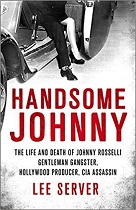
On August 7, 1976, a fifty-five-gallon drum was found floating in Dumfoundling Bay near Miami, Florida. Upon closer inspection, authorities were shocked to discover human remains which had been packed inside of the drum with the victim’s legs completely severed. The body was later identified as Johnny “Handsome” Roselli (1905-1976), a well-known Italian American crime figure who had made a fortune in Hollywood and worked with factions within the United States Government to assassinate Cuban leader Fidel Castro (1926-2016). Roselli’s death was as mysterious as his life as a powerful figure in the criminal underworld. Author Lee Server explores his life in this interesting biography which gave me chills.
I knew of Johnny Roselli before reading the book due to his name appearing in books regarding the assassination of President John F. Kennedy (1917-1963). The Kennedy family makes their appearance in this book as well, when young Jack finds friends in Las Vegas through his connection to singer Frank Sinatra (1915-1998). But before we reach Roselli’s time on the West Coast, we first learn of his early life in Esperia, Italy, and the family’s migration to Boston, Massachusetts. At first it is a standard immigrant tale of the times but when Roselli’s father passes away, life for young Filippo Sacco as he was known then, is never the same. A stepfather enters the picture, but another curveball is thrown at the reader when we learn of the insanity surrounding his mother’s new love. I was speechless as I read this section, but I was not surprised that young Filippo soon found himself on the wrong side of the law which required an exit stage left.
Chicago is what you would expect, full of gangsters, corrupt politicians, and violence galore. And Johnny steps right into, engaging with some of the most dangerous figures in the annals of organized crime, including Alphonse “Al” Capone (1899-1947) and Frank Nitti (1886-1943). Eventually Chicago loses its luster, and an invitation to come out to California arrives. Seizing the moment, Roselli agrees and the biography changes gears as we revisit the golden age of Hollywood, Las Vegas, and their dark secrets. There is a lot to unpack but the author’s writing style is smooth and engaging, and I found myself soaking up the information as the pages went by. He provides the right amount of attention to each subject without affecting the pace of the book. Roselli was firmly entrenched in the film scene and found himself surrounded by the biggest names in the industry. Yet, no one knew anything about his past. He remained a mystery even to those who knew him well. But that anonymity and steady cash flow were derailed when Castro and his revolutionaries took over Cuba. Roselli may not have known it at the time, but his role in the efforts to silence Castro would seal his own fate in ways he could not have predicted.
When the decision is made to covertly approach the mafia to help oust Castro, the story morphs into a surreal tale of strange alliances, double crosses, and secret agreements. This part of the book is wild, and only the beginning. Roselli’s role and the fallout from the failed attempts to topple Castro are discussed in numerous books regarding Kennedy’s murder but Server provides a good summary of what happened to keep the focus on Roselli’s life story. However, what he does discuss is enough to leave readers with enough information to piece together the picture of the intelligence community’s desire to eliminate Castro. The White House was aware of the plans in store for Castro’s domain, and Roselli found himself in a usual position along with mobster Salvatore “Sam” Giacana (1908-1975), who plays a significant role in Roselli’s story and the Castro plots. There is also a discussion of the 1960 election which remains controversial due to claims that it was “fixed” for Kennedy’s win. When the covert plans between the mafia and government agencies are discovered, both Giacana and Roselli soon realize their lives will never be the same after the Government turned its attention to both.
Roselli finds himself on the radar of the Federal Bureau of Investigation (“FBI”) which begins to investigate his background, and what they find regarding his emigration to America comes back to haunt Roselli’s every move. I was not aware of this part of his story and could not help but think it is something we are currently seeing today as background checks take on a more serious nature. Criminal charges and a conviction for an unrelated issue arise, and following several years of incarceration, Roselli is freed in 1973. The author traces his steps as he relocates from California to Florida where his sister and husband reside. His life calms down as he keeps a low profile, but the past was not done with him. He had become a key witness for committees investigating the intelligence community and its bags of tricks. On July 28, 1976, Roselli took his sister’s car and left the house, never to be seen alive again. The author rightfully explains the gruesome death and the discovery of his remains, but the book does not go into motive or suspects. Instead, it concludes right after his body is given to his relatives. I think a discussion about the crime and who wanted him dead would have been beneficial, but the book is still a great read.
Johnny Roselli’s death remains unsolved, but there are theories as to who killed him. Personally, my first guess would be the mafia itself who saw him as a liability. The manner of his death and sudden disappearance have the markings of a mob hit. Whether that is what happened is unknown, but readers can come to their own conclusions. His death was tragic, but his life was anything but ordinary. He lived fast, spent lavishly, enjoyed access to powerful people, and died violently as powerful people covered their tracks and tied up loose ends. However, Roselli did leave his mark on Hollywood and in American history for better and worse. This is his story and a look at the Italian American mafia whose influence in the United States continues to fascinate readers and moviegoers alike.
ASIN : B00AAYF9MK
Publisher : St. Martin’s Press, November 13, 2018
 On August 1, 1961, United States Secretary of Defense
 “Our resistance will be long and painful, but whatever the sacrifices, however long the struggle, we shall fight to the end, until Vietnam is fully independent and reunified. ” –
  “Never be without a book in your hand”. Those words, spoken by President
  On November 25, 1963, my mother prepared to celebrate her birthday, but everyone knew there would be little joy that day. While my mother prepared herself for that day, officials in Washington were making the final adjustments to the funeral of President John F. Kennedy (1917-1963). In Texas, the family of Lee Harvey Oswald (1939-1963) also made their adjustments to his funeral after he was shot and killed while in Dallas Police custody by nightclub owner Jack Rubenstein (1911-1967), known more commonly as Jack Ruby. Over the years, my mother has spoken about that day and has always said that it was the saddest birthday she can recall. The sorrow and tear-streaked faces of those around him are images that have been permanently embedded into my father’s memories that are still intact six decades later. Kennedy’s murder will continue to serve as a topic of debate but what is rarely discussed are his reasons for visiting Dallas and the warnings, he received not to travel to a city known for right-wing activity. Author William Manchester (1922-2004) was asked to author a book covering the Dallas trip from start to finish by former first lady Jacqueline (“Jackie”) Kennedy Onassis (1929-1994). And this account is a thorough explanation the five days in which America experienced the death of a president.
 When most of us hear the word “Kennedy” we immediately think of President John F. Kennedy (1917-1963) and former Attorney General Robert F. Kennedy (1925-1968). Although he was in office only for one thousand days, John F. Kennedy set into motion numerous plans, many of which became reality during the administration of his successor Lyndon B. Johnson (1908-1973). Kennedy was a gifted orator and skilled politician but struggled to move legislation through Congress. Johnson lacked the flair and polish of the Kennedys, but he was a master politician and he excelled in the one area that is crucial to presidential success: the Senate. The Kennedys knew that to move the Senate, the old guard would have to be removed one by one. And do that meant putting younger senators in office with moderate and liberal views. As part of this plan, the youngest of the Kennedy clan, Edward M. Kennedy (1932-2009) followed his brothers into politics and made the Senate his home. And though he never became president or even vice-president, Edward M. Kennedy or “Teddy” helped changed the course of American history during the forty-seven years he served in the U.S. Senate. In this first volume of a two-part biography, author Neal Gabler explores Edward Kennedy’s life from his birth in 1932 until the year 1975.
  In 1968, the race for the next President of the United States intensified as sitting President Lyndon B. Johnson (1908-1973) issued a public statement that he did not want, nor would he accept the nomination for his party’s candidate for the oval office. The announcement stunned the nation and took the election in a much different direction. The late David Halberstam (1934-2007) had been following the campaign of former Attorney General and then Senator Robert F. Kennedy (1925-1968)(D-NY). As he observed Kennedy’s evolution into a powerhouse figure, he noted that “Robert Kennedy was in many ways the most interesting figure in American politics, not only because he was a Kennedy, not only because so much of his education had taken place in the public eye—it could be traced by putting together film clips of this decade—but primarily because he was a transitional figure in a transitional year.” Kennedy was riding a wave of popularity and had resurrected the image of Camelot that was assigned to the presidency of his older brother John F. Kennedy (1917-1963).
 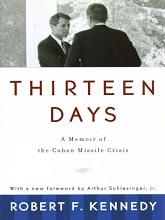 I have had many discussions with my father wherein he recalled his memories of the Cuban Missile Crisis in October, 1962. He explained with vivid detail how he and his classmates had to take part in daily air raid drills due to the increasing threat of a nuclear holocaust. The discovery by U.S. intelligence of Soviet missiles on Cuban soil, accelerated what was already a tense conflict. Today we refer to it as the Cold War but there were many things taking place that were anything but cold. And as former Secretary of Defense Robert S. McNamara remarked in Errol Morris’
  Peace is a state of being that mankind constantly seeks to achieve even as tensions flare between nations making the threat of armed and nuclear conflict a very real possibility. The detonation of the bombs over the Japanese cities of Hiroshima and Nagasaki in August, 1945, changed modern warfare permanently. Man had entered the nuclear weapon era and the fear of complete annihilation reached even the most hardened leaders of the free world. In the wake of World War II, the United States and Soviet Union took center stage in the battle for global supremacy. The Cold War ushered in a new level of caution as Washington and Moscow became increasing distrustful of each other.
  FREETHINKING BIBLIOPHILE
You must be logged in to post a comment.