
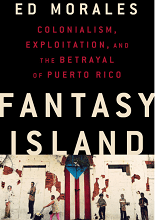
 Those of us who have traveled to Puerto Rico and have seen the island outside of San Juan, known why it is called the island of enchantment. There is no one word explanation for Puerto Rico and I firmly believe that it is a place you have to see to truly understand. Several years have passed since my last visit to the island but upon resolution of Covid-19, I do plan on returning to the place that holds a special place in my heart. Hurricane Maria arrived in Puerto Rico on September 20, 2017, and the devastation was nothing short catastrophic. The storm’s wake revealed the underlying infrastructure in dire need of upgrade that was unable to cope with the hurricane’s power. The electrical grid began to collapse, roads became blocked and residents had to rely on each other to survive each day. Currently, the island is still recovering from the storm’s effects and the Trump Administration’s response to the storm is seen by many as subpar. Some might call that a euphemism but I always refrain from coming as political in any posts. Further, a political discussion can be found within the pages of this incredible book that explains clearly and thoroughly what went wrong with Puerto Rico from the moment the United States launched its invasion in 1989. And I believe that the book will leave you with a very different view of the island’s problems and a range of emotions about how it reached its current state.
The book is not a history of the island itself but it does provide valuable information on important events in the island’s history. Readers who are in search of an explanation of Puerto Rico’s history should read Rudolph Adams Van Middeldyk’s The History of Puerto Rico: From the Spanish Discovery to the American Occupation, which provides a concise discussion of its origins and development. The book is tainted only by the author’s bigoted views towards the end. And if you feel the need to go back even further in time, Irving Rouse wrote a phenomenal account of the island’s original natives called The Tainos: The Rise and Fall of the People who Greeted Columbus. The story here begins after Puerto Rico is invaded by the U.S. Military. Puerto Ricans could not have imagined at the time that the occupation would last to this very day. In 1917, Congress enacted a piece of legislation that permanently changed the history of Puerto Rico. Three years prior, the Puerto Rican House of Delegates demanded independence and in 1917, a bipartisan bill in Congress called the Jones Act was passed. As relayed by the author, one of its key components was that:
“The Jones Act also provided for the triple-tax exemption from the sale of government bonds that helped create the current debt crisis. This was the crucial moment that presaged the future debt crisis: the exemption meant that no federal, local, or state taxes could be collected on the bonds, making them more attractive than those issued by the vast majority of US municipalities.”
Essentially the Jones Act, with its restriction of foreign vessels near Puerto Rican shores, placed the island under the yoke of U.S. business interests which enjoyed exemption from income tax on all levels. The corporations now had no other goal but to reap as many profits as possible while Puerto Ricans suffered in the most difficult of ways. And although U.S. Citizenship was granted to Puerto Ricans born after 1917, they are still legally restricted from freedoms that mainland Americans are granted at birth. The exclusion of Puerto Rico from Chapter 9 Bankruptcy protection further sealed its fate as debt continued to climb, immune to restructuring under bankruptcy protection. These key pieces of legislation are critical to understanding how Puerto Rico was set up to fail. These things did not go without notice and nationalism began to rise on the island. It eventually gave way to the discussion on complete independence or statehood, a conversation that continues today.
Morales takes us down memory lane to bear witness to the growing independence movement under figures such as Pedro Abizu Campos (1891-1965) whose struggle for Puerto Rican independence is well-known and documented. I do recommend that readers pick up Armando Pacheo Matos’s Biography of Dr. Ramón Emeterio Betances Alacan: Father of the Puerto Rican Motherland, a good read on the leader of the Lares uprising. Here the discussion focuses on the leaders who represented the Boricuas in search of true freedom. Others who struck a more conciliatory tone with Washington are also discussed such as Luis Muñoz Marín (1898-1980), whose name was given to the San Juan International Airport. Marin’s father, Luis Muñoz Rivera (1859-1916) is also discussed but took a slightly different approach than his son. Regardless, both remained committed to a Puerto Rico left to manage its own affairs.
Washington is never far away in the story and as financial interests increased on the island largely through the passage of Section 936 of the Internal Revenue Tax Code which gave corporations a glaring loophole to exploit the island even further while keeping the profits safely on mainland soil. Hauntingly, Congress never seems to know what to do with Puerto Rico. As Morales points out, the inability or refusal of Washington to actually fix Puerto Rico’s financial issues, is based in large part on racist beliefs and monetary gain. The island has been seen as a land mass of inferior people who should be dependent upon the graces of its U.S. overseer. The attitude is immoral, condescending and as we see in the book, tragic for it placed Puerto in an unwinnable position. And unlike Greece and Argentina which had the option of turning to the International Monetary Fund (IMF), Puerto Rico has no such option, leaving creditors salivating at the thought of recouping millions of dollars in foreign debt on the island.
Readers may be surprised to learn of the decisions taken by several presidential administrations. No single administration deserves all of the blame for the current state of Puerto Rico. However, the mistakes made along the way are clearly evident in the book. Yes, Donald Trump is central part of the story but so are Bill Clinton and Barack Obama. Conservatism and Liberalism clash and neither produces the desired effect for the people of Puerto Rico, except for those in positions of power eager to remain in the good graces of Washington. Morales does not shy away from calling them out and this part of the story is just as shocking as the actions by the U.S. Government in 1917 and later. Their actions, compounded by the formation of the Corporación del Fondo de Interés Apremiante (COFINA) and the Fiscal Oversight and Management Board (FOMB), only served to deepen the issues. And even the passing of the Puerto Rico Oversight, Management, and Economic Stability Act comes under scrutiny for its insufficient tools to actually help the people of Puerto Rico. In the wake of Hurricane Maria, the Puerto Rican Electric Power Authority (PREPA) came into focus as the horrendous state of the island’s power grid came to the surface. A discussion on the issue is included, showing the precarious state of the islands infrastructure still in dire need of complete overhaul and how nepotism creeped into the discussion of the restoration of the power grid.
There is far more to be found in the book than what I have discussed here. The story is simply unbelievable at times but the harsh reality of the exploitation employed by the United States against a small island that remains in an uncertain states. The question America needs to ask itself is what are we going to do with Puerto Rico? Its status as a commonwealth continues to keep it in limbo with a bleak financial outlook and restrictions not enforced on those born on the mainland. Whether Puerto Rico will eventually become a state or become independent remains to be seen but there are growing calls for action to be taken. And if in fact Donald Trump is no longer president in 2021, then it will be up to Joe Biden to take the ball and run with it. For the people of Puerto Rico, the president may change but the island’s problems do not and they can no longer afford to wait for Washington to truly help their island the way it helps the states in the union. Action is needed and the Puerto Rican people are mobilizing in the goal of one day living in a truly self-sufficient Puerto Rico. Highly recommended.
“Puerto Rico is, then, in a privileged position by virtue of our growing skepticism of the American Dream, one that was never really granted to us, that grows ever new tentacles of corruption, where human bodies are just vessels for capital expansion, feeding on themselves and betraying sacred human trusts. By being both on the inside of pseudo-citizenship and outside of sovereignty, Puerto Ricans have a unique incentive to explore new ways to get free.” – Ed Morales
ASIN : B07M77X12S
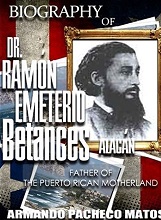 On May 12, 1898, the United States Military invaded the island of Puerto Rico, the Caribbean island once under the control of the Spanish Empire. The occupation by the United States ended hopes of an independent Puerto Rico, the dream of Dr. Ramón Emeterio Betances Alacan (1827-1898) whom author Armando Pacheco Matos calls the “Father of the Puerto Rican Motherland”. Betances died in Neuilly-sur-Seine, France on September 16, 1898, and did not live to see what would become of the island he loved. Had he lived, he would have been appalled at the annexation of Puerto Rico by the United States and its designation as a commonwealth. Betances’ goal from the start was complete independence of Puerto Rico from the bruality of the Spanish empire. Today, his name is rarely mentioned but if we want to have a discussion about Puerto Rico’s history, he must be part of the conversation. To understand why, it is necessary to read this book which captures Betances’ life and how it impacted the history and culture of Puerto Rico.
 On December 31, 1972, a DC-7, loaded beyond its maximum capacity, taxied down the runway at San Juan International Airport in Puerto Rico. The plane had been chartered by Pittsburgh Pirates star Roberto Enrique Clemente Walker (1934-1972), who set out to deliver supplies to the Central American nation of Nicaragua that was struggling to recover in the wake of a devastating earthquake. There were no survivors and Clemente’s body was never found. He was 38 years of age and left behind a widow Vera (1941-2019) and three sons. He was posthumously inducted in the Major League Baseball Hall of Fame and his number, 21, was officially retired by the Pirates in 1973. More than forty years have passed since his death, but to this day he is regarded as one of the greatest Latin baseball players to have ever played the game. This is the story of his life by fan and author David Maraniss.
 If you have visited the Caribbean island of Puerto Rico, then you know very well why it is called the “Island of Enchantment”. It has a mystical feel to it and attracts thousands of tourist everyday. The presence of the United States is found across the island, reminding the visitor of the territory’s status as a commonwealth. Regardless, Old San Juan is like a step back in time several hundred years earlier as European explorers under the command of Christopher Columbus (1451-1506) make their way to the new world. The history of Puerto Rico is often misunderstood or unknown. The American occupation and the events that followed still ring fresh in the minds of Puerto Ricans both on the island and across the continental United States. But for a large number of people, the history of Puerto Rico prior to American intervention is often a mystery. This book by Rudolph Adams Van Middeldyk addresses that very topic, providing a true history of how Puerto Rico came into existence and why it ended up in the possession of the United States.
 If you’ve ever visited Old San Juan, you’ll know why Puerto Rico is called the Island of Enchantment. The aura that permeates the old city fills the soul with a sense of warmth and nostalgia. I’ve visited the island twice spending time in various cities across the island and climbing the rocks at the El Yunque rain forest. The many friends that currently live there are some of the most hospitable people I’ve ever met and the cuisine is one of the best you’ll find in the western hemisphere. Founded in 1509, Old San Juan is a major tourist attraction for travelers from all parts of the world. United States citizens have a unique connection to the island in that no passport is needed and American currency is the standard. The relationship between Puerto Rico and the United States is perhaps the most complex and unique in all of the Caribbean. The island, ceded to the United States by Spain at the Treaty of Paris in 1898, has been in a state of steady economic decline resulting in a surge in crime rates and unemployment. The deteriorating conditions threaten to turn the island into a shell of its former self. The future of the island is a critical issue for Washington and as of today no clear-cut solution is in place.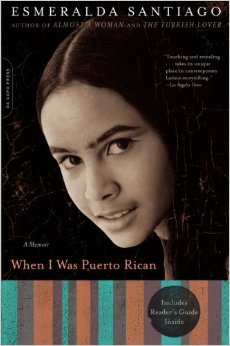
 FREETHINKING BIBLIOPHILE
You must be logged in to post a comment.