
 Last summer at a family cookout, I noticed my uncle who had served in the Vietnam War, wearing a baseball cap which indicated that he was a veteran of the conflict. It was the first time I had seen him wear anything connected to Vietnam or the military. As I watched him, I asked myself why it took so long for Vietnam veterans to find acceptance and peace. He is from a generation which fought in a deeply unpopular war that saw America fall short of its stated goal. The official policy was to help South Vietnam withstand communism and survive as its own democratic republic but the reality on the ground was far more complicated. The truth about South Vietnam is a bitter pill to swallow but necessary in understanding the failures which took place. Author and Pulitzer Prize winner Frances Fitzgerald originally wrote this book in 1971 and it was published in 1972, three years before the conflict’s end. But contained in its pages is an insightful discussion about Vietnamese history, French colonialism, and America’s entry into Indochina. And having finished the book, I can say with certainty that it is one the best books I have ever read about the war in Vietnam.
Fitzgerald did not serve in the military and the book is not written from a soldier’s point of view. Her focus is on South Vietnam, particularly the instability of its government and the complex social structure in Vietnam which western minds struggled to understand. The book excels is explaining how and why the Vietnamese lived as they did. These lessons seemed to have been lost to officials as the conflict heated up. Readers do not need prior knowledge of the war to find value in this book. In fact, no prior knowledge is needed. Fitzgerald covers the country’s history, the French occupation, and the buildup to American intervention. Her narrative is smooth and flows beautifully, which makes the book easy to read and engaging from start to finish.
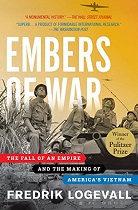
I have read and reviewed several books on Vietnam, each with its own approach to the war. But the book I found to be the closest in comparison to this discussion by Fitzgerald is Fredrik Logevall’s ‘Embers of War: The Fall of an Empire and the Making of America’s Vietnam‘, which I strongly recommend for anyone interested in the war’s history. However, I believe Fitzgerald’s account in regard to South Vietnam is absolute gold. And the nexus of President Ngo Dinh Diem (1901-1963), brother Ngo Dinh Nhu (1910-1963) and sister-in-law Madame Nhu (Trần Lệ Xuân)(1924-2011) is explored thoroughly in one of the most thorough explanations I have read. This trifecta of power would affect Vietnam in many ways and haunt the American effort in the years that followed their removal from power in 1963. But this was no secret in Washington as we see in the book. Readers may also want to take a look at the book by former Secretary of Defense Robert S. McNamara (1916-2009) ‘In Retrospect: The Tragedy and Lessons of Vietnam‘, which is a fair analysis of the failures by officials in handling the conflict. McNamara is seen as a villain by some, and the war’s chief architect by others. His role and errors are discussions for another time, but his book is still a valuable source of information.
Prior to American troops landing in Vietnam, warnings had been issued by both foreign governments and the United States intelligence apparatus. A young and well-traveled senator from Massachusetts named John F. Kennedy (1917-1963) was convinced that a war in Indochina was a disaster, but he would be forced to confront the matter himself when he was elected to the presidency in 1960. But despite numerous warnings, the stage was set in the wake of the Gulf of Tonkin incident in August 1964. President Lyndon B. Johnson (1908-1973) asked for and received congressional authority to use military force in Vietnam. In four years, the war became an “albatross” around his neck and played a significant role in his decision not to seek or accept the Democratic nomination for the 1968 presidential election. In Vietnam, American military commanders continued to face an enemy encouraged by deception and a mindset that seemed inexplicable to the west. And added to the mix is the National Liberation Front (“NLF”) whose goal was to remove the Diem regime from power and seek reunification with North Vietnam. As I read, I found my view of the conflict changing as I understood more about the NLF and the dislike of the Diem regime. Further, the author highlights the degradation of Vietnamese society due to its American occupiers. This part of the book may be difficult for some to accept, but what the author discusses is crucial in understanding why South Vietnam could never stand on its own.
As the war rages on, American officials and military commanders are forced to accept uncomfortable truths. Publicly, the belief in American victory remained strong, but behind closed doors, Washington knew that the war was not going as planned and victory not as certain as one would believe. And the Tet Offensive in January 1968, was a sobering wake up call for anyone who assumed the war would be over soon. Fitzgerald discusses the offensive and its impact here as well, and she also pulls no punches regarding American atrocities in Vietnam. The war had turned Indochina into hell, and she drives home the point that instead of liberating South Vietnam, America flipped it upside down in ways which officials had not anticipated. The Vietnamese people had their lives upended for a cause which many of them had no strong feeling in support of.
Following Johnson’s decision not to see re-election in 1968, a new president arrives and inherits the war in Vietnam. The administration of Richard M. Nixon (1913-1994) would have its own difficulties with the raging infernor which he pledged to bring to an end. But he would soon find out that doing so was far more difficult than that implied. The war’s expansion into neighboring Cambodia set off alarm bells and revealed the uncomfortable truth that the nightmare in Vietnam was far from over. The heartbreaking saga plays out in the book but ends in 1971 when Fitzgerald finishes her analysis. Hauntingly, her words proved to be prophetic and the departure of American forces in 1975 was confirmation that without permanent U.S. involvement, reunification was bound to happen.
After I finished the book, I sat silently for a few minutes thinking about the war and its many casualties. I thought of my uncle who carries scars from the war, both physically and mentally. In a rare moment of admission, he once told me that people asked him why he had answered his draft call. He never wanted to go to Vietnam but did not have the money or connections to avoid being called to serve. So, he took his draft card and arrived at his assigned location. And several months later, he found himself three thousand miles away in a country he had never seen to fight in a war he wanted no part of. And that is the story of many Vietnam veterans who are still with us today. I can only hope that they receive the acknowledgment and acceptance they have not always been given. If you are a student of the Vietnam War, you will appreciate this book.
ASIN : B0028MM2MM
Publisher : Little, Brown and Company (May 5, 2009)
 On October 19, 1965, North Vietnamese soldiers fortified their positions surrounding the
  On August 1, 1961, United States Secretary of Defense
  “Our resistance will be long and painful, but whatever the sacrifices, however long the struggle, we shall fight to the end, until Vietnam is fully independent and reunified. ” –
  On January 6, 2021, I and millions of people in America and abroad watched the events at the U.S. Capitol in which thousands of individuals breached security and entered the historic building in the belief that the 2020 Presidential Election had been stolen from Donald J. Trump. As I watched the video footage, a sense of gloom came over me due to the realization that the pillars of our vision of democracy were under siege. Personally, I have no political affiliation and regardless of which party we belong to, none of them are above reproach when our government is threatened from within or abroad. By evening, the dust had settled over Washington and officials began to piece together the chain of events that left several dead, dozens injured, and hundreds detained or the target of criminal investigation. Messages from family members and friends started to arrive on my phone with nearly if I had seen the events in Washington, D.C. The insurrection forced many of us to confront unsettling realities and acknowledge that threats exist all around us. Further, the day also showed how far America has strayed from the principles it professes to believe in.
 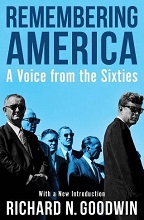 On more than one occasion my father has commented that the 1960s was the scariest decade of his life. The threat of Nuclear War, increasing tensions in Southeast Asia and the growing Civil Rights Movement captivated American society and the world. During one conversation he turned and said to me “at the time of the Cuban Missile Crisis, we didn’t know if we would live to see tomorrow or die in a nuclear exchange with the Soviet Union”. The assassinations of several activists and politicians spread fear across the nation and to many, it seemed as if America was on the verge of total anarchy. Richard N. Goodwin (1931-2018) worked in the administrations of Presidents John F. Kennedy (1917-1963) and Lyndon B. Johnson (1908-1973) and helped draft some of the most memorable speeches given by the iconic figures. In 1988 he completed this memoir which was re-published in 2014, of the decade he spent in politics with two presidents and two presidential candidates. And the result is a spellbinding account of a critical time in American history during which the country underwent profound heartache and change.
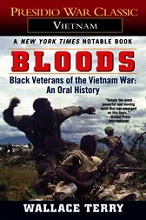 The last time I saw my Uncle William in person, we discussed his time in Vietnam and later discharge from the military in the 1960s. During a routine physical, it was discovered that he had suffered damage to hearing in one of his ears due to being too close to the 50-caliber machine gun while on patrol. As a result, his balance and coordination began to suffer, and he was declared not fit for active duty. He accepted the discharge and found work with the postal service before moving on to the private sector. Over the years he has only talked about Vietnam on a handful of occasions and the stories were typically very brief. He never went into too much detail but there are couple of stories that made the hair stand up on the back of my neck. His experiences are like those of other black veterans of the Vietnam War whose struggles have not received the full attention that they undoubtedly deserve. Wallace Terry (1938-2003) was a journalist and oral historian who conducted interviews with dozens of veterans and chose twenty of them which are the focus of this book. It is a detailed look at the life of black soldiers in a war that remains a dark memory in American history.
 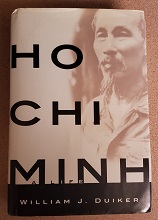 On April 30, 1975, the People’s Army of Vietnam and Viet Cong forces succeeded in the occupation of the city of Saigon in the wake of withdrawal by United States Armed Forces. America’s departure marked the end of the Vietnam War and provided the Democratic Republic of North Vietnam with the opporunity to unify North and South Vietnam. The final act of unification would have been welcomed by the first Prime Minister of North Vietnam Nyguen Ai Quoc who was known to the world as Ho Chih Minh (1890-1969). Older Vietanemse sometimes refer to him as “Uncle Ho”, a benevolent figure who’s life as devoted to completely independence in Indochina from French and Chinese rule. Ho Chih Minh has always come across as a slightly mysterious figure and some parts of his life are still unknown. However, author William Duiker provides an informative and thought-provoking biography that explains Ho’s life and the true tragedy of the Vietnam War.
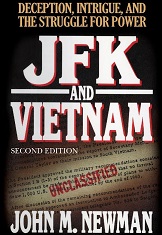 March 29, 2019, marked the forty-six anniversary of the departure of the last remaining United States troops in South Vietnam. Two years after their departure,on April 30, 1975, Siagon fell to North Vietnamese forces as Hanoi tightened its grip around the country. By the time the war ended, fifty-eight thousand American soldiers had lost their lives in Vietnam. North Vietnamese Army and Viet Cong losses were estimated to be well over one million. Civilian deaths were even higher in number but despite the large numbers of casualties, North Vietnam refused to surrender and was determined to achieve reunification. The withdrawal of American troops was a sobering reality and cold hard truth: the American effort in Southeast Asia had not succeeded. To this day, there are many people who still wonder how and why the United States became entangled in Vietnam. The defeat of French forces at Dien Bien Phu in 1954 should have served as a reminder that military might is not always a guarantee of success. In January, 1960, President John F. Kennedy (1917-1963) took office and from the beginning of his administration until his death, the issue of Vietnam continued to fester like an open sore. Kennedy died before he could implement any further plans regarding Vietnam and took many secrets with him to his grave. But declassified documents and political memoirs shed much light on what was really happening in his administration as it grappled to combat the growing Viet Cong menace.
 In
In  FREETHINKING BIBLIOPHILE
You must be logged in to post a comment.