
 Every summer, my parents make their annual visit to the Mashantucket Pequot Museum and Research Center in Ledyard, Connecticut to continue learning about the Pequot Indian tribe who lived in what is now the State of Connecticut. They are one of the many tribes that called North America home prior to the arrival of European settlers and the creation of the United States. Today, they can be found largely on reservations having been forced off of the only lands they knew to make way for a country that had liberated itself from British colonization. Far too often, their plight is ignored and history books have traditionally re-written the history of the foundation of the United States of America. This book by the late Dorris Alexander “Dee” Brown (1908-2002) challenges everything we thought we knew about our country and the scores of people often referred to simply as “the Indians”.
Hollywood has played a large part in the historical view by many of the Native Americans, the enemies of White Cowboys as depicted in Westerns and other television programs of the past. John Wayne is admired by many as the icon of the American West. The Native Americans, considered to be savages, uncivilized and dangerous became the object of the wrath of bloodthirsty soldiers filled with an ideology that could classified as genocide today. The true story was carefully and deceptively hidden from public light but it has come out in more recent times. And as the Native Americans and Indians of the Caribbean are shown in a more positive light, more of the truth will come to the surface. Several cities here in America have now replaced the holiday of Columbus Day with Indigenous People’s Day. Columbus was only a small part of the story and he never set foot on North American soil. But the actions of the municipalities were for the right reasons and I believe in time, more cities will follow suit.
In the wake of the American Revolution, a new nation was born with the desire to obtain as much land as possible under the guise of “Manifest Destiny” and its actions changed the course of history and nearly exterminated the continent’s native inhabitants. I am sure you have heard many of the names that became legends; Tecumseh (1768-1813), Sitting Bull( 1831-1890), Geronimo (1829-1909), Crazy Horse (d. 1877) and Cochise (d.1874). These leaders are revered in Native American history but are only small parts of a much larger and deadlier picture. Their lives crossed paths with American soldiers whose names have become both famous and infamous such as Kit Carson (1869-1868) and General George Armstrong Custer (1839-1876) whose last stand is sometimes fodder for situations in which a positive outcome is highly unlikely. The battles that took place across the plains of North America reveal a violent struggle as two opposing of forces sought to maintain their own ways of life. For the Native Americans, their goal was to live as they always had and not like the invaders who annexed territory and brought disease, starvation and death. For the American soldiers, the Indians were savages who needed to learn the White man’s way of life and give their hearts to Christianity. The two systems were never compatible but Washington refused to accept any deals that would preserve Native American land. The methods used to forcibly remove the natives are some of the darkest moments in American history.
It is imperative to keep in mind while reading the book that America did not yet have 50 states. In fact, the reader has to pay close attention to the location descriptions to form a picture of the region in which these events take place. In comparison to clearly marked state boundaries today, land then was sometimes loosely divided among tribes with recognized boundaries by each side. I do recommend having a map of Native American tribes while reading the book to gain a more accurate image. Brown also adds small bonuses at the beginning of each chapters as he highlights the most important events that occurred. Readers may find that they have bookmarked random facts that have nothing to do with the story at hand but are useful information to retain.
I warn the reader that the book is not always easy to read. The graphic descriptions of the atrocities committed in battle and the fate of the Native Americans are a rude awakening to any ideas about a graceful creation of America where the settlers and Indians worked side by side and everyone was friends. This is the unfiltered truth and to say it is ugly would be an understatement. Those of you who are of Native-American heritage will be familiar with the tragedies that befell your ancestors. For others, in particular Americans, this book is a chance to fully understand how violence played a crucial role in the development of what is now a superpower. We are unable to turn back the hands of time and change the course of history but what we can do moving forward is to acknowledge the tragic story of North America’s forgotten residents.
I firmly believe that this book, which was written in 1970, should be read by students in every history class across the country. These are the stories that you will not find in textbooks that seeks to portray the history of this nation in the most positive light possible. Interestingly, Native Americans are present in many of us today. Millions of American have their blood running through their veins. That heritage has sadly been forgotten or in some cases ignored. But it is never too late to learn about those who gave up so much so that we are able to enjoy the privileges afforded to us. Their lives have never been the same and their heritage was nearly destroyed. I hope that one day they too find the peace of mind that they have sought for so long. And the next time you think about wearing a Native American costume for a party, this book might make you think twice. This is the dark and ugly history of America and the mission to eradicate the Native Americans.
ASIN: B009KY5OGC
ISBN-10: 0805086846
ISBN-13: 978-0805086843
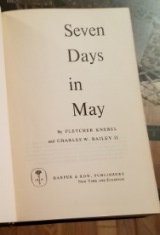 Many of us believe that it could never happen here and that the United States is too stable and developed for the military to even attempt a coup. The suggestion would be dismissed instantly by those who believe such things happen in Third World nations. But what if it did happen in the United States? And how would the plot develop? Fletcher Knebel (1911-1993) and Charles W. Bailey, II (1929-2012) put their minds together as they pondered these questions and others resulting in this masterpiece, Seven Days in May. According to legend, President John F. Kennedy (1917-1963) liked the book so much that he allowed director John Frankenheimer (1930-2002) to use the White House grounds while creating the film of the same name that was released in 1964 starring Burt Lancaster (1913-1994) and Kirk Douglas (1916-). Kennedy did not live to see the film and his assassination was more than the writers could have imagined as they created this book.
 On July 18, 1969, Senator Edward M. “Ted” Kennedy (1932-2009) lost control of his vehicle while crossing the Dike Bridge on Chappaquiddick Island, Massachusetts. In the passenger seat was a twenty-eight old former staff member of Robert F. Kennedy’s (1929-1968) presidential campaign and member of a group of women known as the “Boiler Room Girls”. She was later identified as Mary Jo Kopechne. In death she became a permanent part of the history of Chappaquiddick and a reminder of what happens when we are negligent in our actions. Over time she has been largely forgotten, having been overshadowed by the lives of the Kennedy family. And with regards to Chappaquiddick, she has been known as the “woman in Kennedy’s car”. But the real Mary Jo Kopechne has an interesting story of her own that was cut short at only twenty-eight years of age.
 The definition of courage is the ability to do something that frightens one. On October 13, 1972, Roberto Canessa was one of forty passengers aboard Uruguayan Air Force Flight 571 bound for Santiago, Chile. The plane clipped the top of a mountain peak and crashed in a region known as the Valley of Tears. Seventy-two days passed before all of the survivors were rescued. Canessa and Nando Parrado, author of
  On October 13, 1972, Nando Parrado was a twenty-two year old rugby player with the Old Christians from Montevideo, Uruguay. The team was en route to Santiago Chile for an annual match against a rival team. As their Fairchild 227 flew north through the Andes following a navigational error by the plane’s pilots, it clipped the top of a mountain peak as the crew struggled to force the aircraft to climb over the deadly terrain. The initial crash killed several passengers and by the time the survivors were rescued in December, 1972, only sixteen remained. Their story was told by author Piers Paul Read in the 1974 book
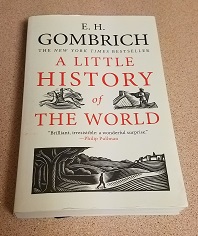 Can you imagine several thousand years of world history compressed into three hundred four pages? Before reading this book, I certainly did not and I believe the same applies to many others. However, that is exactly what Ernst Han Josef Gombrich (1909-2001) has done in this history book that came into existence as a result of challenge issued to the author to write a better history book than the one he was editing at the time. The book was written in 1935 and subsequently re-published bringing it up to date with modern history events. Gombrich never intended for the book to replace all of the history textbooks in use by teachers and professors. However, the book does serve as a complement to dozens of study aids used by students across the globe. Interestingly, the book is geared towards the ages of seven to nine years but I think that readers of all ages will find it to be quite informative.
 When I think back on the history classes I attended in elementary school, high school and then college, I remember that it seemed as if it took forever to go through any topic. And that says a lot for someone like myself who has always loved the subject and still does. For most people, history is beyond mind-numbing and often revisits events in the past to which most people do not give a second thought. But as we are often reminded through history, we need to know our past in order to reach our future. In comparison to the history of Europe, Asia and other parts of the world, the United States is a very young nation that has been in existence less than three hundred years. Incredibly, in that short amount of time on the world stage, some of the most memorable events in modern history have taken place in North America and had reverberating effects across the planet. If we were to study American in its entirety, that would be a course that would last a couple of years at least. But what happens when you cram that history into a book that is three hundred nine pages long?
 It is not often that a former Director of the Federal Bureau of Investigation writes a book. In fact, it is almost unprecedented. In all fairness, there have been books written by former members of the Central Intelligence Agency and U.S. intelligence apparatus. When James Comey published this book, news outlets were eagerly waiting to get a copy of one of the most anticipated book releases in history. The political climate of the United States is unlike anything most of us have ever seen. There are a number of adjectives that come to mind, any of which could be rightfully applied to Washington, D.C. Time will tell what will happen in the oval office. The firing of James Comey through the media left many of us shocked, confused and even angry. For some, it was just one more act by a vindictive and childish commander-in-chief. Others believed that it was the right call as they believed the FBI was out of control. I watched broadcasts that day and found myself astonished at the day’s events and wondering if this was just the start of a regrettable trend developing in the United States government.
 The title of this book is enough to cause a range of emotions in deist, agnostics and atheist. Next to politics, religion is a subject which unites or divides, sometimes through the use of extreme violence. Today, when we think of religious fundamentalism, images of Islamic radicals readily come to mind causing us to forget that extremism exist is nearly every religion known to man. In the United States, most deists are followers of monotheistic faiths. Others are followers of polytheistic faiths and the remainder could be classified as agnostic, spiritual or even atheist. Those who are atheist remain firm in their belief that God does not exist. But for deists, God does exist and is present all around us at all times. But what if is there is no such thing as God? Believers will find the mere mention of such a concept preposterous. But in all fairness, no one has ever come back from the dead to tell humanity what really happens when we die. Furthermore, non-believers point to the world’s many ills as proof that an all-loving God is nothing more than make-believe. Christopher Hitchens (1949-2011) wrote at least thirty books, some of which like this, addressed religious faith. Here, he takes on God and puts forth his argument that religion itself is the cause of many of the world’s ills. One look at the cover will cause some to claim blasphemy and write Hitchens off as doomed and demented soul who surely found out when he died, that God does in fact exist. Regardless of what side of the fence you are on, the book is a good discussion on the effect religion truly has on our lives.
 FREETHINKING BIBLIOPHILE
You must be logged in to post a comment.