
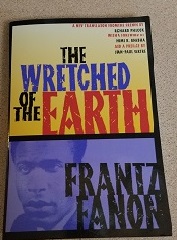
 On July 1, 1962 a referendum was held that paved the way for Algerian independence from the government of France. The complete cessation of armed conflict marked the end of war that lasted seventeen years. The Algeria movement for freedom stands out as a success story similar to the legendary revolutionary campaigns in the Caribbean and Latin America. It is also a case study for those seeking to go down the path of revolution as a method to enforce social reform. No revolution is complete without a defining text and in this case, the struggle was analyzed and transcribed the famed revolutionary, writer, philosopher and psychiatrist, Frantz Fanon. (1925-1961) The book was finished shortly before his death and published not long after. Originally written in French, it has been translated by Richard Philcox for English readers.
Tragically, Fanon died on December 6, 1961 from the effects of leukemia and did not live to see the success of what became a masterpiece. And in a cruel twist of fate, his deteriorating condition forced him to seek treatment in the one country that became the poster child for imperialism, the United States. Following his death, he was buried in Algeria, the nation he wrote so passionately about. The Wretched Of The Earth dissects the Algerian campaign and the complicated, dysfunctional and deadly relationship between colonial governments and their colonized territories. Fanon minces no words, he is frank and his rhetoric sharp. His mission is writing this text was to explain to the reader the ingredients necessary for armed revolution and in inevitability of the inclusion of violence. The benefit of having a first hand witness to the bloody struggle for liberation put him in a unique perspective to become the movement’s biographer.
Fanon proves himself to be a complex and deeply intellectual figure. Tapping into this seeming endless intellect, he does not stop at examining the oppression of the colonized. He dives further discussing the mental and physical state of both opponents before moving on to the rebuilding of the nation that has newfound freedom. If we fully digest what Fanon tells us we can see the long-lasting effects of colonialism even to this day. Across the world, revolutions are taking place and others are being formulated as the oppressed masses reached their breaking point. Along the way, Fanon will be there to guide them with his insight and words. His critics have said that he incites violence. I do not believe the criticism is warranted entirely. As Fanon points out, violence is a part of revolution and is a logical result of systematic oppression over a period of time. A system that subjects its citizens to daily discrimination and deplorable living conditions will eventually engineer its own downfall. And this is the point that Fanon emphatically drives home. Decolonization is never pleasant but it must be strategically developed and carried out by those who truly wish to break the back of their colonial rulers.
Throughout the year, his work has been studied and employed by countless revolutionaries figures including Huey P. Newton and the Black Panther Party for self-defense. Next to Che Guevara and Fidel Castro, Fanon stands out as one of the loudest voices against American and European imperialism. And like Guevara, he died before reaching forty years of age and had yet to reach his full literary and revolutionary potential. But through his works his legacy continues and he finds new fame as young minds embrace the works of the past as seek to understand the brutal system of colonization which takes of many different forms but possesses the same agenda to extract as much as possible from the nations and people under its control. Fanon was survived by his widow Josie who died on July 13, 1989 in Algiers after tragically taking her own life. After Frantz’s death she never remarried and carried his name for the rest of her life. Her devotion to him is reminiscent of the devotion given by those who have read and studied him and believe him to be a voice for their own struggles. And for many more years, The Wretched Of The Earth will be one of the most important books ever written about decolonization.
“When we revolt it’s not for a particular culture. We revolt simply because, for many reasons, we can no longer breathe” -Frantz Fanon
ISBN-10: 0802141323
ISBN-13: 978-0802141323
 Wagner Moura became one of Netflix’s most memorable faces when he assumed the role of infamous drug czar Pablo Escobar in the hit series Narcos. The series, while based off of true events, is also a fictional account of the late kingpin’s life as a cocaine trafficker and public enemy number one in Colombia. The received rave reviews and I enjoyed it immensely. I was aware of Escobar’s story before watching the show and knew that the producers would tweak some parts of the story to enhance its seduction. The created a hit that will remain one of the best products of the digital behemoth. But some of us may be asking ourselves, how much did Netflix get right? And what did they change as they filmed the show? Shaun Attwood goes behind the camera and revisits the real story of Pablo’s rise and downfall that lead to his death on December 2, 1993 in the city of Medellín.
 Today it is hard to imagine that less than fifty years ago, New York City was once considered one of the most dangerous cities in America. Rising crime, poverty, budgetary mismanagement and police corruption combined to turn the Big Apple into a city that took more than it gave. The New York City Police Department was tasked with maintaining order in the concrete jungle in the face of budget cuts and incredibly layoffs in the late 1970s. The officers who survived those dark years carry with them endless memories about their time on the streets of New York City. Tom Walker, who retired in 2004, spent several years of his career at the 41st Precinct in the South Bronx, nicknamed by the officers as “Fort Apache”. The name sounds heroic but as we learn in the book, it was for darker and more tragic reasons that the station was referred to as a fort. Outside the walls of the precinct existed a world that bordered on the surreal and gave a glimpse into what hell must really be like.
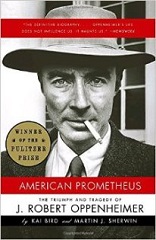 In August, 1945, the course of modern warfare was changed forever when the United States dropped two atomic bombs on Japan, striking the cities of Hiroshima and Nagasaki. Following the successful deployment of the bomb, the Soviet Union and other nations enhanced their own programs to develop a nuclear weapon. The nuclear arms race produced a fear in mankind that still exists today as war continues and dictators drunk on power set their eyes on world domination and a test of egos. It has often been said that the next major world war will be the last war mankind will ever fight. Humanity now has the absolute power to destroy itself literally at the push of a button. Thankfully, since the second world war, there has been no further use of atomic weapons in an armed conflict. But the danger still exists and there have been many who have warned against the escalation of nuclear armament. One of these voices was that of J. Robert Oppenheimer (1904-1967), referred to as the father of atomic bomb and in this excellent biography, an American Prometheus. Kali Bird and Martin J. Sherwin have captured Oppenheimer’s life splendidly making sure that his life is recorded for history.
 On April 6, 2017, The Global Confederation of Labor (CGT) conducted a one-day general strike in protest of the policies of the administration of President Mauricio Macri. (1959-) Inflation, high taxes, low wages and job cuts have constrained the people of Argentina into an economic vice grip as the president attempts to steer the country away from a looming economic crisis. The strike is just one in many that have taken place during the last one hundred years in one of South America’s most popular countries. In July, 2017, I had the privilege to visit Buenos Aires, the city that has been called the Paris of South America. In July of this year I will return to the nation that is home to world-famous steaks, milanesa, wine, asado and dozens of culinary delights that make the heart flutter and the mouth water. I do not know what the political climate will be like when I visit but I can be sure that the people of Buenos Aires will show me the same hospitality that they did in the past and in the process help to create memories that will remain with me for the rest of my life. My favorite Argentine presented this book to me as a gift, a gift that keeps on giving. This book is a history of the Argentine Republic during the twentieth century. And what is contained in the pages of this book is essential in understanding modern-day Argentina. James P. Brennan has translated the work of Luis Alberto Romero (1944-), who became a Professor of History at the University of Buenos Aires in
  During a trip back to New York from Miami this week, I was browsing the books at the terminal’s newsstand and came across this book by Anderson Cooper and his mother Gloria Vanderbilt. Like most Americans, I know Cooper from CNN and the years of journalism that he has provided to us. I was not aware of his mother’s story or that she is still going strong at ninety-three years of age. I decided to purchase the book and I am delighted to say this New York Times Bestseller was worth the investment. The title is quite self-explanatory but there is so much more in this book which is a collection of correspondence between Cooper and his mother. It takes place over a period of time and through electronic means. The story of their lives is fascinating and contains an interesting history of its own.
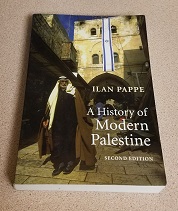 The crisis that exists between Israel and the area that was once the nation of Palestine has evolved into one of the most tragic the world has seen. Anger on both sides and the failure of mediation on more than one occasion has resulted in the continuation of the long feud. Each side has its supporters and detractors refusing to abandon their beliefs and stance of the matter. My interest in the conflict propelled me to acquire this high recommended book on the issue written by Israel historian and social activist, Ilan Pappe (1954-). Pappe was born in Haifa and continues to educate millions about the true origins of the raging battle. This phenomenal account of the history of Palestine and its current day status is a must read by anyone seeking to understand the origins of the matter. To be fair, Pappe is not anti-Israel, but he does however, confront many facts about the history of Palestine that are often very uncomfortable. But any good researcher should do just that and it is in this area that Pappe shines through.
 Epidemics have been a part of mankind for thousands of years. At some point in time, humanity has been threatened with the possibility of extinction in the form a new disease that had not yet been understood by doctors and government officials. In the United States, there was a disease that caused widespread panic and afflicted millions of Americans before it was contained. Its most-famous victim was former President Franklin D. Roosevelt who became known as the “Wheelchair President”. The disease was officially designated poliomyelitis or polio for short. To this day, it remains one of America’s deadliest epidemics next to AIDS and cancer which continues to claim lives each year. The origins of polio are mysterious and the successful creation of a vaccine was the result of the hard work and dedication of the greatest virologists who rose to the occasion to save the nation from a deadly disease. Today the disease is largely forgotten and taken for granted. A diagnosis of polio is exceedingly rare and in the event it is detected, vaccines are readily available to contain the virus and give the patient a long and happy life. However, less than sixty years ago the race to find a vaccine was hotly contested as Americans and the world lived in suspense at the possible eradication of a silent killer. Two doctors on opposites ends of the spectrum are forever linked with the disease and the successful campaign to eliminate it; Albert Sabin and Jonas Salk. This is the story of polio and the two physicians that have become legends in American history. The book is presented to us by David Oshinsky, author and Pulitzer Prize winner who also published
 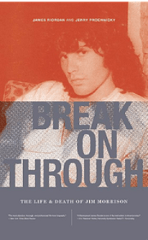 In death several musicians have become in a sense larger than life. Their recordings, writings and interviews become collector’s items catapulting them to legendary status. A cruel irony in life is that some of the greatest artist and performers to have graced a stage, died a young age before reaching their full potential. James Dean (1931-1955), Tupac Shakur (1971-1996), Janis Joplin (1943-1970), Jimi Hendrix (1942-1970) and Jim Morrison (1943-1971) are just a handful of names of talented individuals who rose to fame and were gone before thirty years of age. Morrison, with his band The Doors, had become a sex icon and the poster boy for the anti-establishment movement sweeping across the United States. His death on July 3, 1972 concluded a chaotic life that seemed to get even more bizarre as it continued. Eerily, Morrison joined the group of musicians who died at twenty-seven. Joplin, Hendrix and Brian James of The Rolling Stones all died at the age of twenty-seven. And Morrison’s long-term girlfriend Pamela Courson (1946-1974), also died at the age of twenty-seven. The dark coincidences highlights the fragility of life and its unpredictable nature for we are here one day and sometimes gone the next. In death, Morrison became an even bigger legend and still has millions of adoring fans across the globe. But for all of his wild antics on stage, some of which nearly resulted in his incarceration for an extended-stay, the real Morrison proved to be a mysterious and confusing character as evidenced by this informative and well-researched biography by James Riordan and Jerry Prochnicky.

You must be logged in to post a comment.