
 On February 13, 1961, United Nations Ambassador Adlai Stevenson (1900-1965) placed a call to President John F. Kennedy (1917-1963) and informed him that Patrice Lumumba (1925-1961), the first Prime Minister of the Independent Democratic Republic of the Congo, had been murdered a month earlier. The moment that Kennedy took the call was captured by a photographer and the image shows him with his hand covering his face in shock. The picture truly does speak a thousand words and Kennedy’s dismay resonated with millions of people around the world.
To a growing following, Lumumba represented hope for a new course to be charted by the continent of Africa. The Congo would lead the way and help other African nations achieve independence and change the world. As the leader of the Mouvement National Congolais (MNC), he stood at the front of the growing movement for independence which occurred on June 30, 1960. Nearly immediately after his historic election as Prime Minister, his enemies began plotting his elimination. Brussels became increasingly alarmed as its grip over the Congo became weaker with each day that passed. And before long, the decision to remove Lumumba became a priority for Belgium and other nations afraid of the rising Congolese star. In less than one year, he was dead and all hopes for a new Congo were shattered beyond repair. There are some people in the Congo who have never moved on from his murder. To this day, Lumumba remains a martyr in the African struggle for liberation from imperialism.
The first question to be answered is why was the Congo such a desirable location? Leo Zeilig has the answer to that question and many others. He explores the Congo’s past and in particular the actions of Henry Morton Stanley (1841-1904) and Dunlop Rubber. Their actions set the stage for the brutal Belgian occupation that ruled the Congo with an iron grip. Racism was a founding principle and enforced through strict segregation. It was into this world that Lumumba was born on July 2, 1925 in Onalua, located in the territory of Katako-Kombe. From the beginning, his life was anything but ordinary.
Zeilig did a masterful job at presenting Lumumba’s story so that we can see his development into an adolescent and then young man, forced to navigate a racist society whose goal was to reap enormous profits at the expense of Congolese men and women, often viewed by their occupiers as “savages”. Lumumba’s path to politics took many turns along the way and his personal life nearly rivaled his political life in intrigue. Zeilig pulls no punches, revealing any facades and clarifying any myths that might exist. Several wives, multiple children and a burning passion for knowledge were just some of the many sides to Lumumba’s life.
The book picks up speed after the election and granting of independence. Unsurprisingly, the Congo was plagued by tribal divisions which would later become problematic for any chance of unity. Those familiar with the events of that time will know very well the names of Joseph Kasa Vubu (1915-1969) and Moise Tshombe (1919-1969). Each would play a role in the removal of Lumumba and what is revealed will surely leave the reader in shock. Behind the facade of a coalition government, a deadly game of chess ensued, pitting critical figures against each other as the country slipped closer and closer to all out civil war in the wake of the Belgian exodus. Zeilig covers all angles and puts the pieces together as multiple nations soon join in the call for Lumumba’s removal. It is hard to put into the words how much of a threat he truly was to western powers. But Lumumba made several missteps along the way that helped open the door for the actions that resulted in his demise.
Suspense builds in the story and the effort to removal Lumumba kicks into high gear. The young leader is not unaware of opposing forces but believes he has the will of people behind him. One of the true ironies of his tragic story is that his fate was partly a result of the simmering Cold War between Washington and Moscow. His efforts at diplomacy are eerily similar to those of Ho Chih Minh and other revolutionary leaders who reached out to Washington and received no response. We can only ask what if questions today and ponder how things might have turned out different had President Dwight Eisenhower (1890-1969) given Lumumba the courtesy of a meeting. The actions of Washington pushed many nations toward the Soviet Union, which welcomed the new allies as it attempted to expand its reach beyond the Soviet Republics. In hindsight, we can see with clarity the many errors made by all involved as they sought to outsmart each other in a game of cat and mouse that could have reached catastrophic levels.
The author builds the tension just right as the pending doom in Lumumba’s life steadily approaches. I could not help feel overcome by a feeling of dread as I read through the sections leading up to the assassination. The writing was on the wall and I felt myself wanting to tell Lumumba to move faster and leave even quicker. However, his fate came to pass on January 17, 1961 in the town of Elisabethville. Unbeknownst at the time, his savage death was a premonition of the future chaos that engulfed the continent and highlighted that moment as the day when the Congo was lost.
I had always wondered what happened to his children and Zeilig followed up with them as he researched this book. Their experience during and after his death, adds another level of tragedy to an already gripping story. They join the long list of victims who have suffered following the murder of the person who Zeilig rightfully calls Africa’s lost leader. Lumumba’s story is told beautifully by Zeilig and stands out as a firm biography. This is the life and death of the late Patrice Émery Lumumba.
ISBN-10: 190579102X
ISBN-13: 978-1905791026
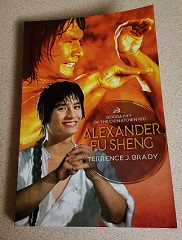 Legends never die, that is an absolute fact. Some legends never live past fifty years of age, often leaving their mortal coil through tragedy or illness. For Alexander Fu Sheng (1954-1983), a single car accident was the cause of his demise and in the early morning hours of July 7, 1983, he died at the young age of twenty-eight. He left behind grieving parents, siblings and his widow Jenny Tseng, an accomplished Hong Kong singer who has also performed abroad. At the time of his death, he had risen to become one of the most popular stars to come out of the legendary Shaw Brothers Studio. Before ceasing film production in late 1985, Shaw Brothers had released several hundred films which had been locked away until Celestial Pictures bought the rights to the films and digitally remastered the majority of the collection. As a long-term fan of the martial-arts film genre, I had amassed a large collection of films which included all of Fu Sheng’s movies. My favorite is the film that catapulted him to international stardom,
  On January 11, 2019, Netflix released ReMastered: Massacre at the Stadium, a look back at the violent coup in September, 1973 in which President Salvador Allende (1908-1973) was overthrown by the Chilean military. In his place, General Augusto Pinochet (1915-2006) assumed power and unleashed a reign of tyranny that lasted sixteen years and caused the deaths of thousands of Chileans. His reign came to an end when Patricio Aylwin (1918-2016) was elected as the next President of the Republic of Chile. Pinochet was arrested in October, 1998, by British intelligence and repatriated to Chile on March 3, 2000. He died on December 10, 2006, without having served a day in prison for the human rights violations that occurred during his time in office. Today he is largely recognized as one of Latin America’s most infamous tyrants. The story of his rise to power and fall are covered beautifully in Peter Kornbluh’s
  The United States and Iran share a long and storied past, defined in moments that changed world history. The removal of Mohammad Mossadegh in 1953, followed by the reinstatement of the Shah and the Iran Hostage Crisis in 1979, set the stage for decades of tension between the two nations. And incredibly, it was under this tension that the administration of U.S. President Barack H. Obama engaged in talks that resulted in the The Joint Comprehensive Plan of Action, simply known as the Iran Nuclear Deal. The deal was both heralded as a landmark achievement and a kowtow of the worst kind. But what many Americans did not know, was that there was far more taking place behind the scenes, including the release of U.S. prisoners held in Iranian jails. Among those prisoners, was American born journalist Jason Rezaian, of The Washington Post. You may remember him from his appearance on Anthony Bourdain’s (1956-2018) hit show No Reservations. The episode was beautifully done and Rezaian and his wife Yeganeh, appear as voices of insight into Iranian culture. At the conclusion of the episode, there is a message on the screen that they both had been taken by Iranian intelligence. The episode is my second favorite, the first is Vietnam in which President Obama makes a surprise appearance and enjoys a meal with Bourdain in Ho Chih Minh City. On January 16, 2016, Rezaian was released was repatriated to the United States. Joining him were his Iranian born wife and his mother who never stopped fighting for her son’s release.
 Those of us who have visited the Museum of Modern Art in New York City, can testify to its seduction of visitors with a passion for treasured art. The second floor is home to Campbell’s Soup Cans and Other Works, 1953–1967, a collection of thirty-two pieces by the late Andy Warhol (1928-1987). February 22 will mark thirty-two years since his untimely death at the age of fifty-eight. Art students and museum aficionados have long studied his work as the shining example of the Pop Art movement that swept across the United Kingdom and United States during the 1950s. Warhol undoubtedly became the poster child for the movement with his sleek frame, white wig, large frame glasses and black sweater. His personal life, carefully hidden from the public, became a mystery to those seeking to know just who is and who was the real Andy Warhol? Bob Colacello worked for Warhol on their publication Interview, for twelve years and in this intriguing account of their time together, he reveals the Andy Warhol he knew with all his quirks, ingenuity and fears in life.
 On September 1, 1939, the Second World War began as the German army invaded Poland as part of Adolf Hitler’s quest for world domination. Britain had warned Germany that any military action against Poland would result in England coming to the aid of its ally. Interestingly, Adolf Hitler (1889-1945) did not want to go to war with England, preferring to accomplish the annexation of Poland through diplomatic methods after having successfully partitioned Czechoslovakia in what is infamously referred to as the “appeasement at Munich”. But if Hitler did not want to wage war against Britain, knowing their intention to save Poland, then why did he give approval to the invasion that plunged the world into a major conflict? The answer to that question lies in the story of his Foreign Minister and Nuremberg defendant, Ulrich Friedrich Wilhelm Joachim von Ribbentrop (1893-1946).
 This past Saturday was the fifty-fourth anniversary of the death of the late American playwright and author Lorraine Vivian Hansberry (1930-1965). Her untimely death at the age of thirty-four silenced one of literature’s greatest voices. However, more than fifty years after her death, her masterpiece, A Raisin In the Sun, continues draw audiences curious to learn why the play is one of the longest running on Broadway. I personally attended a run starring Denzel Washington and his portrayal as Walter Lee Younger is as good as the original performance by the legendary Sidney Poitier. For some, Hansberry remains a bit of a mystery. and a throwback to an era long past. The younger generation of today largely have yet to discover her genius and her influence on the African-American experience. And what many of them are unaware of is that five decades ago, she was a voice advocating for the many freedoms they have today. Sadly, it has taken many years for her to be recognized for the gifted writer that she was. As we come to know her work more intimately, we must ask ourselves, who was the real Lorraine Hansberry? Imani Perry searched for and found her in this semi-autobiography and psychoanalysis. The book is an examination of Lorraine’s thoughts and writings while also adding recollections of historical events filled with larger than life figures who are no longer with us today. But make no mistake, this is about Lorraine, the woman who changed Broadway.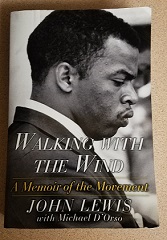
 It is difficult to put into words, the polarizing effect of the trial of O.J. Simpson had on America. The ugly history of racism took center stage as lead attorney Johnnie Cochran (1937-2005) formed a defense based on it and the prosecution under the guidance of lead attorney Marcia Clark, sought to exclude it. The crime was beyond brutal and contained a level of savagery that caused a twitch even in the most hardened of stomachs. Photos of the crime scene are available on the internet in all of their shocking and gory details. I vividly recall the car chase that played out on the television screen as the Los Angeles Police Department followed Simpson’s white Ford Bronco. The truck later became fodder for parody but at the time, caused bewilderment as everyone wondered where on earth Simpson could be going. When he was acquitted of murder, loud cheers could be heard throughout the school. To many of us, it seemed unfathomable that Simpson, the gridiron great could have committed such a heinous crime. Further, the L.A. Riots remained fresh on our minds and the video footage of the beating of Rodney King, a reminder of the fragile co-existence between the police and Black communities across the country. To some, the justice system had worked and we knew O.J. was innocent. Or did we? Were we assuming his innocence based on his skin color and our need for a hero? Or was it, as some believed, a chance to “get even” with the system? The trial was many things but above all it was surreal.
 In the annals of Latin American history, perhaps no other figure is as studied as Simón Bolívar (1783-1830), the liberator of South America. Former Venezuelan President Hugh Chavez (1954-2013) famously spoke with images of Bolívar behind him as he sought to transform the country into a contender on the world stage. The life of Bolívar lasted less than fifty years but within two decades he became the leading figure in the Latin American movement for independence from the Spanish Empire. The nations of Colombia, Peru, Ecuador, Venezuela, Panama and Bolivia (his namesake) are the products of his vision, a united South America free from the influence of its northern neighbor. And prophetically, many of his beliefs about the future of South America have come to pass, cementing his legacy as one of the continent’s greatest heroes. Marie Arana, a native of Bolívar’s beloved Peru, has composed a stunning biography of the late figure that shows a complex character, driven by ideology but crippled by his own generosity and disregard for personal well-being.

You must be logged in to post a comment.