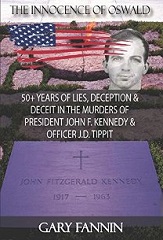
The Innocence of Oswald: 50+ Years of Lies, Deception & Deceit in the Murders of President John F. Kennedy and Officer J.D. Tippit-Gary Fannin

q1As November slowly approaches this year, the anniversary of one of America’s darkest moments will be upon us once again as we remember the tragic death of the late John F. Kennedy.  His murder continues to stay with us and to this day it is technically an unsolved murder in that his alleged assassin, Lee Harvey Oswald, was never convicted in a court of law.  He had been accused of murdering both President Kennedy and Dallas Police Officer J.D. Tippit, and convicted in the court of public opinion through misstatements and so-called evidence that wouldn’t hold up in a court of law.  And as author Gary Fannin points out, for over 50 years, lies, deception and deceit continue to be propagated making the truth of the matter seemingly harder and harder to unravel.
This book is not a smoking gun about the assassination.  Fannin examines the major parts of the story, holding them up to the light so to speak, to be examined thoroughly and in the process sheds light on the many contradictions and shortcomings on the official story.  He does point clearly that he does not believe in any way, that Lee Harvey Oswald murdered anyone on November 22, 1963 or even fired a rifle that day.   Oswald was murdered in cold blood by Jack Ruby before he had a chance to tell his side of the story taking any information he could have offered with him to the grave.   Nevertheless, the U.S. Government stands by the conclusion the Warren Report that Oswald as indeed the long gunman.  But upon closer examination as Fannin shows us, the case against him has serious flaws and there were many suspicious events that took place that were beyond Oswald’s control.

Acting as sort of a public defender of Oswald, Fannin methodically tackles each piece of alleged “evidence” against Oswald and refutes each one by one.  And in the process, Fannin brings to our attention, the many fingerprints on the crime of U.S. Intelligence agencies and he even gives a highly plausible scenario of how the shooting might have been carried out.  Fannin points out that he will probably become and an enemy of the government for the book but published it regardless as he believes the American public is owed more than what we’ve been told all of these years.  The next release date for the remaining records held on the assassination are scheduled to be released in October, 2017.  In those records are thousands of pages of documents on many individuals long suspected by researchers as being complicit in Kennedy’s death.

Anyone who’s read books on this subject will know that they tend to be quite large and the information contained in them can be staggering.  The crime itself  is so complex that just one part of it is enough to fill up a shelf on a bookcase.  Fannin did an excellent job of keeping the book straight to the point and it never loses pace.  The information is exactly the right amount to get the reader to ask questions and do their own research. But at no point, does the book feel as if it’s information overload.  For those just starting to dive into the Kennedy assassination, this is a good place to start. And even for those, who are advanced researchers have read dozens of books on the crime, it’s a welcome addition the ever-growing collection of incredible books on this heinous crime.

ISBN-10: 0692532242
ISBN-13: 978-0692532249

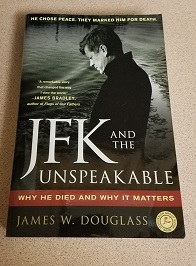
JFK and the Unspeakable: Why He Died and Why it Matters: James W. Douglass

20180603_134919Recently, I re-watched President Kennedy’s peace speech at American University on June 10, 1963.  The speech is considered to be one of Kennedy’s shining moments.  In the speech, he called for a new vision of peace in the face of the escalating conflict in Vietnam and continuing aggression with the Soviet Union and its Cuban ally, Fidel Castro.  Researchers into Kennedy’s administration and his murder have often said that this is the speech that served as the final straw for those surrounding him wishing to have him removed from office.  Tragically, several months later, after this speech, that’s exactly what happened as he was murdered in broad daylight on the streets of Dallas,  Texas.  Two days later, his alleged assassin, Lee Harvey Oswald was also murdered raising more questions that have yet to be answered to this very day.
Today, the murder of a sitting U.S. President seems inconceivable.  The Secret Service, FBI and local law enforcement agencies are expected to do their part to ensure the President has a safe visit to every destination domestic and abroad.  But what happens when the President goes from being seen as the commander-in-chief to an enemy of the state?  When John F. Kennedy assumed the oval office, he inherited several simmering crisis ready to explode a moment’s notice.  Warned by his predecessor about the military industrial complex, Kennedy found himself in the middle of a circle of fanatical cold war veterans hell-bent on the defeat of the Soviet Union and communism at any cost.   Many years after his death we are now able to look back with this incredible book by James W. Douglass, and reexamine the uphill struggle Kennedy faced as he struggled to contain the push of his own generals for military involvement in Cuba, a preemptive strike against the Soviet Union using nuclear weapons and a full-out ground war in Laos and Vietnam. And what we see is treason of the highest order and a crime that truly is unspeakable.

The official story of the U.S. government is that Lee Harvey Oswald, a disgruntled former Marine decided to squeeze off three shots in six seconds as the motorcade made its way through Dealey Plaza with speeds as low as 10 m.p.h.  But to this day, no investigator or investigative committee has been able to figure out one highly important part of the crime-motive.  No motive has ever been disclosed for Lee Harvey Oswald allegedly shooting John F. Kennedy.   But if we do look at motive, there were plenty of others who did have motive and as we make our way through Douglass’ masterpiece, we see that the number of those who bore a grudge against Kennedy was nothing short of staggering.  From the start of his presidency until his final day in Dallas, the resistance and deceptive behavior of subordinates in his cabinet, the military and intelligence communities was beyond belief.  But just who were these people and what exactly was occurring?

Douglass’s exhaustive research efforts shed light on why was opposed to the young leader and why.   Kennedy had averted a nuclear war, begun to seek peace with Cuba,  taken on the steel industry, placed constraints on the  CIA and was wholeheartedly attempting to make a complete withdrawal from Vietnam.   Further, he was pushing forward a platform on civil rights and economic reform and in the process bucking the system in place for decades.  And the result was a hornet’s nest destined to strike.

Following Kennedy’s murder, the investigation into his murder took on a life of its own.  The warning signs had been there in advance, most famously in the story of Rose Cheramie who attempted to warn authorities of the upcoming assassination.  And there’s strong evidence that a man named “Lee” had warned the authorities as well of the events in Dallas but the failed attempt in Chicago several week earlier.   Fake Secret Service agents, two different arrest at the Texas Theater and a night club owner with mafia and CIA ties provides us with a cast of characters complicit in the death of a president. The murder is a web of deceit that becomes more complex as we dive further into the events of that day. But authors such as James Douglass have done a service and made the murder and investigation easier to understand by revealing the cloak of mystery that has shielded Kennedy’s murder for over 50 years.

ISBN-10: 1439193886
ISBN-13: 978-1439193884

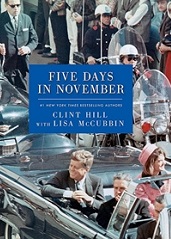
Five Days in November-Clint Hill with Lisa McCubbin

five daysAbraham Zapruder captured a defining and tragic moment in history when his camera recorded the assassination of President John F. Kennedy.  The film was originally locked away by Time Life but was finally released to the public years later as a result of the investigation of Jim Garrison into Kennedy’s murder. The film leaves the view speechless and speaks more than a thousand words.  Next to the gruesome murder of the President, there’s  an iconic sequence that occurs that also remains cemented in the memory of the witnesses in Dealey Plaza that day and the millions others who have repeated watched the film.  As the motorcade speeds toward the triple underpass, a Secret Service agent is seen jumping on to the back of the car as it speeds up to transport the mortally wounded Kennedy to Parkland Hospital.  The agent is Clint Hill, a veteran of the Secret Service who served several presidents during his multi-decade career.  Now 84, he’s become an author over the years, having written a few books, one of which is this account of the fateful trip to Dallas, Texas and the tragedy that ensued.
The book begins on November 21 as the party prepares for the departure to Texas.  Hill shines light on the commotion and last-minute maneuvers that are required to make the trip go as smoothly as possible. We also see the softer side of the President as he embraces his children for the very last time.   And as Air Force One departs for San Antonio, the first stop, no one aboard knows that this is the last trip that they will make with Kennedy.  After receiving a warming welcome at San Antonio, the party is jubilant about the potential to mend political fences in Texas to bolster Kennedy’s chances for reelection in 1964.  The morning of the 22nd starts out on a positive note as the President makes his last speech at the Ft. Worth Chamber of Commerce.  The flight to Dallas is only fifteen minutes and the first couple emerges after landing to a crowd of eager supporters.  The motorcade makes its way through the streets of Dallas and at 12:29 p.m. everything goes dark as the nightmare begins changing history and Hill’s life forever.

As the tragedy unfolds in Dallas, Hill serves as our point man takings us through each development as it happened.  We also get a feel for the emotions and thoughts going through the minds of everyone as they struggle to remained composed in the face of an unspeakable tragedy.  The vivid reality of the chaos in Parkland and later on Air Force One becomes even clearer as Hill takes us through the day and all the way until Kennedy’s body returns to the east coast for the autopsy at Bethesda Naval Hospital and his final placement in the coffin in which he was buried.   Funeral arrangements, the arrival of family and guests combined with the changing of the guard in Washington prove to be heavy tasks on all present and each does their best under the strain.  Up until Kennedy’s final moment before he lowered into the ground, Hill remains a loyal agent and intimate family friend.

Because this book is written by a former agent on Kennedy’s detail, some would expect it to have possible clues as to who might have killed the President.  This is not the case and Hill sticks to the government’s story of Lee Harvey Oswald as the lone gunman.  Whether Hill continues to believe that is beyond the scope of the book and a completely different discussion.  What this book is, is a poignant memoir by a man who remains haunted by those five days in November, 1963.


CIA & The Secret Assassination Files-Jefferson Mobley

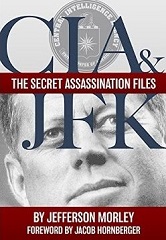
cia jfkOctober, 2017, will mark a turning point in American history.  Pursuant to the JFK Records Act of 1992, all remaining classified files relating to the assassination of President John Kennedy  are slated to be released to the American public.  If no opposition is received from the FBI, CIA or any government agency with a vested interest in the files, more than 3,000 pages of once classified documents will be disclosed more than 50 years after Kennedy’s tragic death on the streets of Dallas, Texas.
While the news of this possible release of thousands of documents is uplifting, it also raises concerns about the U.S. intelligence community and its prior actions under Kennedy’s administration. Researchers of JFK’s murder have long suspected the involvement of the CIA of having a role in the murder.  And although no one at the CIA was ever officially charged or prosecuted for Kennedy’s death, there were many actions of the agency that were not only strange but deeply disturbing.  The House Select Committee on Assassinations served to shed light on the mysterious agency whose cover had been slowly lifted as a result of the Watergate investigation and the failed counterintelligence activities James J. Angleton, arguably the most mysterious figure in CIA history.  The American public learned of the infamous actions of the agency in places such as Nazi Germany, Iraq, Guatemala and Cuba.  The alliance with Italian-American gangsters and the smuggling of arms and ammunition to Cuban rebels opened the eyes of many Americans unaware of the true activities of the secretive agency.  If the documents are released next October, just what exactly could that mean for the CIA and the American public?  Jefferson Morley seeks to answer those questions in this short analysis of the many unanswered questions regarding the CIA and the death of John F. Kennedy.

A study of the assassination produces an endless amount of names, places, times and locations.  Like a never-ending puzzle, it’s a mystery that has grown deeper over time.  But as the layers of complexity have been peeled off, names and faces have been matched putting together crucial pieces of the crime.  Among those faces which are known to long-term investigators, assassination researchers and mentioned in this book are David Morales, David Atlee Phillips, Richard Helms, and the legendary and infamous William Harvey.  While none of the aforementioned were ever charged with any crime relating to Kennedy’s death, their names have come up more than once over the years as suspects who may have taken part in the plan to murder Kennedy or in the actions to cover up the crime.  The documents slated for release contain pages of information relating to most of these complex figures. Morley touches briefly on the lives of these former intelligence legends giving a primer of what could possibly come forth with the release of the once classified records.

The murder of John F. Kennedy continues to haunt the United States and is by far the most infamous murder of a government official in United States history.  To the young generation of America, Kennedy is a remnant of a very distant past, but for older Americans, his death was a turning point in the direction and history of the United States.  Some have speculated that the truth about JFK’s murder would never been known, at least not in this lifetime.  The release of the records in October, 2017 gives hope that the truth may eventually come out and possibly in this lifetime.  And as Morley has pointed out, the CIA may have serious cause for concern.


Retired Dallas Police Chief Jesse Curry reveals his personal JFK Assassination File-Jesse Curry

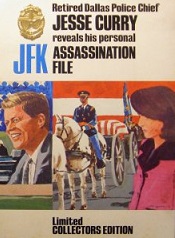
71osgnowlrlChief Curry had been in the lead car of the motorcade making him a crucial eye-witness to the events in Dealey Plaza.  He gave his testimony before the Warren Commission on April 15, 1964.   This limited collector’s edition of Curry’s book reveals the beliefs of the former chief and sheds slight on several interesting parts of the crime that have never been fully explained. Curry is frank and to the point making it clear that the book is not intended to support the Warren Commission’s conclusions or any other conclusions that have been made about the crime.  He further states that it is up to each person to make up their mind on what they think really happened on that day.   Provided in the book are miscellaneous pieces of evidence such as documentation taken off of Oswald, homicide reports and statements of officers of the force regarding the custody of Oswald and the alleged relationship between Jack Ruby and the Dallas Police.
In the years that have passed since the release of Curry’s book, a staggering amount of information has come to light regarding the events of that day.   And what we know now conflicts with some of the statements in Curry’s book.  But whether Curry was unaware of these facts or misstated certain facts is knowledge he took with him to the grave.  In fairness, the book was never intended to be a smoking gun about the crime but rather the recollections of the top office in the Dallas Police at the time.  With that being said, I think it’s a good read and unquestionably relevant to the growing amount of literature regarding the assassination of President John F. Kennedy.

ASIN: B0006CZR8M

Crossfire: The Plot That Killed Kennedy- Jim Marrs

20180603_134850The murder of John F. Kennedy continues to haunt the United States.  Although more than fifty years have passed since that tragic day in Dallas,  the investigation into his murder continues and researchers have not given up hope in finding out the truth surrounding the events in Dealey Plaza.  Allen Dulles once remarked that people don’t read and that most Americans would never read the Warren Commission’s report.  Painfully true, the former director of the CIA’s statement reflects a troubling fact about the investigation in the murder of our 35th President, that many Americans did not read and have not read the commission’s report and accept the story of the lone nut.  However, doubters and critics have increased in number throughout the years and many people have spoken out in regards to the crime of the century.   The assassination has resulted in hundreds of thousands of pages of documents, dozens of books, articles, websites and documentaries.   But the question that is always asked, is where to start?

To say that the murder of John F. Kennedy was a crime on a massive scale is an understatement.   To understand just what happened on that day in November, 1963, it is necessary to comprehend the entire crime from start to finish.  Jim Marrs, a former journalist and resident of Dallas at the time of the murder, has given to us what is the definitive book on the assassination and investigation that followed.  And to this day it has stood the test of time as a masterpiece of investigative journalism.  Not only was it a  New York Times bestseller but it also served as the basis for Oliver Stone’s ‘JFK’.

But what really happened on November 22, 1963?  The government’s position on the crime seemed simple enough at first; a former Marine who embrace communism that fired three shots with a bolt-action rifle killing the President and wounding Governor John Connally.  But when one digs deeper into the crime and reads through this encyclopedic account of what was really happening in Dallas and Washington, a dark and uglier truth begins to emerge that shows the government in a completely different light.   One thing I’d like to point out is that as exceptional as this book is, it is not exactly a smoking gun, no book on the crime is. And as Marrs points out towards in the end of the book, it’s more likely that we’ll never know how pulled the triggers in Dealey Plaza that day.  We may also never know who really shot JFK and J.D. Tippitt and what Jack Ruby’s true role was in the plot.  And many questions about Oswald’s life and mysterious periods of unexplained travel domestic and abroad will never be answered fully.  Almost all of the major figures in the book are now deceased. However, what you will find in this book, is why he was murdered and who was most likely responsible and profited from Kennedy’s death.

For some of us who consider ourselves patriots of the highest order, it may be tempting to dismiss Marrs as another crack pot conspiracy theorist. But I assure you that as you make your way though this book, many disturbing truths will come to light that will force you to question everything you thought you knew about the crime.   The amount of research that went into this book is staggering and at first glance overwhelming.  But as you make it through the book, your knowledge of the crime will expand exponentially and by the end of it, I believe you will have a clearer picture of what was really happening in the United States on November 22, 1963.   Some people may read this book and feel that Oswald is still the lone trigger man.  But others will begin to think and ask if the murders of John F. Kennedy, Lee Harvey Oswald and J.D. Tippitt were random acts of violence or murders connected in a web of deceit that resulted in one of the worst crimes in the history of this nation.

ISBN-10: 0465031803
ISBN-13: 978-0465031801


The Man Who Killed Kennedy: The Case Against LBJ-Roger Stone with Mike Colapietro

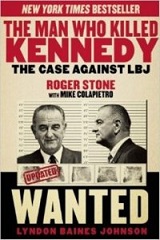
lbj kennedy deadOn November 22, 1963, a shift of government occurred in the United States that permanently altered the course of history taken by this nation.  Aboard Air Force One, Lyndon Baines Johnson is sworn in as the 36th President of the United States following the assassination of John F. Kennedy in Dallas, Texas.  Rumors and speculation about the alleged assassin, Lee Harvey Oswald and possible conspirators, began to grow exponentially following Oswald’s arrest.  And after Oswald’s murder at the hands of Jack Ruby on Sunday, November 24, the nature of the crime took a darker and more sinister turn.  The murders of the President, Lee Harvey Oswald and Dallas Polices Officer J.D. Tippitt, transfixed the nation and resembled events often seen in nations thought of as nothing more than Banana Republics. And Kennedy’s murder is considered by many, to this day, to be the most notorious crime and unsolved murder in American history.
The question has been asked more than once if we will ever know the truth about Dallas.  Some believe we are inching closer while others feel that the crime is so complex that no one will be able to put all of the pieces together.  However, what is clear, is that the murder was a concerted effort among an unknown number of individuals and groups, all benefiting from the removal of John F. Kennedy from office.  The official story is that a lone nut with a cheap Manlicher Carcano rifle executed Kennedy with three shots from the Texas School Book Depository.  In 1976, the House Select Committee on Assassinations found a “probable” conspiracy in the murders of John F. Kennedy and Dr. Martin Luther King, Jr.  Both murders continue to raise suspicion as the truth about the events on each day are still shrouded in mystery.

Similar to a jigsaw puzzle with thousand of pieces, Kennedy’s murder has produced a staggering amount of possible conspirators.  Intelligence agencies, Cuban exiles, mobsters and politicians are among the endless number of suspects.  On nearly every list of suspects that I’ve seen in books and articles on the assassination, one name continues to stand out, Lyndon Baines Johnson.   Many readers will have a knee jerk reaction at the thought that anyone would accuse the former President of murdering his own Commander-in-Chief.   But when we take a closer look at the life of LBJ and his rise to power, many dark and disturbing actions come to light showing the true nature of our former President.

This book is Roger Stone and Mike Colapietro’s indictment of Lyndon Baines Johnson for the murder of John F. Kennedy.  No stranger to politics, Stone worked closely with another former President, Richard Nixon has as keen grasp on dirty side of the political spectrum.   The reader may be tempted to dismiss the duo as crackpots out to smear the legacy of Johnson but I caution the reader to have an open mind and cross-reference what’s in the book.  What you will find just might shock you to the core.   And once you’ve finished this, I highly recommend David Talbot’s ‘Brothers: The Hidden History of the Kenned Years‘, ‘The Devil’s Chessboard‘ and Seymour Hersh’s ‘ The Dark Side of Camelot‘.

All of the usual suspects known to be associated with LBJ make an appearance such as  Malcolm “Mac” Wallace, Billy Sol Estes and Bobby Baker.  The murders of Doug Kinser, Josefa Johnson, Henry Marshall and Sam Smithwick are examined as well as the 1948 election against Coke Stevenson.  The tragedies of Vietnam and the USS Liberty are also revisited.  Fidel Castro once remarked that history would absolve him.  In the final analysis, was LBJ a champion of civil rights and defender of the US against communist aggression? Or was he a power-hungry lunatic, bent of starting war with help defense contractors get rich and the murderer of John Fitzgerald Kennedy?  You be the judge.


JFK Has Been Shot: A Parkland Hospital Surgeon Speaks Out-Charles Crenshaw, M.D.

51goclba5il-_sx303_bo1204203200_On November 22, 1963, Charles Crenshaw was a resident surgeon working at Parkland Hospital when President John F. Kennedy arrived mortally wounded following an ambush in Dealey Plaza.  Crenshaw, along with many other physicians that day, relied upon all of their medical training in an effort to save the President’s life.  Following Kennedy’s death, rumors, misstatements and mystery began to surround the events that took place inside Trauma Room 1 that day and two days later in Trauma Room 2, when Lee Harvey Oswald arrived after being fatally wounded by Dallas nightclub owner Jack Ruby in the basement of the Dallas County jail.

For many years after the events of that horrific weekend in November, 1963, a majority of the doctors remained silent about what they saw that day and their role in the treatment administered to the dying President.  Crenshaw, in direct rejection of an order given by then head surgeon Charles Baxter, decided to write his account of his role that day and published the first version of this book then titled ‘JFK: Conspiracy of Silence’ which has been revised and renamed to the current title.  Dr. Crenshaw’s memoir takes us back in time into Trauma Room 1 and the arrival of the Presidential motorcade.  The recollections are gritty and unrelenting and through his words we are able to visualize the massive wounds sustained by John F. Kennedy and Gov. John Connally and the desperate attempts of the hospital staff to save JFK and the successful effort that saved the life of Gov. Connally.    He also recalls the often overlooked extensive treatment given to the alleged assassin Lee Harvey Oswald, two days later on Nov. 24.

This book, which became a #1 bestseller upon its release, is an invaluable piece of literature about one of the darkest days in American history where the government and direction of this nation changed course.   The doctors at Parkland Hospital faced insurmountable tasks that weekend in their attempts to save the lives of three men forever joined in history through murder, deception and complicity.  The book also forces us to ask many what if questions, some of which, if they had been answered, would have changed the investigation into the death of the President and his alleged assassin.  For any JFK assassination researcher or just anyone curious about what exactly happened inside Parkland Hospital, this book is a must read.

ASIN: B017MYRDFQ


JFK From Parkland to Bethesda-Vincent Palamara

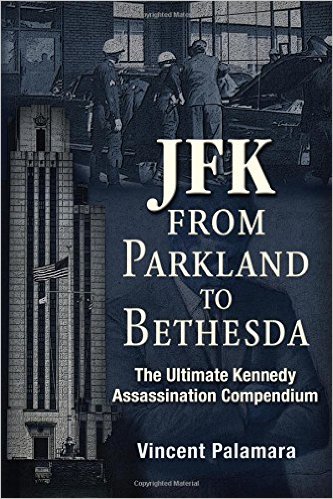
511no8zpqyl-_sx331_bo1204203200_On November 22, 1963, several crimes occurred in the city of Dallas.  The murders of JFK, J.D. Tippitt and Lee Harvey Oswald gripped the nation and dominated news headlines here in America and abroad.  The investigation that followed was intended to be an open and shut case, but when we look back in hindsight, we are able to see that it was anything but.  One of the most disturbing aspects of the crime, is the illegal removal of Kennedy’s body from Parkland Hospital.  Far from standard procedure, the removal violated Texas State Law and raised endless suspicious about the actions of the Secret Service and Lyndon Baines Johnson.  The Warren Commission and its report created more questions and provided fewer answers.   To this day, chilling and horrific details about the handling of Kennedy’s body continue to come to light showing a dark and sinister plot in effect.

Vincent Palamara has composed the ultimate compendium, based on testimony of those involved, as to what occurred regarding the shots in Dealey Plaza, the arrival of the motorcade at Parkland Hospital, the treatment of the President up until his death, the removal of the body, the trip to Bethesda and the controversial autopsy that followed.  Presented in a reference format, the key portions of testimony are provided in an outstanding reference format.  And as we follow Palamara’s chronology, we are able to visualize the horror and anguish that gripped the halls of Parkland Hospital.  The Zapruder film showed the public the devastating head wound suffered by Kennedy and the aftermath that followed in the motorcade.  But it is through the testimony of  doctors that we can began to truly understand the violent and gory death that Kennedy suffered.  And even more disturbing is the secretive and deceptive transport of Kennedy’s body to Bethesda Naval Hospital, a later change from the intended Walter Reed Hospital.   The true gift of this book is not that Palamara is writing his own opinions, but that the details we learn come directly from those who were there.  And through their words, that the true horror of that day comes to us refusing to leave.

ISBN-10: 1634240278
ISBN-13: 978-1634240277

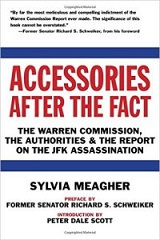
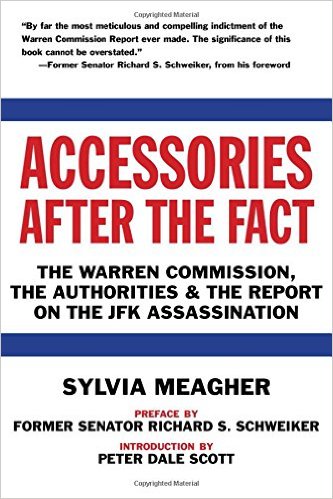
Accessories After The Fact: The Warren Commission, The Authorities & The Report On The JFK Assassination-Sylvia Meagher

51dhdvrotvl-_sx331_bo1204203200_

Sixty years have passed since the assassination of President John F. Kennedy (1917-1963) in Dallas, Texas on November 22, 1963. Public opinion in regard to the Warren Commission’s report has continued to shift, with a majority of Americans disapproving of its conclusions. Over time, the National Archives has released more documents relating to Kennedy’s murder, but there are still important materials that remain classified. When taken at face value, the Commission’s report seems to provide an open and shut case; three bullets fired by a lone deranged gunman from his sniper’s position on the sixth floor at the former Texas School Book Depository building. But upon closer examination, it becomes clear that there are unanswered questions and troubling aspects of the official investigation which have never been explained.

The biggest issue with the Warren Commission’s report is the lack of a usable index. This inadequacy combined with contradictions and other unnerving aspects, convinced the late Sylvia Meagher (1921-1989), that action was needed. As she read the report and its supporting volumes, she could not ignore the growing belief inside of her that the official story was not true. This book is her dissection of the Commission’s report, paying close focus on the case against Oswald and the story put forth by the Dallas Police Department. To be clear, there is no smoking gun and Meagher does suggest who might have pulled the trigger. She does, however, stick to the evidence which results in hair-raising questions about what really happened that day.

Officially, the U.S. Government has maintained that Lee Harvey Oswald (1939-1963)  fired three shots from a bolt-action Mannlicher Carcano rifle in six seconds, fatally wounding Kennedy and seriously wounding Texas Governor John Connally (1917-1993). Incredibly, it is claimed that one bullet struck both, inflicting multiple non-fatal wounds. This “single bullet” theory has been the foundation of the Commission’s conclusion that Oswald was the lone gunman. But the question remains, if no one saw Oswald pull the trigger or on the sixth floor at the time of the assassination, then who did? Skeptics of Meagher will say that Oswald purchased the rifle, brought it to work, assembled it before killing Kennedy and decided to leave the evidence behind as he “escaped” from the building and boarded a bus then taxi to arrive home in the Oak Cliff section of Dallas. A selling point of his guilt has been that he “fled” from Dealey Plaza and had previously attempted to assassinate ultra right-wing General Edwin Walker (1909-1993). But is that really true? Meagher points out remarkably interesting evidence that does not support that thesis. Further, Oswald’s widow Marina admitted to initially lying to investigators out of her “distrust” of them. Oswald  may have been telling the truth when he said he was a patsy.

The murder of Dallas Police Officer J.D. Tippit (1924-1963) has been used to convince the public that Oswald was cold-blooded murderer who not only killed an officer in the line of duty but also eliminated the head of the U.S. Government. However, like everything else, Tippit’s story is far from open and shut. The author discusses his situation and points out things that raise more questions.  The analysis is thorough and I strongly recommend Joseph McBride’s ‘Into the Nightmare: My Search for the Killers of President John F. Kennedy and Officer J.D. Tippit‘ which provides even more crucial information about Tippit’s life. To date, there is no evidence that proves Tippit was part of a conspiracy to murder Kennedy. However, his movements in the forty-five-minute window prior to his death are highly unusual and have never been fully explained. In fact, his communications with the police dispatcher only add to the mystery.

A major topic of debate has been whether Oswald was on an intelligence mission at the time of the Kennedy’s death. His mother Marguerite Oswald (1907-1981) claimed several years before the assassination that her son was working for U.S. intelligence. At times she has been written off as a crackpot, but when Oswald’s movement’s to and from the Soviet Union are explored, one cannot ignore that his ability to escape the U.S. criminal justice system is nothing short of mind blowing. Meagher revisits his move to the Soviet Union,  attempt to “defect” and provide military secrets to the Russians, and return to the United States with a Soviet wife, and without any criminal prosecution during the infamous Cold War. The story is surreal but was written off by the Commission as ordinary.

Following Kennedy and Tippit’s murders, Oswald was apprehended at the Texas Theater. While he sat in the Dallas County jail, many strange things and people were moving behind the scenes unbeknownst to him. One of these people was Jack Ruby (1911-1967) whose murder of Oswald on November 25, 1963 on live television, sent shockwaves across the globe. Ruby insisted that he was emotional and snapped when murdering Oswald. But his actions that weekend around Dallas and the jail are highly questionable, and Meagher makes sure to take a deep dive into the two days when the world was on edge. One thing that stood out is Ruby’s appearances near the homicide office on the third floor of the jail complex. Further, his access to the basement of the jail preceding Oswald’s murder has always been a murky tale. While it is known that Ruby had scores of officers as friends, none were ever charged with letting him into the jail. But was he “let in” or “allowed in”? The testimony excerpts from Dallas policemen only add to the confusion.

On a final note, Meagher mentions the investigation by former New Orleans District Attorney James “Jim” Garrison (1921-1992). His case, which was both groundbreaking and problematic, is a topic for a whole other discussion. However, Meagher does point out something in regard to the Warren Commission report’s role in Garrison’s case which I had not noticed previously. And as I read her words, I had to scratch my head in disbelief. On January 14, 1989, Meagher died at the age of 67 at St. Vincent’s Hospital in New York City from complications of the flu.  Had she lived, I believe she would have been thrilled to see Oliver Stone’s ‘JFK’, the film which renewed public interest, resulted in the JFK Assassination Records  Collection Act of 1992 and supported Garrison’s belief that rogue elements of the intelligence community played a role in Kennedy’s death. Stone’s film is solid, but Garrison and his investigation were far more complicated. The case against Clay L. Shaw (1913-1974) was weak but Garrison did succeed in opening the door for more analysis of the crime. The investigation into the events in Dealey Plaza is far from over and the search for truth as to who killed John F. Kennedy continues. And this tool can help guide the way.

ASIN‏ :‎ B00E25IM6S