
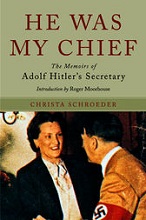
 Recently, I reviewed the memoir of Traudl Junge (1920-2002) who served as one of Adolf Hitler’s (1889-1945) secretaries during World War II. Her book, Hitler’s Last Secretary is highly regarded as an intimate account of what Hitler was like behind closed doors. Hers is not the only book written by those who knew Hitler personally but it is undoubtedly one of the most interesting. Another secretary, Christa Schroeder (1908-1984), compiled this memoir about her life under Hitler during the war. And although the book does not reveal anything groundbreaking, it is interesting in its own right.
In comparison to Junge’s account, Schroeder’s also focuses on Hitler but takes a slightly different path in discussions about his association with various women whether friends or more intimate such as the case with Eva Braun (1912-1945). Some may be tempted to write off what she says about Braun as irrelevant gossip but I think she included it because of how Braun eventually became part of Hitler’s story. Schroeder points out in the book that before the end of the war, most people had no idea who Braun was. Hitler never publicly acknowledge being acquainted with any woman and always said that he belonged to Germany. His destiny as he saw it, was to lead the nation on a path of domination over Europe and if possible, the rest of the world. However, even Hitler had a softer side and it is clearly evident here. One subject that does come up which is still not completely understood is the suicide of his niece Angela Maria “Geli” Raubal (1908-1931). Her death just might be the critical piece of the puzzle in understanding Hitler’s future interactions with the opposite sex.
We do learn from Schroeder, that Hitler had a quite unusual relationship with his family. Today we would call it estranged and the author elaborates on the matter as follows:
“Hitler had no sense of family. His sister Paula was quite a few years younger than he was. She was a quiet, shy child and he had no great opinion of her. It may have been for the difference in their ages that he shut her out of his life. Paula lived in Vienna until the end of the Second World War, and then in Berchtesgaden until her death.”
I took notice of the irony that the most powerful man in Nazi Germany who professed never ending love for the fatherland, barely associated with his own family members. The revelation sets the stage for a Wizard of Oz type scenario in which we see the man behind the curtain. And the picture that is formed is of a person who was often at odds with nearly everything in society except his dog Blondie, beloved apple pie desserts and world domination.
Traudl Junge’s memoir is far more extensive mainly for the reason that she decided to include her life before Hitler in the book. Schroeder takes a different approach and makes no mention of childhood or life in Germany prior to joining Hitler. Readers that might be expecting a discussion of the rise of the Nazi party and Germany life prior to 1933, will not find much of it here. However, she does keep the narrative streamlined and the focus remains of the man who was her chief. She points of notable descriptions of his physique and mannerisms, some of which have been discusses elsewhere. Hitler’s trembling left hand enters the story as well as the role of the physician Theodor Morell (1886-1948). High-ranking members of the Reich and physicians were leery of Morrell and even went as far to advise Hitler of his physician’s ineptitude. Schroeder points out that:
“Dr. Brandt and Dr. Hasselbach explained to Hitler that the trembling of his left hand and gradual loss of vision were the result of the poisons in the anti-flatulence pills and that it was irresponsible of Dr. Morell to have made them freely available to be eaten like sweets.”
The subject of Hitler’s reliance on drugs is well-documented and it is widely known that before his famous meeting with Benito Mussolini (1883-1945) on July 20, 1944, Hitler had received one of Morrell’s “cocktails”. It is reported that Hitler raved non-stop for several hours. The chief was a physical and nervous wreck but remained determined to see a German victory even in the face of a clear defeat. Schroeder makes note of his changing mood and the atmosphere as the tide of the war changed and the Allies made steady progress towards Berlin. And in what could be described as surreal, the band played on.
Schroeder was given orders by Hitler to leave the bunker on April 20, 1945, and did not see what transpired in the bunker as the situation became dire and those who could leave did. Hitler refused to leave and Schroeder recalls Hitler phoning the secretaries as they were packing to depart. In the twelve years she worked for him, this was the only time that she recalled him ever using the phone to contact his secretaries. It was clear at this point that Berlin was beyond hope. Schroeder did not make it out of Germany but was instead taken into custody by Allied forces in May, 1945. On May 22, 1945, she was interviewed by Erich Albrecht, an officer of the US Counter-Intelligence Corp and the transcript is provided at the end of the book. There are no smoking guns in her answers but what I did notice was missing from the entire book was a discussion about the infamous Final Solution.
Christa Schroeder makes no mention of the Final Solution. There are no references to any camps. Unlike Traudl Junge who does acknowledge that they should have known what happening to the Jews, Schroeder says nothing. I do find it incredibly hard to believe that as Hitler’s secretary, she was unaware of what was happening to the Jews across Germany. While her position at one of Hitler’s secretaries would have isolated her from many things, the Final Solution was not a state secret. There were those who knew and many of them indeed. We will never know exactly how much she knew as she took with her to the grave, all knowledge she had about her years working for Hitler. Had she made a statement on the Final Solution and showed remorse, I believe that this book would be of more value. Sure, the book reveals a lot about Hitler but it stays completely away from his darkest fantasy, the idea of racial purity and the removal of all non-Aryan people from German society. It seems as if Germany’s darkest deed during the war was not important enough to merit even a comment in the author’s words. Schroeder is long gone but I am inclined to believe that she knew far more than she was willing to admit to and preferred to keep things close to the chest.
The number of books written about Adolf Hitler are numerous with some having much higher value than others naturally. Christa Schroeder’s account joins that group and while there is much value in what she says, there are also many questions regarding what she did not say.
ASIN : B00CBJXZA0
 January 30, 1933 – Adolf Hitler (1889-1945) becomes Chancellor of Germany and his National Socialist German Workers’ Party becomes the dominant political party in Germany. As Hitler marched through the streets of Germany under the banner of the Third Reich, millions of Germans watched the history unfolding before them with both anticipation and apprehension. Among them was a young Germany boy named Hans-Jürgen Massaquoi (1926-2013), who was born to a Liberian father and German mother. Over the next twelve years, he witnessed the transformation of German society in a bastion of racial ideology founded on Hitler’s unrelenting thirst for world conquest. This is the story of his life growing up black in Nazi Germany.
 On April 30, 1945, the Soviet Union Red Army, had reached within several blocks of the Reich Chancellory. Realizing that their fates were sealed, Reich Chancellery Adolf Hitler (1889-1945) and Eva Braun (1912-1945) took their own lives instead of risking capture by Allied forces. Over the next two days, those who had chosen to remain with them in the underground bunker made their way to surface and attempted to flee Berlin. Among them was one of Hitler’s personal secretaries, Gertraud “Traudl” Junge (1920-2002). As a close assistant to the Führer, she found herself in a unique position to observe the daily routine of one of the most powerful men in world history. This is her memoir of the time she spent with the man who lit the spark for the second world war.
 Learning one’s family history can be an enlightening and liberating experience. However, it can also reveal many truths that some wish to remain hidden. So what happens when you discover that your grandfather, the younger brother of a key architect in the “Final Solution” was not as innocent as you have been led to believe? Well, that is what happened to Katrin Himmler, whose grandfather Ernst Himmler (1905-1945), was the younger brother of Schutzstaffel Reichsführer Heinrich Himmler (1900-1945). Himmler’s father had asked her to search the Federal Archives in Berlin for information on his father Ernst and what she discovered was a trove of information not just on her grandfather, but on her uncles Heinrich and Gebhard Himmler (1898-1982). What started out as simple research request, evolved into the family history contained within the pages of this eye-opening account of the Himmler story.
 On June 6, 1944, American, British and Canadian troops stormed the beaches at Normandy, France and commenced an ground war against Nazi Germany. The European Theatre was marked by brutal fighting that saw high numbers of casualties on all sides of the conflict. In the end, Nazi Germany fell to allied forces and accepted an unconditional surrender on May 8, 1945, commonly known as VE Day. The Japanese military continued to fight and remained defiant until two atomic bombs forced it too into surrending to Allied forces. VJ Day marked the end to World War II and the world breathed a sign of relief. For the United States Army, the European Theatre was a hard fought campaign that no one ever wanted to see again. Author Stephen Ambrose has composed a breathtaking account of the Army’s mission from the beaches at Normandy until the Allies seized Berlin in May, 1945.
 A colleague gave me this book as a gift during the holiday season, mainly due to his knowledge of my fondness for history. I quickly made a mental note to give it a read in the near future. When I saw the title, I was slightly puzzled at the term “The Forgotten 500”. I have read books on World War II but none mentioned any 500 forgotten soldiers. Upon closer inspection, I soon began to realize why I had not heard the story. At the time the mission occurred, it was carefully hidden by the State Department and Office of Strategic Services who did not wish to jeopardize the lives of any remaining U.S. soldiers still trapped behind enemy lines. Further, in the years that followed, the the story faded into the annals of military history regarding the second world war. Even my father, who is an ardent World War II buff, has never mentioned this story. Our next discussion will certainly be interesting.
 A few days ago I was browsing recommendations on Amazon and came across this book whose title caught my attention. I have not read anything on Nazi Germany in quite some time so I decided to take a closer look. I was unaware of Hans Baur (1897-1995) and his relationship with Adolf Hitler (1889-1945). As the Fuhrer’s pilot, I knew Baur would have very intimate knowledge of Hitler’s life behind the scenes and the book does not disappoint. However, it should be noted that it is really Baur’s story with Hitler filling many of the pages for obvious reasons. The story is interesting but I could not help feel that Baur left many things out. Readers may also feel the same way for reasons that will be discussed below.
 On April 30, 1945, Adolf Hitler fatally shot his wife Eva Braun and then turned the gun on himself as it became evidently clear that allied forces were closing on the führerbunker. The fear of falling into Russian hands and a subsequent trial for war crimes proved to be too much for the top echelon of the Third Reich that remained in Berlin. Many top-ranking officials had previously fled and others had left Germany after realizing that all hope for a victory in the war had been lost. As allied forces move in and occupied the country, the true horrors of the Nazi reign became clear and soldiers were faced with the grim discoveries of concentration camps, emaciated and dead prisoners. The Final Solution had been revealed for the entire world to see. In the aftermath of the war, several hundred Nazi party members were executed by allied forces. Others were acquitted or had their death sentences commuted to long-term imprisonment. Another group consisting of scientists and doctors, found their way to America with the help of the United States Government in what became known as Operation Paperclip. Their story is the focus of this incredible book by author Annie Jacobsen.
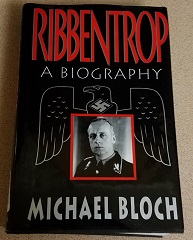 On September 1, 1939, the Second World War began as the German army invaded Poland as part of Adolf Hitler’s quest for world domination. Britain had warned Germany that any military action against Poland would result in England coming to the aid of its ally. Interestingly, Adolf Hitler (1889-1945) did not want to go to war with England, preferring to accomplish the annexation of Poland through diplomatic methods after having successfully partitioned Czechoslovakia in what is infamously referred to as the “appeasement at Munich”. But if Hitler did not want to wage war against Britain, knowing their intention to save Poland, then why did he give approval to the invasion that plunged the world into a major conflict? The answer to that question lies in the story of his Foreign Minister and Nuremberg defendant, Ulrich Friedrich Wilhelm Joachim von Ribbentrop (1893-1946).
 On September 1, 1939, Adolf Hitler’s Third Reich invaded Poland and started the Second World War. In violation of the terms of the Treaty of Versailles, Germany had rearmed itself and under the determination of Hitler, set its eyes upon conquering all of Europe. The looming threat of German domination had been lingering for quite some time before the outbreak of the war. But sadly, many of the nations that would later be opposed to Germany did not think that Hitler would be brazen enough or have the resources to initiate a world conflict. In hindsight, we know that way of thinking was short-sighted and later highly regrettable. The actions of the British government in response to Hitler’s annexation of Czechoslovakia, resulted in the condemnation of Prime Minister Neville Chamberlain and established Germany as a legitimate threat to world peace. The episode has been recalled in history books and documentaries and continues to provoke discussion about how Hitler could have been stopped before his army invaded neighboring Poland.

You must be logged in to post a comment.