The History of Puerto Rico: From the Spanish Discovery to the American Occupation – Rudolph Adams Van Middeldyk


91zChcroMlL._SR500,500_If you have visited the Caribbean island of Puerto Rico, then you know very well why it is called the “Island of Enchantment”.   It has a mystical feel to it and attracts thousands of tourist everyday.   The presence of the United States is found across the island, reminding the visitor of the territory’s status as a commonwealth.  Regardless, Old San Juan is like a step back in time several hundred years earlier as European explorers under the command of Christopher Columbus (1451-1506) make their way to the new world.  The history of Puerto Rico is often misunderstood or unknown.  The American occupation and the  events that followed still ring fresh in the minds of Puerto Ricans both on the island and across the continental United States.  But for a large number of people, the history of Puerto Rico prior to American intervention is often a mystery.  This book by Rudolph Adams Van Middeldyk addresses that very topic, providing a true history of how Puerto Rico came into existence and why it ended up in the possession of the United States.

The story begins in 1493 as Columbus and his entourage makes another journey to the Caribbean at the service of the Spanish monarchy.  Gold, spices and human labor are on the list of items to obtain as Spain seeks to expand its global influence.  However, Columbus had bigger plans and does not stay on the island long. In fact, he is only mentioned early in the story before departing for Hispaniola where he would establish Santo Domingo.  Other figures take prominence such as Juan Ponce de León (1474-1521), whom the town in the southern part of the island is named after.  There are many players active in the story, each with their own agenda and claim to a stake in a part of the new territory.  Ponce establishes a capital named Capárra from which he served the Spanish Government.  But his tenure is short lived as Columbus’ son Diego (1479-1526) embraces chicanery and Ponce decides to continue exploring resulting in his discovery of new territory that he names Florida.

Ponce’s actions are literally the tip of the iceberg.  As the new settlers move in, the fate of the island population is sealed.  Murder, rape, pillage disease mixed into a deadly brew that systematically erased the native population, some of which had already been enslaved and sent to Europe. Here we learn of the tragic story of the Boriquén population which does not exist today.  They are often referred to as the Tainos, which apparently is a name that might have been given to them by the Europeans.  The Caribs are also mentioned in the book providing a better understanding of their culture and the clash between the natives and the explorers.   The natives do stand idly by  waiting to be extinguished. Revolts take place and the author details them in the book.

Spain had become alarmed by what was happening to the native population and dispatched the Jerome Friars to attend to the island. Ordinances were passed to protect the natives’ lives and prevent their eradication but too much had taken place for too long. When the Friars arrived, the island was split in two with capitals in the north and south.  The southern capital of San German and its dark fate are discussed here in depth.  Visitors to modern day San German will take high interest in this part of the book.   Needless to say, it is quite a story and shows how close Puerto Rico came to being under the rule of several different empires.

Similar to the West Indies and South America, the French, British and Dutch empires all make an appearance as they steal territory from one another in an attempt at world domination.  The story of the British is perhaps the most famous and as an American, it is entrenched in the history of the place I call home. However, the focus here is on Puerto Rico and the number of foreign invasions are simply mind-boggling.  And it is a near miracle the the island eventually became a commonwealth of the United States and not territory of a number of nations.  The author discusses in detail each invasion for the reader to digest.

In September, 2017, Hurricane Maria barreled through the Caribbean and damaged Puerto Rico extensively.  Hurricanes are nothing new for the region and the number of those that have occurred over the past several hundred years are staggering.  Middeldyk provides a timeline for the major hurricanes that took place after the founding of Puerto Rico up until the time of U.S. intervention.  History truly does have a way of repeating itself.

Towards the end of the book, I did feel as if the author had strayed a bit off topic.  He asserts his own beliefs about the characteristics of some groups which could be viewed as prejudiced.  I did feel as if he made several judgments which were quite broad and unfounded.  However, the book was published in 1903, a time in which diversity and acceptance were nearly unheard of.   I do believe that the book has enough value to be of interest without that part included.  But we do not have the ability to go back in time and change his mind.

If you are looking for a quick primer on the history of Puerto Rico prior to commonwealth status, then this book is a good addition. The information is straight forward and clearly presented.   And maybe after finishing the book, you will see why Puerto Ricans say “Yo soy Boricua!”

ASIN: B079R846RP
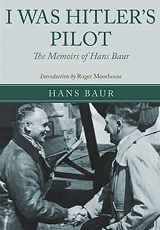
I Was Hitler’s Pilot: The Memoirs of Hans Baur – Hans Baur

baurA few days ago I was browsing recommendations on Amazon and came across this book whose title caught my attention. I have not read anything on Nazi Germany in quite some time so I decided to take a closer look.  I was unaware of Hans Baur (1897-1995) and his relationship with Adolf Hitler (1889-1945).  As the Fuhrer’s pilot, I knew Baur would have very intimate knowledge of Hitler’s life behind the scenes and the book does not disappoint.  However, it should be noted that it is really Baur’s story with Hitler filling many of the pages for obvious reasons.  The story is interesting but I could not help feel that Baur left many things out.  Readers may also feel the same way for reasons that will be discussed below.
Baur begins with his early life but quickly moves forward to his career as a pilot.  It is apparent from the start that he was a very gifted aviator with an extraordinary career.  His recollections about the early days of aviation are fascinating and will remind the reader that flying today is exponentially safer than it once was.   He does not go into too much technical detail but just enough so that anyone can follow along.  He even discusses some monumental moments in aviation including the founding of the German airline Lufthansa.  From a historical standpoint, it is a good summary of the development of air travel in Europe. But by no means is it the only source of information and Baur never implies as much.  He was a devoted pilot and you can feel his love of aviation in his words.  With hundreds of thousand of air miles, the future for him was bright but his entire life changed when he was summoned to appear before Adolf Hitler.

It will be no surprise that at this point in the book, the story picks up pace sharply.  Hitler is no ordinary passenger, but instead the Fuhrer who ruled Germany and began a world war.  Curiously, the image of Hitler given by Baur is in stark contrast to the man who plotted to take over Europe and gave the go ahead for the Final Solution. The Hitler we see here comes across as an affable uncle type character who dotes on his close acquaintances and their children.  In Baur’s defense, his time with Hitler was mainly spent in the air and in private conversation.  And according to his words, Hitler did not discuss future plans for the war with him, typically resulting in Baur finding out major news at the very last minute from someone else working for the Fuhrer.

Because the book is about the Third Reich, there is the elephant in the room regarding the treatment of the Jews.  Baur barely discusses it and only brings it up once in the book.  Without Baur here to answer for himself, it is nearly impossible to say what he believed about Jewish people.   At no point in the book does he display any antisemitism but it is possible that even if he did have those feelings, he would not have stated such in his memoirs.  I was honestly mystified about this and felt that if he was against the Final Solution, he would have made a statement clarifying his position.  But that is simply my opinion.  0Most likely, he had very good reasons to avoid discussing the Final Solution.   This may not satisfy some readers but I caution that the book is still good regardless.

His inside position in Hitler’s circle gave him unrestricted access nearly everywhere and he interacted with all of the major figures of the Reich.  Hermann Goering (1893-1946) and Rudolf Hess (1894-1987) are frequent flyers with Baur, whose criticisms of Goering are quite amusing.  But what is more incredible is that he was present at nearly every major moment in the history of the Reich.  And although he had no military power or responsibilities in planning aerial missions against the Allies, he was a keen observer of the reality facing Germany as it started to become clear that the war would be lost.  Baur is frank in his assessments of those around him and the German war effort.  He confirms what historians have written for years and what many Germans began to realize as the Allies started to make gains and bomb in broad daylight.

In April, 1945, the Allies began to close in on Berlin.  Hitler knew the end was near and had buried himself inside his bunker.  Baur stayed with him until the very end, resisting Hitler’s efforts to send him off.  He provides a detailed account of the final days with Hitler and what happened inside the bunker.  The information he provides can be crossed-referenced and readers will find that it matches with the descriptions given by other authors. However, I believe that the entire dialogue between Baur and Hitler is not provided anywhere else.  As I read this part of the book, I found myself in disbelief at some of the scenes that play out even as the Red Army is only hundreds of yards away.   They are surreal and caused me to wonder if those involved believed they were in a film and waiting for the director to yell cut.

Following Hitler’s death, Baur escapes with several others before falling into Soviet Hands.  The last part of the book is about his time as a prisoner of war being held in Russia.  It was clearly a rough experience and he explains in detail all that happened.  His title and rank resulted in never ending questions and Soviet officers maintained disbelief that he had no knowledge the Reich’s war plans.  After ten hard years, he was released and returned to Germany in a homecoming.  I leave it up to readers to decide whether he was a hero or a war criminal guilty by association.  Yet it is also possible that he was simply Hitler’s pilot.

ASIN: B00FOGG0ZE

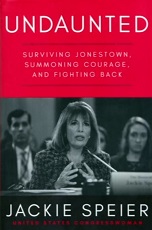
Undaunted: Surviving Jonestown, Summoning Courage, and Fighting Back – Jackie Speier

jspeierForty-one years ago, over nine hundred men, women and children died at the People’s Temple compound in Jonestown, Guyana.  Their charismatic and paranoid leader, Jim Jones (1931-1978), died of a gunshot wound to the head, avoiding the lethal liquid concoction given to a majority of his followers. Disturbingly, many of the deaths were not in fact suicide, but outright murder.  Children and infants were forced to ingest the deadly brew that took their lives in a matter of minutes.  The events of November 18, 1978, concluded the final tragic chapter in Jones’ tyrannical reign.

Earlier in the day on November 18, Congressman Leo Ryan (1925-1978) and a group composed of staff and reporters, were preparing to leave the Jonestown compound with defectors that had come to despise Jones and his lunacy.  Many Temple members knew early on that something was not right about Jones and his continuing descent into madness raised their suspicions and confirmed their belief that they had to leave before it was too late. As the group prepared to board the plane for the short flight to capital of Georgetown, shots rang out on the air strip.  Five people, including Ryan were killed and nine others would seriously wounded.  Among them was Congresswoman Jackie Speier (D-California).  She sustained five bullet wounds but miraculously survived the attack.   Her experience at the Jonestown and the death of Ryan, compelled her to enter a life of politics.  This is her story of Jim Jones, U.S. Politics and all that life has to offer.

I should point out that the book is not solely about Jonestown. In fact, the events there compose only a section in the book.  Readers looking for a more focused discussion Jones and his following will like Tim Reiterman’s Raven: The Untold Story of Rev. Jim Jones and His People. This is primarily a biography but undoubtedly, the attack permanently changed her life, leaving her with physical and emotional scars will never completely heal.   Her early life is typical of the average American girl growing up in the 1950s.  But as she gets older, she comes into her own as a teenager and decides to apply for a position on Ryan’s staff.  To her surprise she is accepted and embarks on a path that would take her all the way to Washington, D.C.

Jones eventually enters the picture as Ryan becomes more concerned with reports filtering in from those desperate to leave Jonestown and others who have already departed.   Jones’ decision to move the People’s Temple, allowed him to evade the eyes of reporters, law enforcement and elected officials. Its remote location in the jungles,  added a valued layer of secrecy that prevent prying eyes from observing Temple activities.  Ryan is determined to see Jonestown for himself and Speier is right by his side to provide legal advice and offer support to those who are determined to leave.  The group eventually arrives in Guyana but is forced to wait several days before being allowed into Jonestown.  Once they are admitted, Speier quickly realizes that there is a dark cloud hovering over the compound and that her group is in grave danger if they continue to stay.  Ryan had seen enough to know that Jonestown was not what Jones had claimed it to be.  The congressman was attacked himself while conducting interviews with various Temple members.  The group’s departure, scheduled for November 18, came a little too late; Jones had made his final descent into the depths of hell.

She recalls the story of her will to survive and the grueling medical treatment she received during her recovery.   Her path was a long process, requiring multiple surgeries and extensive therapy .  However, she never quits and incredibly jumps into politics not long after being discharged from the hospital.  The damage caused by the bullets was extensive and physically she found her herself challenged, but she does her best during her campaigns and success eventually came over time.  All of the highs and lows are discussed, showing the tenacity and devotion of Speier to effecting real change in America.

And as if Jonestown was not enough, her private life is also a roller coaster ride and to say that she has been through a lot would be a severe understatement.  At times, I was literally in shock at everything she has had to endure, even after being shot several times.  Perhaps another person would have broken down for good but Speier does not give up and keeps moving forward even in the face of unrelenting adversity.  Her drive and determination will certainly inspire every reader.  And by the end of the book, you might find yourself in awe of her unwavering spirit and commitment to her beliefs.

The book is a bit short and I wish it had been longer. But in this case, it is quality over quantity.   I truly enjoyed reading it and have a new found understanding and respect for Congresswoman Speier.   Highly recommended.

ASIN: B07GPBS6T2

The War Outside My Window: The Civil War Diary of LeRoy Wiley Gresham 1860-1865 – Janet Elizabeth Croon

CroonI was browsing through recommendations on Amazon when this book caught my attention.  As one would expect, the words Civil War stuck on the cover.  However, the name LeRoy Wiley Gresham (1847-1865) did not sound familiar at all.  My interest peaked and I decided to see why the book had earned a five star rating.  And to say that it is a hidden gem would be an understatement. It is indeed special and the author did a remarkable job of putting it all together.

Janet Elizabeth Croon admits early in the book that she had no idea who Gresham was.  I would wager that a majority of Americans are unaware of him as well. He was never mentioned in any of the history books I studied while in school. Nor is he mentioned in literature regarding the Civil War.  But I firmly believe that this journal is one of the most overlooked accounts of the war from the point of view of the Confederacy.  The story is told from the Gresham family home in Macon, Georgia.  LeRoy is what we would call an invalid, having survived a dangerous accident in 1856 in which his left leg was severely broken by a falling chimney. Following the injury, he developed a dangerous and persistent cough in addition to other symptoms that were later diagnosed as tuberculosis, also known as the “white plague”.  LeRoy is never told of the diagnosis and the journal was written by a young man who did not think death was coming for him until his very last moments.

Readers will notice instantly that Gresham is highly articulate for a young man of his age.  It becomes obvious early on that his mobility is limited and he does not get out often.  However, he is a keen observer of the news and those around him.   His awareness and understanding of the raging conflict between the Union and Confederacy speaks volumes about his level of maturity.   And although he was not always correct in some of his observations, that can partly be attributed to faulty reporting in a time before social media and live news broadcasts.  In fact, news moved so slowly at times, that it could be an entire day or two before information reached its final destination.  Regardless, LeRoy follows the war closely, offering detailed insight into the war’s progression.

As I read through the journal, I did notice that most of his days were actually quite eventful with relatives and friends coming and going constantly.  Games are played,  the weather detailed, various foods eaten and plenty of conversation takes place.   Sadly though, LeRoy’s illness does not let up and he comments on his own physical condition nearly every day.  Readers have the benefit of the doubt in knowing what was wrong with him but he was unaware of his terminal diagnosis.  He mentions old medicinal treatments common during the time and some of the names will be foreign to some readers.  The reports of the war’s battles may also be unfamiliar to those that are not Civil War buffs. But the author provides a ton of invaluable footnotes at the end of the chapter to explain almost everything contained in the journal for each year.  Without these footnotes, the journal would have assuredly been a far more challenging read.

As a Black person, I could not ignore the “elephant in the room”.  LeRoy’s family were slave owners and supporters of the Confederacy under Jefferson Davis (1808-1889). As I started the book, I did feel a bit of uneasiness about what I would find.  I did not find anything extreme in the journal but I did notice he was not averse to using racial terminology that was commonplace at the time, in particular for a slave owning family.  However, he does not lace his journals with it and refers to family slaves by their first names in describing the day’s events.   But I was under no illusions that he believed in the abolitionist movement.  LeRoy believed in the Confederacy and was no fan of Abraham Lincoln (1809-1865), but as the journal progressed, I did notice a few changes in his beliefs that will cause the reader to take notice.   And had he lived, perhaps his views might have changed over the course of time.

The journal only covers between 1860 and 1865, so we do not know all of the details regarding the accident that caused him to break his left leg .  The author explains the accident but LeRoy does not talk of his leg much in the journal. In fact, his back is the main focus in addition to his hacking cough and the abscesses that would plague him as the tuberculosis raged through his body eventually reaching his spine.   As a bonus in the book, the author was able to get a doctor to examine what was known of LeRoy’s medical history, the medications he was taking and the care he received to render the most likely diagnosis.  At the end of the book, the doctor takes a very detailed look at the medications which explain even further exactly what LeRoy’s condition was and why he would have been given them.  Reading the journal did make me grateful for modern medicine.

I strongly advise and recommend that anyone interested in the Civil War to read this book.  It is by no means an authoritative source on the war but it is a very intimate look at the conflict through a very different set of eyes.

ASIN: B07D6QQT77

Sal Mineo: A Biography – Michael Gregg Michaud

SalmIn 1955, Warner Brothers released ‘Rebel Without a Cause’ starring the late film icon James Dean (1931-1955).  And though the film cemented Dean’s legacy in Hollywood, the actor tragically died the month before the film’s release in a violent car crash while en route to Salinas, California.  In death, Dean became the poster boy for the new sense of rebellion sweeping across America.  In the film, he was joined by actress Natalie Wood (1938-1981) who played the role of Judy and Sal Mineo (1939-1976) in the role of Plato.  The film was a hit and is considered a classic.  The enormous success enhanced the careers of the three stars and Mineo quickly became one of Hollywood’s hottest new stars.  The Italian kid from the Bronx had arrived with charming good looks and acting skills to match.   For the next twenty-one years, he would leave his mark on Hollywood and television before his tragic departure on February 12, 1976.  In just thirty-seven years, he had lived what could be considered for some, a lifetime.   I knew of Mineo before reading this book but there was much about his life that I was completely unaware of.  This book came up as a recommendation and I decided to see for myself, why Mineo is still revered.
Author Michael Gregg Michaud presents the story of Mineo’s life, based on meetings with his former lovers, friends and interviews Mineo gave during his career.  The story begins in the borough of the Bronx in New York City where Salvatore, Sr. and Josephine Mineo welcome their youngest son Salvatore, Jr. into the world on January 10, 1932.  As we see in the book, from an early age Mineo was a performer and it was destined that he would later make it to Hollywood.   But before the film industry came calling, he was a young kid in an immigrant family trying to make ends meet in the city that never sleeps.  Michaud takes us back in time to the early 1930s post-depression.  The Mineo family story highlights the challenge faced by many immigrants making a life in America then and even today.  The struggles and successes of Salvatore, Sr., are a prime example of the attainability of the American Dream.   He and his wife do whatever they can for their children and Sal would need and benefit from their never ending support.

The story moves along as a typical biography until Sal is offered a role on Broadway at the age of eleven.  As the roles start to come in, the pace of the book picks up as we follow Sal along his path to stardom. Guided by his mother Josephine, he climbed up the ladder to stardom.  Michaud wisely inserts Sal’s own words which gives the appearance that he is telling the story along with Michaud.   The book does not come off as simply a collection of facts.   By the time Sal made to Hollywood, his life took twists and turns that no one could have ever anticipated.  Michaud covers it all brilliantly and tells Sal’s story in a way that keeps the pace of the book moving just right and at no point did my attention wane nor did I ever feel that Michaud had strayed off track.  The book is focused and stays on point.

One surprise that I did find in the book was the topic of Mineo’s sexuality, of which I had very little prior knowledge.   The revelations are eye-opening and even shocking considering the time period in which Mineo lived. However, he was undoubtedly a free spirit and Michaud captures it in the story.  Readers that are more on the reserved side with regards with sex might find the book a bit of challenge to read.  While there are no graphic details of sex provided, it does feature prominently as Sal matures in manhood.  The idea of normal becomes subjective and it is up to the reader form their own opinion about Sal’s adventures.  I can say that as I read the book I was reminded of the novel ‘Giovanni’s Room‘ by James Baldwin (1924-1987). The author here offers no personal opinion and rightfully remains neutral.  He is simply telling Mineo’s story and does it  showing both the star’s bright side and also his dark side.

As to be expected,  other Hollywood stars make an appearance in the book including Yul Brynner (1920-1985),  Jill Haworth (1945-2011) and Don Johnson.   The story begins in the Bronx, but as Sal moves through life, we follow him to California, France and even London as he searches for the next big project.  There are highs and lows, which show just how difficult it can be in Hollywood to stay relevant.  Michaud addresses Sal’s inability to get work through the words of those who knew Sal best and Mineo’s words on why he believed Hollywood was not knocking on his door.   Today we call it typecasting and it is a vicious cycle many actors work hard to avoid.

As we approach 1976,  you can feel that something is about to change in Sal’s life.  His casting in ‘P.S. Your Cat is Dead‘ after two prior auditions brightened his spirits. On February 12, that spirit was dimmed when the lives of Sal Mineo and Lionel Williams intersected and changed history.  Michaud discusses the crime, the investigation and the trial that followed.  However, it is not an exhausted analysis of the legal proceedings but rather a summary of what happened after Sal’s death with regards to the law and his family.   The encounters between Sal’s family and Courtney Burr are tense and telling.  Mineo was quite open about his sexuality and Burr had an intimate role in Sal’s life.  But incredibly, Mineo was never officially “out of the closet” .  And he was not the only star with a voracious sexual appetite as many of us know.  The tales of Hollywood sexual scandals are endless.  And I think back to my father who has always said “they don’t call it tinsel town for nothing son”.  Sal was free, open and lived with no regrets.  That is a lot more than many of us can say for our own lives at times.

Michael G. Michaud has written what I believe is the definitive biography of Sal Mineo.  It is an incredible story with a sad ending.   A star was taken too soon but this book ensures that along with his films and television appearances, that Sal Mineo is never forgotten.  Had he lived, we can only guess as to where his career would have taken him.  But regardless, he was and is still considered one of the greats from a pivotal time in the history of Hollywood.  He is gone but certainly not forgotten. Great book.

ASIN: B003F3PMN4

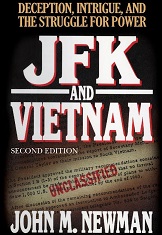
JFK & Vietnam: Deception, Intrigue, and the Struggle for Power – John M. Newman

Newman JFK Vietnam March 29, 2019, marked the forty-six anniversary of the departure of the last remaining United States troops in South Vietnam.  Two years after their departure,on April 30, 1975, Siagon fell to North Vietnamese forces as Hanoi tightened its grip around the country.  By the time the war ended, fifty-eight thousand American soldiers had lost their lives in Vietnam.  North Vietnamese Army and Viet Cong losses were estimated to be well over one million.  Civilian deaths were even higher in number but despite the large numbers of casualties, North Vietnam refused to surrender and was determined to achieve reunification.  The withdrawal of American troops was a sobering reality and cold hard truth:  the American effort in Southeast Asia had not succeeded.   To this day, there are many people who still wonder how and why the United States became entangled in Vietnam.   The defeat of French forces at Dien Bien Phu in 1954 should have served as a reminder that military might is not always a guarantee of success.  In January, 1960, President John F. Kennedy (1917-1963) took office and from the beginning of his administration until his death, the issue of Vietnam continued to fester like an open sore. Kennedy died before he could implement any further plans regarding Vietnam and took many secrets with him to his grave.  But declassified documents and political memoirs shed much light on what was really happening in his administration as it grappled to combat the growing Viet Cong menace.
Author John M. Newman is currently in the middle of a multi-volume set regarding Kennedy’s murder. I have reviewed three of them so far and eagerly await the publication of the next volume.  The books are incredible and the amount of information Newman provides is nothing short of staggering.  But as we see here, he a long time player in the game and in 1992, this masterpiece was released.  If you have seen the film ‘JFK’ by Oliver Stone, you will recall the scene where Jim Garrison (Kevin Costner) meets the character who calls himself “X” (Donald Sutherland).   What many viewers may not know is that Newman helped Stone create those scenes.  His research served as the basis for the dialogue between the two as X enlightens Garrison to many dark secrets surrounding Kennedy’s plans on Vietnam.  The scenes are moving but do not come close to telling the entire story.  This book however, does that and more and should be on the bookshelf of any reader who has an interest in the Vietnam War and in particular, its origins.

Newman takes us back to 1961 as the Kennedy Administration is recovering in the wake of the Bay of Pigs debacle.  The seeds of distrust had been sown and when the Joint Chiefs of Staff began to press him on Laos, Kennedy was wise to the game.  But the generals had a backup plan and if Kennedy would not go into Laos, then Vietnam was next on the list.  However, the generals had a tough road ahead and knew that the young president would not give in easily to their demands.  As a result a pattern of deception developed and before long Kennedy and his own administration were at odds over American foreign policy in Saigon.   The depth of that deception will surely surprise many and still has me shaking my head in disbelief.   I had been aware of many facts in the book but Newman brings even more to light.

The book is exhaustively researched and the information contained within it will cause shock and anger.  But what I liked the most about the book is while Newman makes the case for what Kennedy was thinking about Vietnam at the time of his death, he is also frank about where Kennedy made mistakes that helped contribute to an already precarious situation.  In all fairness to Kennedy, he never had the opportunity to defend himself regarding his decisions on Vietnam.  But the paper trial he left behind, shows definitive actions he took and intended to take as he grappled with South Vietnam and a cabinet that had split down the middle.

The key to understanding how the deception started is to understand how intelligence was being gathered in Southeast Asia.  Newman breaks down the various divisions in military command and the role of the Central Intelligence Agency (CIA).  Kennedy’s advisors are also on the hook and the actions of several of them add even more shock value to an already incredibly eye-opening account.  The realization that members of  his administration were deeply divided and at odds with each other, hovers like a dark cloud over the story as the crisis in South Vietnam unfolds.  All of the members of his administration are now deceased and we can only wonder as to why they committed some of the actions that they did.

No book about Vietnam would be complete without a discussion of Ngo Dinh Diem and his brother Ngo Dinh Nhu.  Both played a critical role in the development of the war and Newman provides a thorough explanation as to why the brothers were important to American success in Vietnam and where they went terribly wrong. The coup that resulted in their deaths, changed the course of history and gave the war a new face.  A few weeks after their assassinations, Kennedy himself was assassinated.  And although there is no proven link between the two events, actions of several figures in high positions in the time period between the two murders are quite suspicious and will surely cause readers to take notice.

Without giving away too much information, I would like to say that readers will benefit by paying close attention to the National Security Action Memos (NSAMs) signed by Kennedy regarding his policy on Vietnam.  They speak volumes and should paint a clearer picture of the forces he was up against.   National Security Actions Memos 55, 56, 57 and 111 are pivotal for they directly addressed many of the pressing issues Kennedy was facing at home and abroad.  The author discusses each so that the reader can easily understand the many nefarious elements that had been influencing foreign policy in some of the most scrupulous of ways.

Seasoned readers might be wondering where Lyndon Johnson fits into the story.  His role is covered here and the suspicious actions on his part are paid close attention to.  The war escalated greatly under his administration but we can only wonder how much Johnson knew and Kennedy did not.  Newman does not discuss any Kennedy assassination theories or give any attention to any suggestions of LBJ being complicit in the crime.  But what he does show is that the vice president certainly had an agenda of his own and it would be shown after the events in Dallas.  National Security Action Memo 263 is one of the book’s most critical moments and readers should pay extremely close attention to this part of the story that highlights the stark differences between the late and sitting presidents and their views on the raging conflict in South Vietnam.

A common question I have heard from Vietnam veterans and others who lived through the war is why were Americans being sent 13,000 miles away from home to fight a war against a country many of them had never heard of?   It is a critical question and I believe that Newman has many of the answers they seek.  By no means is the book a complete account of the war. In fact, I believe a better overall account of the entire conflict would the best-selling ” The Pentagon Papers: The Secret History of the Vietnam War“.   The authors there discussed Kennedy’s administration but concluded that they could not say for sure what Kennedy would have done regarding Vietnam due to his assassination in Dallas.  Newman takes it further and I believe that he clears up much of the mystery surrounding Kennedy’s record on Southeast Asia.

Many years have passed since the Vietnam War ended but for millions of veterans, the wounds and dark memories remain.  Some were sent to Vietnam not yet twenty years of age to a foreign country in which death was prevalent.  They watched their friends die in gruesome manners and were exposed to the horrors of war in a conflict that did not seem to have an endgame.  North Vietnam and the Viet Cong showed Washington that it would not be an “easy” war.  Hanoi was determined to succeed in unifying the country and no amount of United States pressure or troops would change that mission.  In the end, Hanoi did succeed and America was left to wonder what went wrong.   As we move forward as a nation, let us not forget the tragedy of Vietnam which serves as an example of the dangers of misguided and intentionally deceitful foreign policy that changes nations and history.  Newman absolutely nailed the subject in this incredible book that will surely satisfy anyone who decides to open it up.

ASIN: B01N7YNXQ6

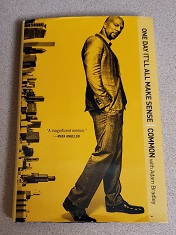
One Day It’ll All Make Sense – Common with Adam Bradley

20191029_225511(0)Some of you known him as a rapper, others know him as a film star.   To be fair, he is both of them and a lot more.  Personally, I knew of Common for years before he broke into Hollywood.  The star of ‘John Wick 2‘ and ‘Run All Night‘ earned his stripes on the underground rap circuit before going mainstream.  I saw him perform live at the Brooklyn Academy of Music and it was a show for the ages.   The electricity was in the air and the place erupted as soon as he stepped on stage.  He was larger than life and rightfully so.   I saw this book in the lobby of my building and instantly grabbed it.  Admittedly, I was unaware of this biography but thoroughly intrigued to see what he had to say.

From the start, it is clear that the book is not a typical autobiography.  In fact, the structure of the book is different with Common and his mother Mahalia Ann Hines taking turns in presenting the story.  As expected, it starts with his birth in Chicago to Mahalia and the late ABA star Lonnie Lynn (1943-2014).   The marriage did not survive and Lynn would later relocate to Denver.   But he remained a part of his son’s life and Common discusses many memories of his father that helped shape him into the man he is today.   But make no mistake, his mother is the dominant force here and their relationship was cemented in stone over the years as young Rashid grows up in one of America’s most dangerous cities.

Since this is a story about Common, the world of rap music is a topic of discussion. Common tells us how he became entranced by rap and his traversal from possible college graduate to a young rapper determined to strike it big.  The odds were surely against him but his determination and belief in himself are inspiring and one of the many uplifting moments in the book.   His success was not easy by any means but he does exemplify the old wisdom that one should never give up on a dream.   And yes, other stars make an appearance in the story such as the late Tupac Shakur (1972-1996).

To say that there is more the Common than what we see on screen is an understatement.  Being from Chicago, he is fully aware of the streets and reveals some mishaps and deeds of his own that he would probably take back if he could.  But such is life and it is full of lessons.  One of the most challenging is love and Common is not immune to the trials and tribulations that come with relationships.  While he does not provide gossip for online forums of magazines, he does talk about his relationships with singer Erykah Badu and actress Taraji P. Henson.   We sometimes view celebrities as living in another dimension but the truth is that they are just like everyone else. Heartbreak can and does happen to everyone.  But this is Common we are talking about and he does not stay down.  He keeps moving forward, taking the lessons in stride with the intention of not making the same mistake again.   And from what I have seen, he is a remarkable person who understands the importance of hard work and humbleness.

His mother Mahalia’s wisdom is timeless and she is wise beyond her years.  I truly loved her part of the book where she passes along sages of knowledge that we can all keep with us.  However, she is not without her faults and is open about where she went wrong at times.  But what is clear is that she loves her son and has always been his biggest supporter.  I am sure that will continue as Common matures and takes on bigger projects which will reap him more and more success.

Common’s story is not over yet, and I do hope that he has many more years to go in his career.  In fact, he is only forty-seven years of age.  But if you want to know who he is, where he comes from and where he wants to go, then you cannot go wrong with this enjoyable autobiography by mother and son who open up their lives to the public.  And it is true that one day it’ll all make sense.

ISBN-10: 1451625871
ISBN-13: 978-1451625875

Voices From Chernobyl: The Oral History of a Nuclear Disaster – Svetlana Alexievich

chernobylThe Chernobyl Nuclear Power Plan was supposed to be the pinnacle of Soviet innovation and a testament to the drive inspired by the spirit of Lenin & Stalin.   Its very construction was intended to be a statement that the western powers were no match for their Soviet counterparts.  But on April 26, 1986, a meltdown at the Number Four reactor changed all of that and the course of world history.  Moscow moved quick to suppress any information coming out of the Soviet Union.  Initially the damage control was somewhat successful but before long, nuclear engineers in neighboring countries and across Europe realized that something was terribly wrong and all indicators pointed towards the Soviet Union.   Officials were forced to issue a public admission regarding the incident, setting off alarm bells across the globe.  I remember watching the news of the disaster with my parents and being in complete shock.  My father could only watch and shake his head in disbelief.  No one knew what would happen next but it was clear that this accident was unlike any that the world had ever seen before.

All hands were on deck as Soviet troops, doctors, engineers and plant workers scrambled to contain the damage.   Massive amounts of gamma rays were escaping by the minute and those in the immediate vicinity of the reactor absorbed lethal dosages of radiation that would later wreak havoc on their bodies and decimate the number of relief workers.  Years would pass before doctors and scientists fully understood the lasting effects of exposure to radiation at the plant.  However, even today there is still much about Chernobyl that remains hidden.  The second sarcophagus that covers the reactor opened on July 3, 2019 and time will tell if it is a permanent fix to contain the deadly amounts of radiation found within the buried reactor.

I have always wondered what happened to ordinary people that lived in Pripyat and surrounding areas.   We know that those who worked in the plant or were assigned cleanup and rescue jobs close to it, developed numerous health conditions that often resulted in death.  Author Adam Higginbotham captured the plight of workers at the plant in his phenomenal book, Midnight in Chernobyl: The Untold Story of the World’s Greatest Nuclear Disaster.  Svetlana Alexievich was born in the Ukraine and raised in Belarus, one of the many former Soviet Social Republics.  In 2015 she was awarded the Nobel Prize in Literature and is known for her criticisms of the Soviet Union.  In this eye opening collection of personal accounts of life post-Chernobyl, she allows ordinary men and women to tell their stories of how Chernobyl changed their lives.  The filter is off and the people interviewed here are frank and unapologetic.  I caution the reader that the subject matter is graphic and the stories may send a chill down your spine.  But they are not here to make people feel good, they are telling the truth about life following the worst nuclear disaster in modern history.   Importantly, the author does not coach any of the people, she gives the green light and lets them tell us what they know and feel.

I believe that it goes without saying that any reader who decides to choose to this book should have an overall knowledge of the Chernobyl story.   While it is not necessary to read any prior material on the disaster, doing so would give the reader an even greater sense of how misinformed people were regarding the plant and the effects of radiation.   As I read through the book, I found the stories to be tragic and at other times surreal.  There is without a doubt a genuine disconnect between what the people believe and the danger that actually existed.  I found it hard to reconcile and can only surmise that the source of the disconnect was the Soviet way of life which relied on the tight control of information and the use of propaganda.  But did this control of information cause more deaths than necessary?

The stories paint a dark picture in which millions of citizens are largely unaware of the danger posed by the reactor’s meltdown.   Some go on as if nothing has changed, oblivious to the mortal danger around them.  The true danger of the exposure to radiation would later manifest itself not just in those with direct contact but even unborn children.   The births defects that plague the babies of Chernobyl are some of the most heartbreaking moments in the story.  The mothers are conflicted by anger, sadness and regret.  They believed in the Soviet system and that everything would be okay.  It is what they were told by those they trusted and by Moscow.  And the inability to actually see radiation undoubtedly made it harder for many to believe that where they were living was contaminated.   Their ignorance is perhaps a glaring defect of the Soviet system:  a population drive by innovation was also hindered by the suppression of  information and a strict chain of command that did not permit freedom of speech.  The inability of lower level party members to sound alarms and take measures that could have changed things is yet another tragedy in the Chernobyl story.   And it is discussed here in several of the interviews.

Sadly, as time continues to move forward, more individuals that are known as “Chernobylites”, will succumb to the long lasting effects from their time near the reactor and living in the areas in and around Pripyat.  Children born to that generation will continue to live with their birth defects and struggle to understand the unfair hand that they have been dealt in life.  The Soviet Union is long gone and it is believed by some that Chernobyl helped to bring about its demise.  The disaster did damage the Soviet reputation and spread mistrusts across the republics but there were other factors involved that lead to the Soviet Union’s dissolution in December, 1991.  Chernobyl will continue to haunt Russia and Ukraine, serving as a reminder of a dark time in Soviet history.  The recent HBO show of the same name has renewed interest in the disaster but to accurately capture what really happened, in particular to those that lived through it, the voices here are invaluable.

ASIN: B016QMCBKM

Into the Storm: The Assassination of President Kennedy Volume III – John M. Newman

Newman Vol 3In Countdown to Darkness: The Assassination of President Kennedy Volume II , author John M. Newman warned us that a storm was brewing.  President John F. Kennedy (1917-1963) and his brother Robert F. Kennedy (19125-1963) had come to realize that not all who smile come as friends.  But what they could not have foreseen, was the depth of resentment towards them from the military, Cuban exiles and the intelligence community.  In the second volume, we learned about the demise of Patrice Lumumba (1925-1961), the relationship between the Kennedys and mobster Sam Giancana (1908-1975), Oswald’s alleged “defection” and the failure of the Bay of Pigs invasion in April, 1961.  Newman resumes the story and takes us deeper behind the scenes in the Kennedy Administration which found itself in damage control to prevent rupturing at the seams.

The present volume revisits the Cuban situation and also focuses on the doomed Operation Mongoose.  The covert operation has gained traction in research circles as an example of the doomed efforts to remove Fidel Castro, but as we see here, there was far more to the story.  For several decades, the rumor of Robert Kennedy giving a green light to assassinate Fidel Castro has persisted.  The myth was pioneered by former CIA operative Samuel Halpern (d. 2005), who was not fond of either Kennedy brother.  Newman investigates that myth and finally separates fact from fiction.  And the story that emerges is one of deception, exemplified by the actions of many such as Bill Harvey (1915-1976), Richard Bissell (1909-1994) and Gen. Edward Lansdale (1908-1987).  Halpern’s tale is so convoluted that it even caught the attention of journalist Seymour Hersh who examined the Kennedy family in his book  ‘The Dark Side of Camelot‘, which does no favors to the Kennedy name. I do not know if Hersh has read this book but when or if he does, I am sure the facts revealed by Newman may cause him to revise his work.

If you have read Gaeton Fonzi’s The Last Investigation, then you are already familiar with one of the most peculiar characters in the JFK assassination story, Antonio Veciana.  As leader of the anti-Castro group Alpha-66, he was responsible for daring acts against the Castro regime.  The acts were so worrisome that Kennedy eventually ordered the military to have them cease and desist.  But just who was Veciana and did he really meet a contact named Maurice Bishop?  It is believed that Bishop was a cover name for David Atlee Phillips (1922-1986), a legendary CIA officer and founder of the Association of Former Intelligence Officers.   The story of Veciana and Bishop can be quite confusing and for years Veciana played mind games with investigators.  Fonzi died before Veciana would make several changes to his story but Newman catches them all here and reveals the truth about Veciana’s recruitment into CIA activities and his alleged meeting with Bishop. To say it is puzzling would be an understatement.

Oswald’s “defection” to the Soviet Union is one of the most bizarre parts of his story.  While he never actually defected, his actions did catch the attention of the Russian KGB and the CIA.   Americans attempting to defect to Russia at the height of the Cold War was beyond comprehension and Oswald would have known this as a former Marine.  But the question remains, if Oswald really wanted to defect, then why didn’t he?  James Angleton (1917-1987) was the CIA Counterintelligence Chief from 1954-1975.  Undoubtedly, Oswald would have been of high interest to Angleton, whose hunt for Soviet moles within the CIA destroyed lives and damaged careers.  Until his final days in the CIA, he was convinced that there was a Soviet mole in the agency.  During his tenure, Soviet defectors did approach American officers.  One of them was Yuri Nosenko, whose story is another critical part of the Kennedy labyrinth.   However, Nosenko was a strange character and a career spy.  But was he a real defector?  Newman re-examines Nosenko’s story to show us what was really taking place in the spy war between the CIA and KGB.

An often misunderstood part of Kennedy’s election to office is the role of the Civil Rights Movement.  American politicians have known for decades that the Black American vote is crucial to winning a major election.   Kennedy faced an enormous hurdle in gaining the black vote primarily because he was Catholic and a Democrat.   The story of how he obtained the Black vote and why is critical to understand what he represented to millions of Americans.  His “New Frontier” program was advanced in many ways but sadly it never came into reality due to his death.  Newman wants us to understand how Kennedy was propelled to office and why the story is relevant to his death in 1963.  In 1960, Kennedy beat Richard Nixon (1913-1994) by an extremely slim margin.  Prior to the election, a series of events took place that changed the course of history.  They would involve both Robert and John Kennedy and Dr. Martin Luther King, Jr. (1929-1968).

The efforts to secure Kennedy’s claim to the White House by Sam Giancana is well-known to researchers and those with a keen ear for mafia tales.  But the relationship between the Kennedy family and Giancana was quite unusual in itself and had the public known of the connection, I can only imagine what the fallout would have been.  Giancana was a walking tomb of dark secrets and he is mentioned briefly in this volume again, along with Johnny Roselli (1905-1976) whose efforts to topple Castro are part of CIA-Mafia lore.

As Kennedy takes office, he soon finds that the battles in Washington are just beginning.  After the disastrous Bay of Pigs fiasco, he knew better than to trust the word of the CIA and Pentagon.  But what they did not know was that Kennedy had been changed by the Bay of Pigs and was determined to make sure the CIA and Pentagon never got away with such a ruse again.  This part of the book is where things get deeper and take a much darker turn.  Laos and Vietnam loom over Kennedy like a dark cloud and he soon finds himself on the defensive as military brass are demanding intervention in Southeast Asia.   Cuba is never far off the radar and once again it becomes a hot topic.  It became so hot that the Pentagon concocted plans that repulsed Kennedy and widened the gap between the President and the Joint Chiefs of Staff.  If you have heard the name Operation Northwoods, then you have an idea of where the story is going.  The stage is slowly being set with tensions rising.  The Pentagon and CIA are hungry for a war but can they proceed with a President who is becoming increasingly distrustful of his own advisors?  As the book concludes, it becomes clear that the Kennedys are on a collision course with the military and intelligence community and the climax will be far more serious that Americans could have imagined.

Volume IV is still in the works but when it is released, I am sure that Newman will continue with this eye-opening assessment of one of America’s darkest moments.  Highly recommended.

ASIN: B07NJRY8WJ

Countdown to Darkness: The Assassination of President Kennedy Volume II – John M. Newman

darknessI recently reviewed Volume I in this exceptional review of the murder of President John F. Kennedy (1917-1963).  Author John M. Newman returns in Volume II to the incredible story of the events leading up to Kennedy’s time in office and his untimely demise.  Here we change gears and take a deeper look at the alleged defection of Lee Harvey Oswald (1939-1963) to the Soviet Union,  the mob ties of Joseph P. Kennedy, Sr. (1888-1969), the role of Italian-American mobster Sam Giancana (1908-1975) and the foreign policy decisions in Cuba, the Congo and Southeast Asia.

The story of Lee Harvey Oswald is an open and shut case if you believe the government’s official story.   What we do know is that he did in fact travel to the Soviet Union and attempted to renounce his U.S. Citizenship.  But what is often left out of the discussion is did he actually renounce it?   To some the question might seem strange but if we take a closer look along with the author, we see that many of Oswald’s actions in Russia did not make sense. In fact, things were so confusing that his mother Marguerite Oswald (1907-1981) wrote to the State Department to verify if her son had given up his U.S. Citizenship.  If you eyebrows are now raised, you are on the right track and what follows in this book will change your perception of Oswald’s possible intentions in the Soviet Union.   Admittedly, Oswald is still a mysterious figure.  The amount of information known about him still pales slightly to the unknown information surrounding his career in the military and his actions in Dallas leading up to Kennedy’s murder.   The Central Intelligence Agency (CIA) has generally been quite vague about what it knew about Oswald’s attempted defection and his return to the United States.  The opening of the infmamous 201 file on Oswald has always been a topic of discussion in assassination researcher circles and for good reason. Newman explores the issue in detail and clears up some of the mysteries that have lingered for years.  But what may really rattle readers is his hypothesis as to why Oswald traveled to the Soviet Union in the first place.  Newman does not declare that his belief is what happened but his suggestion has plenty of traction and if it is ever proven to be correct, it would completely change what we knew about Lee Harvey Oswald.

As John F. Kennedy settled into office in January, 1961, his administration faced its first crisis as news of the murder of Patrice Lumuba (1925-1961) spread across the globe.  Kennedy publicly had believed in a free Africa policy and Lumumba’s murder dealt a heavy blow for his vision of Africa’s future.  Today we have the benefit of hindsight to look back on Lumumba’s death.  And what we can see is a story that is much darker than most could have ever imagined.  I should point out that there is no direct relationship between Lumumba’s death and Kennedy’s murder.  But what is revealed is the role of the CIA which was also discussed in Volume I.  The agency as it is known informally, became a foreign policy division of its own and by the time Kennedy took office, no one in Washington dared to challenge it.  In fact, the agency was so powerful, that several presidents were unaware of what the agency’s true mission actually was.  Author David Talbot discusses the agency in detail in his phenomenal book “The Devil’s Chessboard: Allen Dulles, the CIA and the Rise of America’s Secret Government”, which is a thoroughly researched account of the rise of the CIA under its controversial director Allen Dulles (1893-1969).  Newman puts Dulles and the agency back in the spotlight, revealing a sinister web of deceit determined to engineer Lumumba’s downfall.  The story is critical to understanding what would follow from the agency in Cuba and eventually Southeast Asia.

Cuba once again comes into focus as Fidel Castro breaks ties with Washington and officials are left seeting with disdain towards the beared revolutionary.  This part of the book is perhaps the most chilling as it provides an inside look into the battle being waged behind the scenes to coach Kennedy into an all out war with Cuba.  Truths, half-truths and outright lies served to cause confusion and errant decisions that resulted in the distrastrous Bay of Pigs invasion in April, 1961.  The mission was a total failure and publicly, Kennedy excepted blame.  But behind the scenes, a war was looming between the White House, the Joint Chiefs of Staff and America’s intelligence community.   The stakes had been raised and Kennedy came to realize that the CIA was now an obstacle that had to be removed.  But what he did not know at the time was that the agency plays for keeps and waits patiently for the right moment to execute.

To say that these books are mesmerizing would be an understatement.  This is the history we are never taught in school.   The information revealed in these books should serve as the basis for history lessons given about the events during the Cold War and the CIA’s rise to power.  The author concludes the book with a snippet from the story of former CIA agent David Atlee Phillips (1922-1988), whose words  are an indication of what is come in Volume III of the series titled Into the Storm: The Assassination of President Kennedy.  A storm was definitely brewing and by the time it ended, America was never be the same again.

ASIN: B01N16W6E4