Becoming – Michelle Obama

Books-Michelle ObamaAny former First Lady of the United States will tell you that there is nothing “easy” about that lifestyle.  As the wife of the most powerful man on the planet, there is a high demand on appearance, initiatives and unwavering support for the policies that originate from the White House. Michelle Obama is an alumnus of this world, serving as the nation’s First Lady from January, 2009 to January, 2017.  Her style, look and presence is unmistakable and she will be remembered in time as one of the most dynamic to have lived in the White House. Almost two years have passed since Donald J. Trump took office and the where the United States is headed seems at times uncertain.  There exist a political climate built on division and hate, which will require many years ahead for healing and understanding. As the first Black-American woman to be a First Lady, she has unique perspective on Washington, D.C., and the country she calls home.  Her views and life story are presented here in this phenomenal autobiography of the life of Michelle Robinson who went on to become Mrs. Barack Obama.

As I purchased this book, I satisfied a growing curiosity about the story the former First Lady.  As an American citizen at times dismayed, but I believed that the book could take me back to time in which a sense of normalcy was found at the highest levels of government.  Not only was I completely engulfed in the book, having read it in three days, but it reminded me that it was less than two years ago that the Obamas were in the White House and America seemed to be moving forward in the right direction.  Today it seems like an eternity has passed and only time will tell who will occupy the oval office next.  But this is Michelle’s story and to understand the former First Lady, it is necessary to hear her story as a young girl from the South Side of Chicago who commits to hard work, dedication and supporting the presidential campaign of one of America’s most popular political figures.  In many ways, her story is the epitome of the American Dream supplemented by the added variable of her being a Black-American.

On January 17, 1964, Fraser and Marian Robinson welcomed Michelle LaVaughn Robinson into the world, but I do not believe anyone could have imagined then, the heights she would reach in less than fifty years on earth.  As the product of a hard-working blue-collar home, her story reminded me of my own upbringing.  My father worked for General Electric and my mother for what is now J.P. Morgan Chase.  Both are retired now and I am fortunate to have both of them present each day.   In my neighborhood of East New York, diversity was lacking after New York City endured its own “white flight” to the suburbs.  Over time East New York became one of the worst ghettos in the country with a murder rate that was astronomical.  But our parents and extended family members refused to let my brother and I slack on anything.  And just like Michelle’s grandfather, affectionately called “Southside”,  we had my grandparents and great-parents there to remind us the importance of an education in life.

From the start, the story is seductive as the reader becomes eager to learn about the life of the former First Lady.   Her teen and college years are pretty typical for most young ladies and after graduation from Princeton, she earns a position at the law firm of Sidley Austin, LLP, where fate intervened and she met the man who would change her life forever. It is at this part of the book that the story kicks into high gear and the ride never lets up.  To say that her story is incredible is an understatement.  But what makes it even more special is her humbleness and firm grip on reality.  While I read the book, I never detected any sense of arrogance or entitlement nor was it her chance to brag about herself.   She never loses touch with the fact that at the core, she is still the same Michelle Robinson from the South Side of Chicago., only now older and wiser. Her time as the First Lady has left her with a veteran’s seasoned view of Washington, politics and life.

Some readers might be wondering where Barack Obama fits in to the story.   After their initial courtship, he is as integral to the story as one could imagine.  In fact, it would have been virtually impossible to separate their stories for obvious reasons.  His decision to enter politics was the point at which their lives forever changed in ways they could have never imagined.  And as he ascends to higher office before winning the 2008 Presidential Election, we are given a rare inside view of what was transpiring behind the scenes in his campaign and the changes that took place in the lives of the Obamas.  Following his inauguration in January, 2009, the young couple were placed into an entirely new world in which learning is always constant and surprise around the corner.   And although the focus is always on “Mr. President’ ,  her story is equally interesting even as she settles in to the role of the First Lady while trying to be a good mother, friend, daughter and sister.

There are many highs in the book and also some lows,  but throughout, her story remains inspiring and I recommend that every woman and young woman read this book.  Her story is yet another example that women that achieve great things in this world regardless of what any misogynist may think.  This is a former First Lady of the United States, who personifies class, intelligence and many other things that young women all over the world can aspire to achieve.

ASIN: B079ZYWJJ8
ISBN-10: 0525633758
ISBN-13: 978-0525633754


The Pinochet File: A Declassified Dossier on Atrocity and Accountability – Peter Kornbluh

PinochetDecember 10 will mark twelve years since Augusto José Ramón Pinochet Ugarte (1915-2006) died from the effects of a heart attack in his native Chile.  For many Chileans, he is the epitome of evil and a ruthless tyrant whose regime persecuted thousands of citizens, many of whom were “disappeared”.  He also has his supporters, known simply as “pinochetistas”.  His rise to power after the CIA- backed coup that overthrew the government of Salvador Allende (1908-1973), resulted in a new level of human rights violations across Latin America.  Allende’s removal and death has become known as the other September 11th and a day that no Chilean can ever forget.
Washington’s involvement in the coup and the destabilization of Chilean politics was initially kept hidden from the American Public through the efforts of President Richard M. Nixon (1913-1994) and Secretary of State Henry Kissinger (b. 1923). The true story of the Nixon Administration’s interference in Chile might have remained a carefully guarded secret if not for the efforts of famed reporter Seymour Hersh who broke the story of what was known as Track II and the CIA efforts to bring down Allende’s government, through a published article in the New York Times.  But what Hersh did not know at the time, was that the relationship between Washington and Pinochet was much darker and uglier than anyone could have imagined.   It is here in this look at the Pinochet file, that author Peter Kornbluh goes deep inside the story of what became Chile’s worst nightmare.

I warn the reader that this a book you will not want to put down once you have started. From the beginning, it pulls the reader in with an iron grip as Kornbluh opens our eyes to what really happened in the 1970s as Chile was on the verge of taking a different course from the one approved of in Washington.  As an American citizen, I found myself overcome with a range of emotions from shock to anger and eventually regret. Declassified documents serve as the backbone of the book and what is contained in those files is simply astonishing. As a nice supplement, Kornbluh includes copies of the documents for the reader’s reference.   Some readers, particularly Americans, may find the story hard to believe at first. But I assure you that this is not fiction.  Similar to Jacobo Arbenz (1913-1971) and Mohammed Mossadegh (1882-1967), Allende found himself on the wrong side of Washington foreign policy as he embraced a left-leaning government, believed by many to be a possible pawn of the Soviet Union.  The beliefs were unfounded but the suspicion was enough for the Nixon Administration to set in motion, a deadly chain of events that gave rise to one of Latin America’s worst dictators.

In a cruel twist of fate, the rise of Pinochet and its aftermath was not confined to Chile.  Other rulers seeking to emulate Pinochet’s style, began their own campaigns of oppression and through the Pinochet inspired “Operation Condor”, they would embark on a campaign of extermination of exiled citizens designated as “Enemies of the State”.  The wave of terror spread across several continents including the United States, culminating with the assassination of Orlando Letelier (1932-1976) on September 21, 1976.  The attack also claimed the life of Ronni Karpen Moffitt (1951-1976), the wife of Letelier´s assistant, Michael.  The attack in broad daylight, sent shock waves around the world causing anger and outrage across the nation.  Operation Condor had reached American soil but the U.S. Government´s response is one of the darkest moments in its history with Chile.  There is far more to the story of Operation Condor and Kornbluh does a masterful job of explaining it, in all its mind-blowing detail.

Kornbluh takes us on a carefully guided timeline from start to finish where we witness the downfall of the Pinochet regime.  On October 5, 1988, Patricio Aylwin (1918-2016) was elected the next leader of Chile in a landslide victory after U.S. Officials warned Pinochet not to interfere.  Aylwin served four years and was succeeded by Eduardo Frei Ruiz-Tagle.  Although out of office, Pinochet still maintained a presence in Chilean politics. But as Washington threw its support behind the newly elected government, Pinochet’s star began to fade and while in London recuperating from back surgery, he was arrested by British Agents and held for over a year before being returned to Chile where he was indicted more than a dozen times for a multitude of crimes.  At the time of his death, convictions and imprisonment loomed on the horizon and his departure allowed him to escape justice.  But his dark legacy remains a reminder to Chileans of a past which should never return.

This book is simply incredible and the amount of research that went into is nothing short of monumental.  Kornbluh has given us a gift that will continue to give as more learn about a ruler that controlled a country with an iron fist used in conjunction with murder, arrests and other acts of violence.  They will learn about the many American citizens in Chile, also murdered at the hands of the Pinochet regime and their own government’s inaction and indifference.  For the families of Charles Horman, Boris Weisfeiler and Frank Teruggi, Pinochet escaped the fate that laid before him.  But their efforts and help with this book have resulted in the full story of his murderous reign. The Chilean government long denied any involvement in Operation Condor, Letelier’s murder and other deaths that occurred as Pinochet expanded his power and used the Dirección de Inteligencia Nacional (DINA), under the rule of the infamous Manuel Contreras (1929-2015), as his own personal group of enforcers.  But as we now know and can see here with our own eyes, there was far more than meets the eye.  Pinochet had support from many places and some of them will certainly surprise the reader. I firmly believe that every American should read this book, to understand what was done in the name of our country and why it should never happen again.

If you find that you enjoy this book, I highly recommend Pamela A. Constable and Arturo Valenzeula’s “A Nation of Enemies: Chile Under Pinochet.

ISBN-10: 1595589120
ISBN-13: 978-1595589125

The General vs. the President: MacArthur and Truman at the Brink of Nuclear War – H.W. Brands

On June 25, 1950, 75,000 soldiers from the North Korean People’s Army marched across the 38th Parallel and into the Republic of South Korea.  In the wake of World War II, the country had been split between the Communist North under Kim Il-Sung (1912-1994) and the Democratic South under Syngman Rhee (1875-1965).  The 38th Parallel served as the demilitarized zone between the two nations and remains in place to this day.  In response to the growing North Korean advance, South Korean Troops with the assistance of the United Nations and the Unite States, mounted a counter-offensive to repel the invasion.  As a tactical measure, President Harry S. Truman (1884-1972), appointed Gen. Douglas McArthur (1880-1964), to lead the resistance against the communist advance.  As the conflict unfolded, Korea became ground zero in the struggle for peace and a pawn in the brewing Cold War between the United States and Soviet Union.

The North Korean advanced surprised the South but the tide of the war was soon turned as American troops marched on and captured Pyongyang.  To all it seemed as if the conflict would soon be over and for Syngman Rhee, it appeared that his dream of reunification would come to pass.  However, in October, 1950, all of that changed as the Chinese People’s Liberation Army crossed the Yalu River, lending their support to North Korean troops.  In Washington, alarm bells sounded and it soon became known and accepted that the Korean War would not a “short” conflict.  Instead, the war nearly turned into World War III and the world found itself on edge wondering if the United States would once again use an atomic weapon.  Behind the scenes, Washington was doing its best to remain calm while avoiding another world conflict while its top commander in field was doing the opposite.  This their story, told beautifully by H.W. Brands in this book that it sure to leave you astounded.

Truman, largely unpopular across the country, finds himself at odds with the most popular general in America.  To the public, McArthur was a legendary figure beyond reproach, committed to the safety of the United States at home and around the world.  To the White House, he was a rogue soldier, interfering in foreign policy and possibly providing the spark that would ignite the next world conflict through public statements and unauthorized expansion into Chinese territory.   To understand these two powerful and dynamic figures, it is necessary to understand their backgrounds. Brands provides a brief autobiography of the two, giving readers a complete picture of each and their importance to the story at hand.   As the war rages, they take their place as opponents in a power struggle that coincided with the loss of large numbers of U.S. military personnel and a Congress salivating at the thought of punishing the White House for what it believed to be unauthorized military action on foreign soil.  

The book is written in a thoroughly engaging style and once I began I could not put it down. Readers familiar with the Korean War from either reading about it or living through it will recall many of the facts in the book. But where the book excels is in its deep analysis of the battle between Truman and McArthur, and the political maneuvers occurring in Washington to prevent Chinese escalation, retain the territory of Formosa  and possible involvement by the Soviet Union.   Some parts of the book are absolutely chilling and the late Franklin Roosevelt (1882-1945) is vindicated in his belief that McArthur was at that time, the most dangerous man in America.   Brands includes quotes directly from the central players, giving the book the authentic feel that is has.  It is not simply the author telling the story, but the major players giving their side of the story.  And through their words, we can come to understand McArthur’s belief in his actions which could have escalated the war and the administration’s response in relieving him of his command and substituting him with Gen. Matthew B. Ridgeway. And the result is a roller coaster ride that begins with a Korean invasion and ends with an armistice under President Dwight D. Eisenhower (1890-1969) and the downfall of a military legend.  Truman did not seek reelection but remained a powerful voice in American politics up until the time of his death.

It will soon be sixty-five years since the armistice was signed, and the 38th Parallel continues to be a source of tension between North and South Korea with both sides on high alert at all times for possible escalation and even invasion. The story of the two Korean nations is a long and tragic story, beginning with occupation by the Japanese military during World War II.  The division of the country by the Soviet Union and the United States was a scene that played out in many nations following the defeat of the Axis powers.  Peace became a central goal across the world but in 1953, North Korea decided that there was more at stake than civility.  But due to the efforts of leaders who understood the dangerous nature of the conflict, the world was given a brief reprieve until the United States and Soviet Union once again clashed during the Cuban Missile Crisis in October, 1962.  That conflict would also be resolved, due in part to the efforts of the administration of President John F. Kennedy (1917-1963). 

The story here is at times mind-blowing and shows just how close the world came to Armageddon.  There were no scripts and the central figures were not actors on a studio in Hollywood.  The events were frighteningly real and if we are to prevent future conflicts from going down the same path, we owe it to ourselves to remember the conflict by use of books such as this one by H.W. Brands.  Those who are students of history and in particular the Korean War, will thoroughly enjoy and appreciate Brands’ work. 

ISBN-10: 0385540574
ISBN-13: 978-0385540575


Ten Arguments for Deleting Your Social Media Accounts Right Now – Jaron Lainer

lanierSocial media is literally a modern marvel that has engulfed in its clutches, billions of people around the world.  Facebook, Twitter and Instagram remain the top three platforms for those wishing to step inside the world of “social networking”.   Additionally, other platforms such as LinkedIn cater to specific audiences who do not belong to the mainstream sites.   Even this blog is considered a form of social media. Regardless of what we use, social media has changed the way the world works and that trend will only continue.  But what if we all decided to delete our accounts?  What would happen and how would our lives change?  Jaron Lanier is a silicon valley insider who once helped engineer the very social media platforms billions of people use daily.  In this direct to the point book, he makes it clear that he believes we should all delete our social media accounts right now.

At first glance, it will seem to many that the author has clearly lost his mind and there is no way they would give up any of their social media accounts.  But Lanier is no fool and has come prepared to do psychological battle.  And has he moves through his argument, based on what he calls the Behavior of Users Modified and Made into and Empire, known simply as the BUMMER model.   The acronym is undoubtedly unique to the subject at hand but as Lanier takes us through each part of the model, we are able to see how it relates to our use of social media and the players that control the platforms that we cannot stop using.

The Bummer model is the core of his argument but what is paramount is how social media is changing us and why we are not changing social media.  I firmly believe that all of us are either guilty of or know someone who displays the very things Lanier points out in the book.  For many of us it is hard to imagine life without social media and today’s generation of young adults have grown up with it since birth. For many of them, it will be an unfathomable thought to have no social media existence at all. But if Lanier is correct and I think there is much truth to his words, social media will continue to change us unless we take the power back from the social media companies and place it our hands.  Only then, as Lanier says, will companies be forced to become competitive and offer diversity in platforms that accommodates what the users want and not what tech giants want.  But the first step is to delete our accounts.

Some of us have no social media and see no reason to start now.  And while it is part of the world we live in, there is no requirement that anyone has to use it.  It is truly up to our discretion.  But with anything else that develops habit and sometimes addiction, we must ask ourselves what value does it truly bring to our lives and is it necessary to begin with?  Once we answer these questions, we can then control the influence social media has on us and where we would like to see it go in the future.  Until then, the BUMMER model continues to thrive, claiming new loyal subscribers everyday.   Lanier may seem like a lone wolf but he’s a wolf that fears nothing and wants you to have the same fearlessness and rethink your usage of social media platforms.

ISBN-10: 125019668X
ISBN-13: 978-1250196682

Living in the Era of Revolution: The Words of Malcolm X – Dynast Amir

malcolm 2In the United States, the month of February is dedicated to African-American history.  February 21 stands out during the month as the day that el-Hajj Malik el-Shabazz better known as Malcolm X (1925-1965) was assassinated at the Audubon Ballroom in Harlem, New York City.  On the radio, the eulogy given by the late Ossie Davis (1917-2005) is played taking us back to Malcolm’s final days on earth.   In 1992, Warner Brothers released Malcolm X, the biopic directed by Spike Lee and starring Oscar winner Denzel Washington in the lead role.  Washington lit up the screen, delivering a performance for the ages.  Davis’ eulogy accompanies the closing scenes and the credits are rightly finished to the sounds of Aretha Franklin’s rendition of ‘Someday We’ll All Be Free’ and Arrested Development’s ‘Revolution’.  The film has stood the test of time and is a fitting tribute to Malcolm X’s legacy.  Lee did an incredible job but there was no way he could have included all of Malcolm’s speeches and writings into the final product.  Malcolm was brilliant, not just as an orator but as a critical thinker who presented his arguments in an engaging and articulate manner.  And some of those words can be found in this book by Dynast Amir.
Amir has compiled several selected speeches and combined them will Malcolm’s best quotes on the America in which he lived.  The book is not Amir’s story or a biography of Malcolm.  There are other books that more than serve that purpose such as Alex Haley’s (1921-1992) ‘The Autobiography of Malcolm X’.  Here, this is Malcolm at full throttle, delivering his messages to those in attendance and the many followers of the Nation of Islam (NOI).  His words are sharp and he does not mince words.  Today, many of us would find his words to be extreme, but it is imperative to remember that the America his lived in is quite different from the one that exist today.  Further, he was reacting to the injustices that occurred regularly against Black Americans and others deemed to be a minority.   The truths are uncomfortable and he forces America to look at itself in the mirror.  Sadly, some of his words are still true to this day but if make it a point to remember them, we can continue to move forward as a nation.

Although I am not a follower of the Islamic faith, I have felt that some of their beliefs about the place in society of Black Americans were correct and no one who reads this book can ever say that Malcolm did not love his people.   I firmly believe that even readers who are not Black American or African can still find truth in his words.  But for those readers, some parts may be hard to get through.  The time period in which these selected speeches come from was the turbulent Civil Rights Movement in the deadly decade that was the 1960s.  In his words, you can feel his passion and anger for the deeply rooted discrimination and injustice in American society.

As a Black American, I understand Malcolm’s view and his words are pertinent to the importance of education for without it, we cannot go anywhere in this world just like he says.  Furthermore, we have an obligation human beings to treat others with dignity, compassion and respect.  However, there was one topic which I have never felt completely comfortable with but I do hot hold Malcolm personally responsible for the belief came directly from the teachings of the NOI.  That teaching is the of the story featuring the scientist named Yakub who is believed to have created the White race.  It would require too much space here to go into detail but the story itself suffers from lack of any credible evidence and could be interpreted as right-wing propaganda. Further, the NOI  has always claimed that W.D. Fard was t in 1934 is one of the several mysteries of the NOI that have never been fully explained.  It is also widely believed that the NOI was directly complicit in Malcolm’s murder.

For all of the stirring rhetoric, call to arms and critical evaluation of America, there are some bright spots in the book with the main one being his pilgrimage to Mecca.  Had he  not taken the trip to Mecca and engaged with Muslims of a different ethnicity,  his beliefs about Caucasian men and women may have never changed.  And at the time of his murder, he was at a turning point in his life as he continued to build the Muslim Mosque, Inc., an organization that could have potentially left the NOI in the shadows.  Sadly, fate intervened in a tragic way and Malcolm was silenced forever.

History will potentially remain divided on Malcolm’s legacy with his followers swearing allegiance and his detractors writing him off as a demagogue.   Regardless of what we may think of him,  we cannot deny his importance in history at the truth in his words.  If you want to learn more about what made Malcolm tick and why he had his beliefs, then read this book by any means necessary.

ASIN: B00MSXXCR0

Friends of the Family : The Inside Story of the Mafia Cops Case – Tommy Dades and Michael Vecchione with David Fisher

cops2On October 18, 1986, Betty Hydell answered the doorbell and her home and was confronted by a police officer looking for her son James.  She politely told him that Jimmy not home and she did not know his exact whereabouts.   At the time, she had no idea that she would never see her son James again.  Several hours later,  he was picked up by two men in what appeared to be an unmarked police car. However, he never arrived at the local precinct and no record was made of any arrest.  It was if he simply vanished into thin air and to this day, his body has never been found.  It became one of the many cold cases on file in Brooklyn South.  His brother Frank, had is own encounters with the two and on one occasion Betty even confronted the officer looking for him as she drove her car past his unmarked vehicle.  Frank was later murdered April, 1998 after visiting a gentleman’s club in Staten Island, New York.
On November 6, 1990, Edward Lino, a capo in the Gambino Crime Family, was shot execution style as he sat behind the wheel of his car after being pulled over on the Belt Parkway in South Brooklyn.   Lino’s death became a cold case until it was learned that he was pulled over by two men in what appeared to be an unmarked police car.   A photo of Lino slumped over in his car shows the execution style murder in graphic detail and for some, brings backs memories of the days when mobsters were killing each other across New York City with reckless abandon. Hydell’s disappearance and Lino’s murder remained cold cases for many years and no one then could have imagined that they would both come back to haunt those involved and help reveal one of the biggest scandals in the history of the New York City Police Department.

But who were the two men in what appeared to be an unmarked police car?  Their identities nearly remained a secret for good if not for a book and a television appearance on Sally Jessy Raphael.  Former NYPD Detective Louis Eppolito had written about his life on the force and his family background, appropriately titled ‘Mafia Cop’.  He had starred in Hollywood films, including a bit part as “Fat Andy” in Martin Scorsese’s Goodfellas (Warner Bros., 1990).   On that fateful day of his television appearance, Betty Hydell was one of millions of viewers watching the former detective promote his book.  I can only imagine the shock on her face as she watched the television screen listening to the former detective who once came looking for both of her sons. For NYPD Detective Tommy Dades, this was a major fire among the smoke that surrounded Eppolito and his former partner, Steven Caracappa, who died on April 8, 2017, while incarcerated in Butner, North Carolina.  Dades’ investigation, supported by the Brooklyn District Attorney’s office, opened up Pandora’s Box, revealing a cast of characters who conspired to commit crimes that many thought to be unthinkable.

Michael Vecchione is a senior figure in the Brooklyn District Attorney’s office, and at age 63, continues to serve the City of New York.  He and Dades go back a long way and when it became apparent that two cops had gone rogue, both knew that this case would be one they would never forget.  This is their recollection of the development of the case and how and why it was then taken over by the U.S. Attorney for the Eastern District of New York.  The story at first resembles an intricately woven puzzle with each piece coming into the picture as the story moves forward.   And as each revelation comes to light, I was  as shocked and confused as Dades and Vecchione were then.  But the seduction of the case keeps them lured in and both are determined to do whatever they can to bring down the two corrupt cops who had since retired and moved to Las Vegas. But this was no ordinary cold case and it quickly became apparent that there was far more than meets the eye.

It should be noted that this is not the story of the lives of Eppolito and Caracappa.  While the authors do provide some background information on them, they never go into extensive detail but provide the information when necessary to the narrative at hand. This is the inside story of the case to bring them to prosecution, a case which almost completely fell apart after a District Court Judge reversed his own ruling. At times the story seems surreal as we meet mobsters Anthony “Gaspipe” Casso and Burt Kaplan, who died in July, 2009.  And like a Hollywood production, the story takes off as the mobsters reveal staggering numbers of robberies and murders.   But the cream of the crop were their tales about the cooperation and services of two NYPD Detectives.  To most people, the story seemed absurd and I remember reading about the trial in the newspapers.  Hardly anyone though that two cops could have been pulling off hits for a crime family and shaking down criminals.  But the truth is that we had seen it before with the corruption scandal of the 90s, Michael Dowd and through the testimony of Frank Serpico.  But what was horrifying is that Eppolito and Caracappa had been accused of taking the corruption to a higher and far more deadly level.  In short, this was a whole other ball game and both the Brooklyn DA and U.S. Attorney’s office knew this to be a cold hard fact.

Many of us would like to believe that the effort to bring the deadly duo to justice was the result of a concerted effort by law enforcement. But as the authors point out, this was far from the case and almost from day one, a web of suspicion developed as the FBI and U.S. Attorney began to see the payday in prosecuting the two cops.  At that point it was game on and the cat and mouse spectacle between the State and the Government bordered on the unbelievable. They pull no punches in this book and lay out the case from start to finish.   And while the government did get a RICO Act conviction that was later affirmed by an appeals court, the case nearly crumbled under its own weight.  But the justice system worked as it was designed giving prosecutors the victory they desired.  Today, Eppolito and Casso are still alive but will both spend their last days in prison.   We can only guess as to how many more crimes occurred that were never revealed.  Those are secrets that all of them will undoubtedly take to the grave.  But this book by Vecchione, Dades and Fishers, gives us an inside look into what might possibly be a black hole of crimes between mobsters and law enforcement that have escaped prosecution. In fact, the crimes that are revealed are so mind-boggling that I found myself not wanting to put the book down at times because I could not wait to see where the investigation would lead next.

In the end, the prosecutors and cops scored a victory,  but on personal levels, many sacrifices were made and these are also revealed in the book, showing the human and personal side of the major players.  Their lives are not glamorous and in fact, during the case, they would each go through their own personal dramas that might have pushed others over the edge. Incredibly, the remain dedicated to the case while trying to save marriages, professional relationships and even their sanity while the work on bringing two of their own to justice.  Today as they look back on the case, I am sure they will smile with satisfaction at having achieved justice for Betty Hydell and the families of the other victims of the killer combination of gangster and cops. Eppolito has maintained his innocence from day one, even in the face of overwhelming evidence.  As he sits behind bars, I can only assume that he has pondered his past and how it shaped the future he his now living.   He will take many secrets with him to the grave but he and Caracappa will forever be known as the mafia cops. This is a story of crime, dishonor and the prevail of justice in the City of New York.

ISBN-10: 073228533X
ISBN-13: 978-0732285333

The Meaning of Freedom and Other Difficult Dialogues – Angela Y. Davis

87286100677870LFreedom is a term that is often used but not always understood.  The costs associated with it are often high and some of us have paid and will pay the ultimate price to obtain it.   Here in the United States, we like to think that we are free but the truth of the matter remains in question.  Perhaps we are still in a state of denial of about freedom’s true meaning and its role in the American way of life.  Angela Davis is one of the brightest voices to emerge from the Civil Rights Movement and has established herself a political activist, an author and professor whose many speeches and writings are some of the best society has ever seen.  While the book is not an autobiography, this is clearly Davis’ show and a collection of selected speeches in which she discusses topics that she rightly refers to as difficult dialogues.  But her ability to not only discuss these topics but provoke thought in the reader, is what makes this book so special.  And I can state with full conviction that I wished I had discovered this gem much earlier in life.
If you are contemplating reading this book, I believe that you already know who Davis is or have heard her name.  If you seek intelligent discussion regarding subjects that America still struggles with, then this is a book for you.  But beware, Davis is not here to make anyone feel comfortable.  In fact, her goal is open your eyes and get you to re-examine what you thought you knew about race, justice and social progress.   At no point does she shy away from the topics and moves full speed ahead as she discusses the prison industrial complex, poverty, LGBT rights, the election of Barack Obama and the dark history of segregation under the banner of Jim Crow.  She is a brilliant author who never attempts to lecture the reader but presents her points in a manner that is conducive to dialogue that actually provokes deep thought and constructive criticism.

I had hoped that she would have mentioned more about George Jackson (1941-1971), especially during the discussion on the prison system and the animal known as mass incarceration.   By their own words, she and Jackson were very close, up until the time of his death while incarcerated at San Quentin.  Looking back, I can see why she does not go into extensive detail for that would have required a separate book.  In fact, their story was the focus of her trial for conspiracy commit murder surrounding the death of Judge Harold Haley, taken prisoner by Jackson’s younger brother Jonathan in an effort to free the Soledad Brothers,  to which George belonged.  Both were shot and killed during a shootout with law enforcement.  Davis’ trial and acquittal are covered brilliantly in The Morning Breaks: The Trial of Angela Davis by Bettina Aptheker.   The story of Jackson and Davis takes center stage therein as she fights for her life in a case that could have sent her to death row.

Towards the end of the book, there is a speech she gives about the election of Barack Obama.   His election as the 44th President of the United States was a monumental moment for America but she rightfully points out that the job of improving race relations and civil rights did not belong to him alone.  And in spite of the belief that we live in a post-racial society, common wisdom dictates otherwise and we all share a responsibility in the continuing advancement of civil rights.  I truly believe that anyone who believes in equality, the right of everyone to live their lives free and the advancement of society will find this book relevant not only to the past but even today as mass incarceration continues and America finds itself politically and socially divided.  However, I have hope for the future and if we return to books such as these, we can get back on track and work towards improving life for all Americans.  And as we do so, we can continue to examine the true meaning of freedom.

ISBN-10: 0872865800
ISBN-13: 978-0872865808

Otis Redding: An Unfinished Life – Jonathan Gould

OtisOn December 10, 1967, a charter plane carrying singer Otis Redding (1941-1967) crashed in Lake Monona in Madison, Wisconsin as it made its final landing approach.  Redding was twenty-six years old and left behind a widow Zelma, and three young children.  At the time of his death, he was a top-selling recording artist on the brink a stellar career and the song he recorded shortly before his death “Sitting On The Dock Of The Bay”, went on to become a hit that still sounds good to this very day.  His widow Zelma, is the president of the Otis Redding Foundation and his children Karla, Otis, III, and Dexter are on the board of directors.  Through their hard work, Redding’s legacy lives on as millions of fans of the Soul music replay his songs singing along with an artist who helped define a genre and an era.
Redding died more than a decade before I was born but I have come to appreciate his musical genius.  When I saw this book by Jonathan Gould, I knew that it would be an interesting read.  And to my satisfaction, my instincts proved to be correct.   Admittedly, my knowledge of Redding’s personal life was lacking but I had always known, like millions of others, the particulars of his untimely death.  But what I did not know, was the man behind the music.  Redding, like other artists such as Marvin Gaye, James Brown and Wilson Pickett, became a larger than life figure and a titan in the genre of music that became known commercially as Soul.  But the question remained, how did Redding rise to fame and why did he die so young?  Contained within the pages of this definitive biography are the answers to those questions and many others and Gould not only tells Redding’s story, but also takes us back in time as we relive the Civil Rights Movement while taking a closer look at what race once was and still is in America.

Without question the book is a biography, Gould ingeniously intersperses Redding’s story with historical events that changed the United States one step at a time.  And the way it is done fits perfectly for in order to understand Redding, it is necessary to understand the America he was born into, a country far different from the one in which more than 300 million now live.  Born in 1941 in the deep south, Redding came face to face with the horrors of Jim Crow at an early age and the system of legal segregation and oppression affected every aspect of life for African-Americans.  The daily threat of death and deprivation gave rise to a movement for equality, accompanied by music that reached deep inside a person, in effect, touching their soul.  Some parts of the book might be a tough read as Gould does avoid many dark episodes that occurred during Jim Crow such as lynching, the humiliating practice of blackface and the absurd laws that once prevented Black and White Americans from being seen together in the same place.  The stories and the events are uncomfortable but there is no way around it and its purpose is to remind us of the seemingly endless barriers artists like Redding were forced to overcome in pursuing the passion that they loved as America was being forced to look at itself in the mirror.

Similar to other singers of his time, Redding found his voice in the church as the son of a pastor before realizing that his voice could give him a career.  But in contrast to other singers, his early life was not filled with craziness and in many ways was quite ordinary until fate takes over and he crosses paths with Phil Walden, the man who would help make him a star.  At this point in the book, the story picks up in pace as Redding sets his sights on Los Angeles while becoming a husband and father.  And at twenty-two years of age, he was living a life that many could only dream of.   He performed with some of the biggest names in the business from James Brown, Booker T & The MGs to the late Queen of Soul, Aretha Franklin (1942-2018). The result is that the book is not simply a biography but a step back in time to a period that we will never see again.  In fact, what was being done by singers then could not be done today as Soul is a genre all but retired and there is no equivalent Civil Rights Movement.  Hip-Hop and Pop haven taken over the airwaves making the days of Motown a distant memory.  But to their infinite credit, the sounds coming out of Detroit, Los Angeles, Memphis, New York and other cities have stood the test of time, sounding as good today as they did when they were recorded.

It should be noted that Redding had his faults like other stars and also saw life through a different lens.  Gould includes all of it as any good biographer should do.  In the end, Redding was a human being, born with flaws that many of us have.  Those flaws as well as his positive traits, are critical in analyzing his life and understanding why he was mourned in death.  Stardom was already in his grasp and he was on track to ascend to an even higher level of fame. Gould, did an incredible job of putting together this story that covers Redding’s life from start to finish.  Through interviews with those who knew him, Walden and even the late Jerry Wexler of Atlantic Records, Gould has created the go-to book on the life of Otis Redding.  His writing style brings the past alive and at times I felt as I were right next to Otis as he had discussions with Walden and Wexler.  There will never be another Otis Redding who did in fact have, an unfinished life.

ISBN-10: 9780307453945
ISBN-13: 978-0307453945


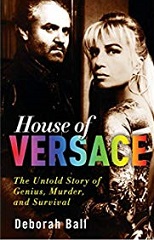
House of Versace: The Untold Story of Genius, Murder and Survival – Deborah Ball

versaceThere are some who say that the City of Miami was never he same after Giovanni Maria “Gianni” Versace (1946-1997) was shot and killed on July 15, 1997 by Andrew Cunanan (1969-1997).  The world-famous fashion designer had given the city new life with his bold designs, outlandish parties and mansion called the Casa Casuarina. At the time of his death, the Versace name was a juggernaut in the fashion world, dominating news headlines and magazine covers.  Tragically, in less than ten seconds, Cunanan changed all of that in ways that no one could have imagined.   After Versace’s death, trials and tribulations nearly brought the company to the brink of extinction but today it is still going strong.  And its creator is regarded as one fashion’s greatest minds.   The story of his death is well-known having been relived through the FX award-winning series The Assassination of Gianni Versace: American Crime Story.  But what may not be familiar to viewers is the story behind the public faces of the company; Santo, Gianni and Donatella.   The three siblings put their minds and personalities together forming the company that became a legend and a legacy.   This is the story of their genius, a murder and the survival of a business.
The Versace story begins in Reggio Calabria, a small coastal town in southern Italy, where Nino and Franca Versace, raised their three children who would go on to achieve world-wide fame.  A fourth sister and their oldest child, Fortunata, who was known by her family as Tinuccia, died in her youth.  As one would expect from a story about a simple family living in post-war Italy,  poverty initially makes itself known, not just for the Versace family but for many in Reggio, who would later immigrate to Milan only to face discrimination from the northerners who viewed their southern neighbors with disdain.  But what no one knew then was that Milan, would one day serve as headquarters for the Versace product and a stepping-stone to stardom for Gianni and his siblings.  From a young age he begins to lean from his mother Franca, the intricate parts of sewing and fashion design.  As he gets older, chance meetings, including one in Paris with Karl Lagerfeld, provided the change of fate Gianni needed and before long, he and his siblings began to set the foundation for the Versace empire.

The book contains a significant amount of information about fashion products, earnings, cat walks and an endless number of celebrities who came into the Versace inner circle.  But at its base,  the book maintains its focus on the personal story of the three siblings.   Their minds were and are still brilliant but even they would not be impervious to the many seductive aspects of quick fame, endless money and an abundant supply of vices,  one of which nearly caused the complete self-destruction of Donatella.  Marriages, relationships and the Gianni’s sexual orientation play their parts in the book as components to the complex yet tragic story that unfolds.  The highs are many but the lows open to the eye to the dangers of excess and the pitfalls that surround the rich and famous.  At the top of the command chain was the creative Gianni, backed by the bookkeeper Santo and the publicity worker Donatella.  Together they seemed unstoppable as they continued to pull in millions of dollars while spreading the Versace name across the world.   But their strengths are also what helped contribute to the dysfunction that existed and increased after Gianni’s untimely death.   Both Donatella and Gianni were known to be lavish spenders but what is revealed in the book is nothing short of jaw-dropping.  The money nearly went out as fast as it came in.

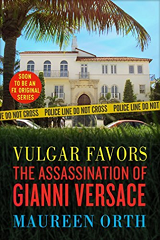
No one will ever know why Cunanan decided to murder Versace.  Ball states that clearly in the book.   And while she covers the murder, she does not give it extensive coverage.  For those who are interested in Cunanan and the manhunt that followed, I highly recommend Vulgar Favors: The Assassination of Gianni Versace by Maureen Orth in which she tells Cunanan’s story from start to finish.  Here, Ball focuses on the aftermath of the murder and how it affected all of those around Gianni, even his niece Allegra who could have imagined the way her late uncle would change her life without her knowledge beforehand.  To her credit, she rises to the occasion, providing an interesting turn of events in the story that never lets up from the start.  Regrettably, she did not provide an interview for the book and Ball states that she would have provided invaluable insight into the story of the company’s survival.  Nevertheless, Ball has clinched it here through interviews with Santo, Donatella and hundreds of other people who work for or personally knew the Versace family. And the result is the definitive account of the House of Versace.

I want to be a designer for my time” – Gianni Versace

ASIN: B00362XLH8

Vulgar Favors: The Assassination of Gianni Versace – Maureen Orth

CunananI remember with vivid clarity the day that Giovanni Maria “Gianni” Versace (1946-1997) was shot and killed in front of his home in Miami, Florida.  My friends and I were in shock and in the wake of the shooting, we kept hearing the name Andrew Cunanan (1969-1997).  None of it made sense but from the news we did learn, Cunanan was a one man crime spree and through fate, he crossed paths with the world-famous fashion designer.  Twenty-one years have passed since Versace’s death but the fashion line that bears his name continues to remain strong.  Several days after Versace was shot and killed, Cunanan took his own life aboard a houseboat that was eventually seized by the City of Miami.  In the days after his death,  more information about his erratic and deadly lifestyle came to light and also revealed how law enforcement missed vital clues contributing to what Maureen Orth calls the largest failed manhunt in U.S. history.   By all accounts, Cunanan should have been caught long before he walked up to Versace on July 15, 1997.  However, miscommunication and in some cases prejudice against homosexuals, resulted in investigations crippled from neglect, allowing Cunanan to remain at large before committing his final murderous act.  The world now new the name Andrew Cunanan and it would never be forgotten.  But just who was Andrew Cunanan and how did he make the FBI’s Most Wanted List?  The list is reserved for the most dangerous of criminals and typically a suspect such as Cunanan would not normally be found on the list. His use of extremedly deadly force rightfully earned him a place among the most deadly killers on the run in America at the time.  Maureen Orth, a journalist for Vanity Fair, covered Versace’s murder and was familiar with Cunanan before the final events in Miami.  In this chilling account of Cunanan’s path of rage, she recounts his life helping us understand how and why he descended into madness.

Orth takes us back in time to the Cunanan home were Modesto “Pete” Cunanan (1930-2005) and his wife Mary Ann (1938-2012) raise their several children.  Andrew quickly becomes his dad’s favorite, but even his charm would not be enough to keep the family together as his father fled to his native Philippines in 1989.  The event would have a profound effect on the young child and unbeknownst to many, the seeds of chaos had already been planted. What is evidently clear in the book is that from an early age Cunanan displayed many of the characteristics that would be shown in adulthood and vividly remembered by those he encountered.   And as he makes his way to manhood, he becomes more immersed in his homosexuality and it is at this point in the book picks up speed and Orth takes us deep inside the world of gay men.  I should point out that Cunanan was not a “gay killer”.  While he did commit murder, it was not based off of his orientation nor were his victims targeted because of their orientation.   And I also believe that readers uncomfortable with homosexual subject matter should avoid the book altogether.  But for those who have been fascinated by the Versace murder and Cunanan’s story, it is necessary to understand this world to understand Cunanan.  Further, the misunderstanding of this world is one of the factors behind the failure of authorities to capture Cunanan earlier in their investigations.

If Bret Easton Ellis had not written American Psycho in 1991, he could have easily used Cunanan as the model for the book’s central character Patrick Bateman, but with a few minor tweaks.  Every killer has that one moment where something snaps and they begin their rampage.  Cunanan was no different and once he began his murder spree that would spread across several states,  he left a trial of violence that will undoubtedly shock many readers.  At times the book may seem like a Hollywood production but this is not fiction, the events were real and the aftermath devastating.   Selfishly, Cunanan chose suicide instead of standing trial for his crimes.   He did not leave behind any journals or notes explaining his motives.  In fact, it seems that his own goal was to kill.   Orth does an incredible job of taking us through the events as we follow him across the U.S.  From one city to the next,  he adds a new victim leaving law enforcement in the dark as to why and how he was able to keep evading authorities.  Tensions ran high and even the FBI, drawn into the case through cross-state crimes, found itself deeply wanting to apprehend the monster. When Cunanan was found dead, authorities and the public breathed a sigh of relief.  His death would not bring Versace back but it did mark the end to a path of destruction that surpsisingly did not claim many more victims.

If you want to know the story behind the hunt for Cunanan and the crazy yet glamorous lifestyle he lead, then this is the book for you.  It is not a biography of Versace although she does include a good of information on the Versace empire.  This is Cuanan’s story and the deadly path he took as he slowly made his way to the home of the world’s most popular fashion icon.

ASIN: B004478APW