
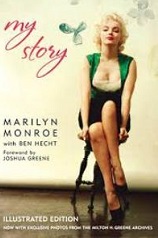
 Marilyn Monroe remains to this day one of Hollywood’s biggest sex symbols. Her image continues to be promoted today through articles about her life, books, posters and even documentaries. When she died suddenly on August 5, 1962, she left behind millions of fans, a career and a film industry in which she was at the top of its list of stars. Her marriages and love affairs have been documented relentlessly and her sex appealed is desired by young men looking to be the next great sex symbol in Hollywood. But just who was the real Marilyn Monroe? When she died she was only thirty-six years of age, far too young to have written a complete autobiography or to have experienced all that life has to offer. However, prior to her death, she had begun to tell her life story to friend and business associate Milton Green. Green kept the manuscript along with thousands of photos he took of the late actress. His son Joshua, has preserved the images digitally restoring them in the process. When he found the manuscript he had it published into this short but revealing book about the early life of Norma Jean Mortenson.
This book is her story told in her own words. Her story is not glamorous nor is it tragic. In fact, aside from her early childhood memories and living situation that changed regularly, there isn’t much that stands out in the way of chaos. For the most part, she was a normal girl trying to have a normal life. I believe that is imperative that the reader abandon any preconceived notions about Monroe’s life. Her marriage to Joe DiMaggio and later love affair with President Kennedy are fodder for gossip columns and distract from her life behind the camera. In fact, the images we see of her on film and in pictures do not come close to revealing the real Marilyn Monroe.
It is incredible that fifty-four years after her death that you can still find her face on posters at most stores. Recently on a trip to IKEA, a poster with her image was among the many that the store sells. In just thirty-six years, she created a legacy that is certain to last for an eternity. Sadly, the book ends right after she marries DiMaggio. She has just set out to entertain troops in Korea. We know that there is more to her story and that her life took a darker and more sinister turn. Rumors about the real cause or her death have survived since she passed and show no signs of slowing down. It remains to be seen if we will ever know the truth about her death and why it happened. And even if the truth is known, the loss of the late icon will still be felt.
Her story is short but highly entertaining. There are no pieces of gossip about other stars and it will be surprising for some to learn how unassuming she actually was at the time. She is very candid about her experiences and gives of a welcoming charm that explains the never-ending infatuation the media has with her. I believe that if she had lived, she would have finished this manuscript and it would be by far one of the best autobiographies we have seen. But even in its shortness, Marilyn does a good job of telling us her story.
ISBN-10: 1589793161
ISBN-13: 978-1589793163
 The murder of John F. Kennedy remains one of America’s darkest moments. His assassination in Dealey Plaza and the murder of his alleged assassin two days later shocked the world and marked a turning point in American history. The Warren Commission’s report is still the government’s official position on the murder. It concluded that there was no conspiracy to murder John F. Kennedy and that Lee Harvey Oswald acted alone. In 1966, Mark Lane’s Rush to Judgment was released and became the first major book to challenge the Commission’s conclusions. Lane became a pioneer in the process with his book being followed by more than 200 hundred others regarding the events of that day. Each has its strengths and weaknesses but all provide a window into what some have called the crime of the century. There are literally dozens of theories as to how and why Kennedy was killed. It is up to the reader to cross-reference the facts and reach a conclusion. However, in the majority of the books regarding the murder, all tend to focus on the complicity of the U.S. Government and organized crime. The Italian-American mafia has long been suspected in the assassination. But like everything else regarding the murder, things are not always as they may seem.
 This past November marked thirty-eight years since City Supervisor Harvey Milk and George Moscone were shot and killed by Dan White. Their murders and the sentencing of Dan White to just five years in prison, led to the White Night Riots and filled the LGBT community of San Franciscans with shame and disgust. After serving several years in prison, Dan White committed suicide in 1981. Milk’s life was adapted for the silver screen in the Gus Van Sant directed biopic Milk. Sean Penn assumed the role of Milk in what became on his greatest performances. Josh Brolin took on the role of the film’s antagonist, Dan White and turned in an equally great performance. They were joined in the cast by James Franco, Alison Pill, Diego Luna and Emile Hirsch who plays the role of activist Cleve Jones. Jones is the most energetic character in the film and serves as Milk’s second in command as they take of Anita Bryant, John Briggs and Proposition 6.
 America still struggles to understand the Middle East and a large number of Americans have suspicion and fear of the religion of Islam. Acts of terrorism and reports of the extremes of Sharia law have caused many Americans to dismiss Islam as an archaic system of faith maintained by fear, intimidation and capital punishment. Furthermore we are rarely exposed to the positive aspects of life in an Islamic state and are only shown the most extreme acts of aggression that occur. It has been planted in our minds that Muslims around the world would like nothing more than to see the United States collapse. Near the top of this list are the people of the Islamic Republic of Iran, a nation which shares a long and troubled history with the United States of America.
 For twelve years Evelyn Lincoln served as John F. Kennedy’s devoted secretary. Following Kennedy’s murder she penned a memoir of her time as his assistant under the title “My Twelve Years with John F. Kennedy”. As his secretary she was a first hand witness to his daily routine and the decision making process behind some of the biggest moments in American history. The relationship between Kennedy and Vice-President Lyndon Johnson has been documented in scores of books. But Lincoln’s account is a welcomed look into the unusual relationship between two polar opposite individuals.
 In 1955, Dorothy Dandridge was nominated for Best Leading Actress in a Leading Role for her performance in “Carmen Jones”. Her nomination marked the first time an African-American woman had been considered for the prized recognition. Ten years later she was gone, having died of an accidental overdose of prescription pills on September 8, 1965. She was forty-two years old. Her rise and fall in Hollywood is one of the most tragic stories of the era and she joins the ranks of other fallen female greats such as Billie Holiday and Marilyn Monroe. She left behind a legacy that is undeniable and she broke down barriers that other African-American female stars faced prior to her rise to stardom. But for all of her success on the silver screen, Dandridge’s personal life as shown here in this definitive biography by Donald Bogle, shows a woman who struggled throughout her life with her childhood, motherhood, fame, success and love. Her story is largely forgotten but at one point in America history she was one of Hollywood’s biggest actresses.
 ening of March 24, 1980 marked a changed in the course of the history of El Salvador. In the evening of that day, Archbishop Oscar Romero was shot and fatally wounded as he conducted a mass for his followers. He is rushed to a nearby hospital but quickly succumbs to his wounds. His death plunges the nation in mourning and earns widespread condemnation across the globe. On May 23, 2015, thirty-five years after his death, he was
  On January 7, 1971 law enforcement personnel responded to the scene of a single car accident on U.S. Route 271 near Pittsburg, Texas. The deceased is identified as Malcolm “Mac” Wallace. His death marks the end of a life replete murder, sex, alcohol and suspicion. Wallace was a known associate of several powerful figures in the State of Texas, most notably, Billie Sol Estes and Lyndon Baines Johnson. His association with Johnson earned him the title of a conspirator in the murder of President John F. Kennedy. An unidentified finger print at the Texas School Depository discovered in the wake of Kennedy’s murder, puzzled investigators and researchers for years. In 1998, Nathan Darby, a career fingerprint analyst, identified the print as belonging to Wallace giving rise to the belief of many conspiracy theorists that Wallace had been on the sixth floor either right before or during the assassination. Wallace’s death was cloaked in conspiracy theories about how and why he died. But just who was Mac Wallace? Was it really his print at the book depository? And was he LBJ’s hitman for hire as has been alleged? Joan Mellen, a noted scholar and author of several books related to JFK’s murder explores the relationship between Wallace and Johnson in this phenomenal account of the lives of both of these Texas natives.
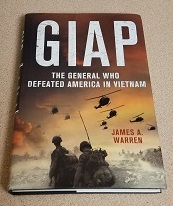 April 30, 1975-The city of Saigon, the capital of South Vietnam, falls to the People’s Army of Vietnam and the National Liberation Front of South Vietnam. The siege of the capital is the final push by North Vietnam on the course towards reunification. The final withdrawal by U.S. military and government personnel marks the of a deadly and protracted war that cost 58,000 American lives and over 1 million Vietnamese lives. To date, it is the only loss suffered by the United States Armed Forces. The success of North Vietnam is a shining moment in the Vietnamese struggle for independence for colonialism by France and the anti-communism policies of the United States. Ho Chih Minh becomes a legend in Vietnamese history and many years later Saigon is renamed in his honor. Ho died on September 2, 1969, several years before the war’s conclusion, but his ideology and belief in a free Vietnam helped his successors continue his goal of unconditional victory. Looking back at the war, it seems almost absurd that a country the size of Vietnam was able to resist and defeat efforts by the French and Americans to impose their will. Both nations were equipped with better weapons, bigger budgets and highly skilled armies. However on the Vietnamese side, there was a general who proved to be just as sharp as any the French or the United States had to offer. And by the end of the war, he would also become a legend in his own right. His name was Võ Nguyên Giáp. (1911-2013)
 On December 30, 1970, Charles “Sonny” Liston (1932-1970) died at his home in Las Vegas, Nevada at the age of thirty-eight. His body was discovered six days later by his wife Geraldine when she returned home from a trip out-of-state with Liston’s son Daniel. It was first suspected that Liston, a known user of heroin, had overdosed. But it was later declared by the coroner’s office that he died of natural causes. To this day it is the official cause of death. The late Liston is remembered as one of the greatest boxers to ever grace a ring. His battles in and out of the ring with Muhammad Ali are some of boxing’s most entertaining moments. Although Liston lacked the personality of Ali or the flair of Floyd Mayweather, Jr., he was feared in the ring as a powerhouse of a brawler unafraid to go in and demolish whoever stood in front of him. His personality in the ring was a direct reflection of his personality outside the ring in a life full of twist, turns and ultimately tragedy. Shaun Assael recounts the short and tragic life of Liston and his death which he believes was in fact a homicide that was wrongly classified at the time of Liston’s death.
 FREETHINKING BIBLIOPHILE
You must be logged in to post a comment.