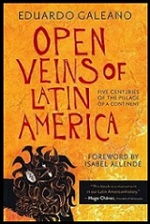
 Latin America is home to some of the most beautiful scenery in the world. The Iguazu Falls, Andes Mountains and Patagonia attract millions of visitors annually. The beauty of these and other sites across Latin America stand in stark contrast to the poverty that can be found outside of major cities and sometimes within. In between major railway stations and ports exist slums that remind us of the severely uneven distribution of wealth throughout the continent. Speaking from personal experience, most Americans would be shocked at living conditions that still exist in Latin America to this day. But why does a continent with a history that goes back several hundred years and is home to beautiful people, beautiful languages, great foods and beautiful scenes of nature, continue to suffer from poverty, corruption and exploitation.
The key to understanding the current state of these and other Latin American affairs, is to revisit its history. Eduardo Galeano (1940-2015) has done just that in this eye-opening and best-selling study of Latin American history that was first published in 1971. The edition that is the subject of this review was re-published in 1997, and contains a foreword by Isabel Allende, a cousin of the late Chilean President Salvador Allende (1908-1973). On September 11, 1973, Allende died on a self-inflicted gunshot wound as opposition forces engaged in a CIA-backed overthrow of the government. Isabel currently lives in California and is a naturalized United States Citizen.
Galeano starts by revisiting how Latin America came into existence from a continent of indigenous people to one in which Spanish is the dominant language. The arrival of Christopher Columbus in the Caribbean marked a distinctive change in the course of world history and although he never set foot in North America, Columbus is still considered by many to be the person that discovered what is today the United States. In recent years however, the holiday of Columbus Day has been replaced by Indigenous People’s Day or in others not acknowledged. In Central and South America, the arrival of the Spanish explorers would have a profound impact and set the stage for plunder, murder and exploitation that engulfed the continent. Next to Columbus are the stories of Vasco Núñez de Balboa (1475-1519) and Pedro de Valdivia (1497-1553), explorers who would spend their last days in South America. And as Galeano re-tells their stories, the reader might want to make notes of names, dates and places as the story comes together like a puzzle.
While the tragedy of exploitation and violence played out, not all voices were content with Spanish domination and the extermination of South America’s inhabitants. Tupac Amaru (1545-1572) and Simón Bolívar (1783-1830) also appear in the book and it would be safe to say that an author would find it impossible to discuss Latin American history without recounting their extraordinary and short lives. However their efforts proved to be ineffective against the rush of colonization that dominated the southern hemisphere. And it is at this point in the book that Galeano turns up the heat as we learn how natural resources became a gold mine and and the populations of the Carribean, Central American and South American nearly disappeared as a result of warfare, famine and disease. World superpowers sank their teeth into the Latin American cash machine and have never let go.
The grip of foreign control has proven to have disastrous effects on politics, producing revolutions and widespread practice of the coup d’état. Leaders who leaned left and sought to reclaim industries exploited by foreign corporations were quickly dealt with through American foreign policy. Those who did play the game were rewarded and tolerated through the Good Neighbor Policy and other shady practices. The climate of distrust and violent overthrow of the government has never left Latin America. The current events in Nicaragua, Venezuela and Argentina are prime examples of the volatile political climate that continues to exist. And all the while, foreign corporations continue to reap enormous profits as they move around offices and politicians like pieces on a chess board.
Galeano provides a staggering amount of information in the book which is sure to shock the reader. But this book is key to understanding why Latin America has developed so many third-world countries. It would be easy to blame those countries for their own failures. But what we know is that after a colonizer has left the colonized, it is immensely difficult for those nations to find a permanent path of success. This was beautifully explained by Frantz Fanon (1925-1961) in his classic The Wretched of the Earth. The future is bleak for many Latin American nations as inflation rises and the IMF becomes more reluctant to give out loans. Poverty continues to increase giving rise to protests, crime and strikes. What we see today is a manifestation of what Galeano calls “five hundred years of the pillage of a continent”.
If you have never traveled through Latin America, I implore you to do so at least once. I firmly believe that there are many great things that are unfamiliar to those who live in the northern hemisphere. I have had the privilege of visiting Argentina, Brazil and Uruguay. Chile is next on the list. Through my travels, I have met many people who have become a permanent part of my life and I am eternally grateful for having met them. Galeano died on April 13, 2015 after a battle with lung cancer but he left behind important works and this masterpiece which has been translated into more than twelve languages. This book has proven to be the companion guide every person needs in order to understand many of things that will be seen in Latin America, including the current presence of open veins.
ISBN-10: 0853459916
ISBN-13: 978-0853459910

 The history of Native Americans was for many years, untold and in some cases omitted. the trail of tears is just one example of the systematic process of relocation enforced by the United States Government as America continued to expand. The natives were seen as uncivilized in comparison to their American and European counterparts. The natives would readily say their lives were uncomplicated and simple. Many resisted the influence of soldiers on their land and fought to the death to preserve their homes. Others did not resist and accepted the lifestyle and religion of the white man. Dr. Charles Alexander Eastman (1858-1939) was one of those who migrated from one world to another and in this short but interesting autobiography, he recalls his life and his path from the deep woods to civilization.
 The cover of this book is bound to cause many to do a double take. The crossing out of the word black is far from subtle, but anyone who is familiar with the late Richard Claxton “Dick” Gregory (1932-2017), will know that subtlety was not in his character. He was known as a star comedian for many years but he was also a civil rights activist, nutrition guru, social critic, writer and occasional actor. His death marked the passing of a icon whose sharp wit and frankness earned him the respect of his peers and people across the nation. Published after his death, this book takes a look at the official history of African Americans that Americans have been told for more than a century. Gregory makes it clear early in the book that American History and Black History are one in the same. It is a valid point and for African Americans, the United States is the only home that many have ever known. The history that has been taught in classrooms across America continues to be re-examined in the pursuit of the truth by historians and independent researchers. The gift of the internet has allowed truth-seekers to reach audiences of monumental sizes as we step back in time to learn what really did happen with regards to pivotal events that shaped the modern day United States.
 On the morning of February 26, 1993, Ramzi Yousef and a team of terrorist drove a bomb laden van into the basement of the World Trade Center complex in New York City. As I watched the news from across the river in Brooklyn that morning, I felt a sense of shock and vulnerability. America had been attacked. When Ramzi Yousef was captured and extradited to New York to stand trial, many New Yorkers breathed a sigh of relief. The Hon. Kevin Duffy sentenced Yousef to life with no parole plus an additional 240 years which he is currently serving at the ADX Florence Supermax facility in Fremont County, Colorado. Eight years later on September 11, 2001, America was attacked again when terrorists hijacked four commercial airliners, crashing two into the World Trade Center, one into the Pentagon and the final aircraft outside of Shanksville, Pennsylvania. The response from Washington was swift and a show of force nearly unparalleled in modern times. The mission to capture those responsible and root out terrorists, led to Afghanistan, a land-locked country in South-Central Asia. Images of U.S. troops and the enemy Taliban flashed across news screens as reports of successes in the mission to root out terror were triumphantly proclaimed. To many Americans, Afghanistan was another far away place across the world where people lived in ways that seemed to be from ancient times, going against “American ideals”. Today, Afghanistan is nearly completely forgotten by the American public. There has been no news about what America’s current role is and plans to withdraw American forces have been cast aside as yet another victim of the focus on what has become reality television politics. The story of Afghanistan and its importance to world history is often misunderstood and in some cases not even recognized. But there is far more that meets the eye and author Steve Coll explores this topic in this New York Times bestseller that tells the full story what did happen in Afghanistan between the Soviet Invasion and the deadly attacks on September 11, 2001.
 Every summer, my parents make their annual visit to the Mashantucket Pequot Museum and Research Center in Ledyard, Connecticut to continue learning about the Pequot Indian tribe who lived in what is now the State of Connecticut. They are one of the many tribes that called North America home prior to the arrival of European settlers and the creation of the United States. Today, they can be found largely on reservations having been forced off of the only lands they knew to make way for a country that had liberated itself from British colonization. Far too often, their plight is ignored and history books have traditionally re-written the history of the foundation of the United States of America. This book by the late Dorris Alexander “Dee” Brown (1908-2002) challenges everything we thought we knew about our country and the scores of people often referred to simply as “the Indians”.
 The Second World War remains the most brutal conflict in history. The number of those who perished is still up for debate and there are many secrets of the war that have been lost to history forever. In the United States, foreign-born citizens with roots in any of the countries part of the Axis powers, found their selves under suspicion and in the case of the Japanese, placed into concentration camps. Although not as inhumane and deadly as the camps in Germany and Poland, they resulted in the rise of resentment among Japanese-Americans toward the United States Government and the country they called home. The dropping of the Atomic bombs further heightened the feeling of resentment and was the first and only time a nuclear weapon was used in warfare. Survivors of the bomb attacks can still be found today, advanced in their years but tragically familiar with the barbarity of modern warfare. Across the pacific, Japanese-American veterans of the war remember the tragedy that befell Japan, the nation to which their families trace their origins. But what happens when half of a family is in Japan and the other half is in the United States? Or what do you do when one son is part of the Japanese Imperial Army and the other is part of the United States Armed Forces? And when the war is over, how do you come to terms with the effects war has had on your family and yourself? This is the story of the Fukuhara family whose lives are the answer to those questions. Written by Pamela Rotner Sakamoto and containing snippets of interviews conducted with those relevant to the story, Midnight in Broad Daylight is a heart wrenching story of a family struggling to survive, having been affected by a war in more ways than one.
 The 2016 presidential election remains an event that bordered on the surreal and shocked not just American citizens but people around the globe. Donald J. Trump, the political outsider and least likely candidate to win, secured the Republican nomination and the electoral votes needed to become the 45th President of the United States of America. As we begin 2018 we can look back on his first year and office and reach various conclusions depending on our political outlook and beliefs about the state of the nation. What is certain, is that from the start, his administration has been plagued with allegations of collusion with nefarious figures hailing from Russia. Prior to his election, he often showed admiration for Vladimir Putin and since taking office, has taken a passive stance on the country that is believed by intelligence experts to have interfered in the elections of several nations. Former FBI Director Robert Mueller has been appointed Special Counsel to investigate the Trump campaign’s ties to Russia and as of today, the investigation is still ongoing. And while there is no fire yet, there is a lot of smoke.
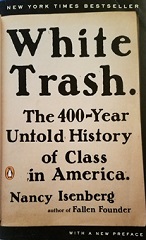 When I first saw the title of this book, I felt my body slightly recoil. In fact, the book was recommended to me by my boss who is a White-American. Previously, Amazon had placed the book on the list of recommended titles for my purchase but I had yet to take the plunge. This time around, I gave in and decided to see what was contained in the pages of this book. Having finished, I can say without a doubt that Nancy Isenberg has produced an eye-opening account of what truly is the untold 400- year history about class and race in America. At first glance, it may seem as if the book is a racist attack on people perceived to be of a lower social class. But in fact, the opposite is true. Isenberg brings light to the suffering and exploitation of a social class that is still disdained and mocked even today. The 2016 Presidential election brought the subject back into the public light provoking fierce debates about the success of the Republican Party and the election of Donald J. Trump. But the question truly remains, what does it mean to be called white trash?
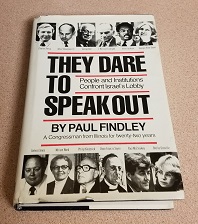 The title alone is enough to grab a person’s attention. Because of the subject matter, it was bound to stir controversy for it touches a topic that remains taboo thirty-seven years after its publication. And with the events this past week regarding the U.S. Embassy in Jerusalem, the contents of this book are as important now as they were then. Before you attempt to read this book, it is critical to understand the difference between Judaism and what is referred to as Zionism. There is a fundamental difference between the two that is often forgotten as charges of anti-Semitism and anti-Israel bias are leveled against those who dare to speak out. However, what I have learned from this book, is critical to understanding how our world functions and why peace is seemingly an impossible objective to accomplish in the Middle East.
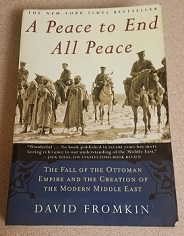 Ideology is sometimes as powerful of a tool as violence and in some cases has been the direct cause of violence. In the Middle East, ideology has maintain a stronghold as it finds itself on a crash course with modernity. Those who live outside the Middle East are at times confused and mystified by the traditions and events that occur throughout the Arab nations. In fact, many of us here in the United States do not know how the modern-day Middle East came into existence. To them, I say that the key to understanding the Middle East is to retrace its history to see why and how it developed into what we know it to be today. David Fromkin lends us a helping hand in this incredible historical investigative account of the fall of the legendary Ottoman Empire and the creation of a region that would never truly know peace.
 FREETHINKING BIBLIOPHILE
You must be logged in to post a comment.