
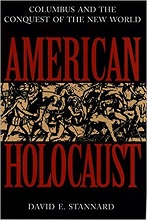
 Earlier this week, my boss mentioned during a Zoom office meeting that Columbus Day needed to be re-examined. He had learned of many dark aspects of Christopher Columbus’ (1451-1506) arrival in the Caribbean. The movement to end the celebration of Columbus’ life has gained considerable traction over the past several years. Some states in America have renamed the Columbus Day to “Indigenous People’s Day”, in honor of the Native Americans who sufferend immensly at the hands of Spanish and other European explorers. It is a sound recommendation and one that may even happen here in New York City as it becomes harder for people to ignore the disturbing actions by Columbus and his group of marauders. Many of us learned in school that he was the man who “discovered America”. But is that what really happened? An uncontested fact is that Columbus never set foot on North American soil, making the claim of discovering America misleading. And we know today after many years of neglect by mainstream media, is that indigenous populations were decimated when exposed to the new visitors from abroad. The true story however, goes far beyond Columbus, who was just one of many bloodthirsty religious fanatics who favored violence over peaceful assimilation. David E. Stannard revisits the Columbus story in this eye-opening and chilling account that resulted in a stiff drink and a long moment of silence after I had finished reading.
I need to point out from the start that this book is not for the faint at heart. If you are easily upset by graphic descriptions of barbaric actions, then this book may not be for you. It is dark, chilling and beyond tragic. And that is exactly why the way history is taught in the United States is in need of change. Although the cover of the book gives the impression that the story is solely about Columbus, there is actually far more included in the book regarding the arrival of Spanish and English explorers whose wave of destruction spread across North America, the Caribbean, Central America and South America.
One question that has always typically been asked about the Americas is how long did the native population live there? It is a good question and Stannard does provide a discussion about the original inhabitants of the Americas. And what he says might suprise some readers. I found the topic of Berengia to be highly interesting. The Berengia theory for human migration into the Americas is plausbible and the Bering Land Bridge which no longer exist, gives credence to the author’s point. However, what is clear is that what we call the Americas had been populated by anicent civilizations thousands of years ago. Creationists may believe differently but to completely diregard the science at hand would be highly unfortunate as the author provides a thorough discussion of humanity’s existence.
The story picks up pace as the Spanish arrive in the New World. in August of 1492, Columbus and his crew wasted no time in implementing their program of terror upon the natives. The violence is nothing short of gratuitous and disease proved to be just a deadly. The combination of the two as detailed in the book, had long reaching and long-term effects from which the Americas have never fully recovered. And in case defenders of Columbus and other explorers point to disease as the major killer, Stannard has this to say:
However, by focusing almost entirely on disease, by displacing responsibility for the mass killing onto an army of invading microbes, contemporary authors increasingly have created the impression that the eradication of those tens of millions of people was inadvertent—a sad, but both inevitable and “unintended consequence” of human migration and progress.
The names of the tribes that suffered so much destruction are voluminous and I learned the name of several that I had no prior knowledge of. Their names are almost endless and I am sure that only a fraction of the true number of indigenous tribes that called the Americas home are covered here. In North America alone there were hundreds of tribes, some of which are now extinct including the Canarsie, who have a neighborhood and high school dedicated in their honor right here in my hometown of Brooklyn, New York. Sadly, most do not know the true story of the Canarise but this book certainly does provide an idea.
Aside from the grim account at hand, Stannard takes yet another approach and explores the reasons behind the Spanish exploration across the ocean. The true reason for Columbus’ voyage should cause readers to take notice about how much he knew about navigation and the position of the Spain in the European hierarchy. Putting that aside, there is a much darker aspect to the Spanish missions and this is where religion enters the story. Many of us know of the Crusades and the horrors of Christianity but in regards to Columbus, there is far more than meets the eye. The mind-boggling details are included in Stannard’s account revealing yet another side of Columbus that will make many stare in disbelief at the words they are reading. And if that is not enough, there were yet other reasons for the Spanish conquest and the end result left me shaking my head.
Halfway through the book I felt as if I needed a break but pressed on as I knew there was much more to learn about extermination of Native Americans in what is today called the United States. Stannard keeps the discussion streamlines but does mention the Trial of Tears and Wounded Knee. Each of those topics would require a separate book to fully go into the stories behind the tragedies. The purpose here is to show the different ideologies behind Spanish and British actions in the Americas which both led to the same result for native populations. The atrocities committed against Native Americans by the United States Government aare beyond upsetting and amount of gore found in recollections of the events might cause some readers to revolt in disgust. Quite frankly, the European arrival in North America was just as deadly as the Spanish pillaging of Central and South America. Each empire had its own reasons but for both, religious ideology, finanical motives and beliefs in racial superiority resulted in what Stannard believes to be the worst genocide in world history. In fact, he states pointedly: “the destruction of the Indians of the Americas was, far and away, the most massive act of genocide in the history of the world.¨
After I finished the book, I had to sit in silence for a while to digest what I had just taken in. Columbus’ actions were not a surprise to me as I had already known of his dark legacy. What I did not know were the names of the numerous forgotten tribes of the Americas who no longer exist today. The systematic destruction and eradication of their lives and culture is indefensible and nothing short of genocide, sexual exploitation and the plundering of territory inhabited by others whose way of life was completely changed by new faces upon their shores. If this book does only thing, I hope that is to shatter the myth of the new settlers in the Americas arriving with open arms and becoming fast friends with the native peoples. Revisiting the past is often painful and reveals many disturbing facts that we would rather not know. But if we are to have a frank and honest discussion about the people we have long called “heroic” and trailblazing” then all of their deeds should be open to examination. This book is masterfully written, haunting but yet eerily relevant even today.
ASIN: B004TFXREI
 History has many dark secrets that some have wished remained hidden from the official record so that the history that has been portrayed remains sanitized and above reproach. But it is also said that what you do in the dark always comes to light. In the wake of the coup that saw the overthrow of Chilean President Salvador Allende (1908-1973) on September 11, 1973, the country was placed in a vice grip by his successor, Augusto Pinochet (1915-2006), who commenced a program of retribution against enemies, activist and those “suspected” of being part of the opposition to the new government. His regime was marred by human rights violations for which he was arrested by British Police in England on October 17, 1998. Pinochet was extradited back to his native Chile but never stood trial for his actions. He died on December 10, 2006 of congestive heart failure and pulmonary edema. His death marked the end of legal action to bring him to justice but it did not stop the prosecution of others who were complicit in the horrific actions that took place in the aftermath of the coup. Researchers continued to investigate Pinochet’s actions and those of fellow dictators in Argentina, Brazil, Paraguay and Uruguay. During one such expedition in Paraguay, a trove of documents were uncovered that shed light on a joint program created by several neighboring countries to track down those deemed enemies of the state with the purpose of execution. The program is known as Operation Condor and here Charles River Editors provides a concise summary of how and why the program came into existence.
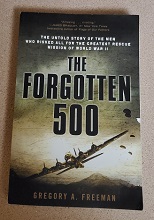 A colleague gave me this book as a gift during the holiday season, mainly due to his knowledge of my fondness for history. I quickly made a mental note to give it a read in the near future. When I saw the title, I was slightly puzzled at the term “The Forgotten 500”. I have read books on World War II but none mentioned any 500 forgotten soldiers. Upon closer inspection, I soon began to realize why I had not heard the story. At the time the mission occurred, it was carefully hidden by the State Department and Office of Strategic Services who did not wish to jeopardize the lives of any remaining U.S. soldiers still trapped behind enemy lines. Further, in the years that followed, the the story faded into the annals of military history regarding the second world war. Even my father, who is an ardent World War II buff, has never mentioned this story. Our next discussion will certainly be interesting.
 President John F. Kennedy (1917-1963) is known primarily from his time in the White House and untimely death but many forget that he was also an accomplished writer. In the well-received “
 When I saw this book on Amazon, I was a skeptical as to what I found find inside of it. However, the nearly five star reviews convinced me to inspect it a bit further. I took the plunge and ordered it to see exactly what Shelby Steele had to say about race, a topic that continues to either unite or divide people in America. The phrase “content of our character” is known to many of us. It was the pivotal moment of Dr. Martin Luther King, Jr.’s (1929-1968) “I Have a Dream” speech on August 28, 1963. Fifty-seven years have passed since that monumental moment in American history and the question remains, do we judge each other on the content of our character? Further, have we progressed as a society or is America still the same place it was when Jim Crow made life miserable for millions of black Americans and others who emigrated to the United States in search of opportunity?
 In the state of South Dakota, the Pine Ridge Reservation is home to the descendants of the Oglala Sioux Native American tribe. The children of Pine Ridge aspire to enroll in the Red Cloud High School with hopes of attending college. Many of their parent, suffer from alcoholism, a plague that has followed the Oglala Sioux since their first encounter with white settlers in the early 1800s. Poverty and discrimination have resulted in depression and despair which has yet to be fully addressed. The true story of the Native American experience remains misunderstood and in some cases neglected. They current day Oglala are the descendants of indigenous people whose home was a North American continent in which life was simple yet effective with languages largely unwritten and passed down through oral teaching. The Sioux were only one of hundreds of tribes, some of whom are now extinct such as the Canarsie Indians. Chief Luther Standing Bear (1868-1939) was born in Rosebud, South Dakota into the Oglala Sioux tribe and this is his story of his life and his people.
 The history of Native Americans was for many years, untold and in some cases omitted. the trail of tears is just one example of the systematic process of relocation enforced by the United States Government as America continued to expand. The natives were seen as uncivilized in comparison to their American and European counterparts. The natives would readily say their lives were uncomplicated and simple. Many resisted the influence of soldiers on their land and fought to the death to preserve their homes. Others did not resist and accepted the lifestyle and religion of the white man. Dr. Charles Alexander Eastman (1858-1939) was one of those who migrated from one world to another and in this short but interesting autobiography, he recalls his life and his path from the deep woods to civilization.
 The cover of this book is bound to cause many to do a double take. The crossing out of the word black is far from subtle, but anyone who is familiar with the late Richard Claxton “Dick” Gregory (1932-2017), will know that subtlety was not in his character. He was known as a star comedian for many years but he was also a civil rights activist, nutrition guru, social critic, writer and occasional actor. His death marked the passing of a icon whose sharp wit and frankness earned him the respect of his peers and people across the nation. Published after his death, this book takes a look at the official history of African Americans that Americans have been told for more than a century. Gregory makes it clear early in the book that American History and Black History are one in the same. It is a valid point and for African Americans, the United States is the only home that many have ever known. The history that has been taught in classrooms across America continues to be re-examined in the pursuit of the truth by historians and independent researchers. The gift of the internet has allowed truth-seekers to reach audiences of monumental sizes as we step back in time to learn what really did happen with regards to pivotal events that shaped the modern day United States.
 On the morning of February 26, 1993, Ramzi Yousef and a team of terrorist drove a bomb laden van into the basement of the World Trade Center complex in New York City. As I watched the news from across the river in Brooklyn that morning, I felt a sense of shock and vulnerability. America had been attacked. When Ramzi Yousef was captured and extradited to New York to stand trial, many New Yorkers breathed a sigh of relief. The Hon. Kevin Duffy sentenced Yousef to life with no parole plus an additional 240 years which he is currently serving at the ADX Florence Supermax facility in Fremont County, Colorado. Eight years later on September 11, 2001, America was attacked again when terrorists hijacked four commercial airliners, crashing two into the World Trade Center, one into the Pentagon and the final aircraft outside of Shanksville, Pennsylvania. The response from Washington was swift and a show of force nearly unparalleled in modern times. The mission to capture those responsible and root out terrorists, led to Afghanistan, a land-locked country in South-Central Asia. Images of U.S. troops and the enemy Taliban flashed across news screens as reports of successes in the mission to root out terror were triumphantly proclaimed. To many Americans, Afghanistan was another far away place across the world where people lived in ways that seemed to be from ancient times, going against “American ideals”. Today, Afghanistan is nearly completely forgotten by the American public. There has been no news about what America’s current role is and plans to withdraw American forces have been cast aside as yet another victim of the focus on what has become reality television politics. The story of Afghanistan and its importance to world history is often misunderstood and in some cases not even recognized. But there is far more that meets the eye and author Steve Coll explores this topic in this New York Times bestseller that tells the full story what did happen in Afghanistan between the Soviet Invasion and the deadly attacks on September 11, 2001.
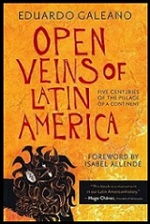 Latin America is home to some of the most beautiful scenery in the world. The Iguazu Falls, Andes Mountains and Patagonia attract millions of visitors annually. The beauty of these and other sites across Latin America stand in stark contrast to the poverty that can be found outside of major cities and sometimes within. In between major railway stations and ports exist slums that remind us of the severely uneven distribution of wealth throughout the continent. Speaking from personal experience, most Americans would be shocked at living conditions that still exist in Latin America to this day. But why does a continent with a history that goes back several hundred years and is home to beautiful people, beautiful languages, great foods and beautiful scenes of nature, continue to suffer from poverty, corruption and exploitation.

You must be logged in to post a comment.