
 On June 8, 1967, the USS Liberty was on a reconnaissance mission in the Mediterranean Sea near Sinai, Egypt. The morning started off normally until members of the ship’s crew noticed Israeli fighter jets circling above. The process was repeated several times more before a full-scale attacked was launched upon the unsuspecting ship. Thirty-four men perished in the attacks. Nearly all of the survivors were severely wounded with injuries that could only be described as horrific. The attack caused international outrage as the American and Israeli governments acted to contain the fallout from the nefarious attack. The official statement was that the attack was a grave error committed by Israeli forces upon a ship that allegedly had no clear markings identifying it as a United States Naval vessel. Members of the crew disputed this and some have made their voices heard in an attempt to tell what they know about that day tragic day in June, 1967. James M. Ennes, Jr., was a member of the crew and survived the attacked with a severely broken leg and other mental and physical injuries. He was one of the lucky ones and never wavered in his conviction to tell the truth about what he remembers from that day. Here he tells us the story from his recollections on record for the reader to digest and form an informed opinion.
The book was published in 1979, roughly about twelve years following the attack. Mysteries of that day still remain but it is here that we have a more accurate picture of what really did happen and a possible explanation as for why it happened. Ennes states that there are some aspects of the incident that will probably remain unknown for a long time. But what he does reveal about the incident is shocking and confusing. Perhaps the biggest question is why would Israeli fighter planes attack a U.S. vessel clearly marked and not on a combat mission?
The story begins before the Liberty arrives near the coast of Egypt. Orders were dispatched for the Liberty to change its position but were never received by the ship due to poor communication channels. If the orders had been received, then maybe this book would not exist. Ennes’ memories are very candid and show some what life is like for men on the seas, far away from home and surrounded by water on all side. The anecdotes at the beginning of the book are entertaining and slowly we are introduced to the characters in the story. Their mission appears to be moving along slowly until June 8, when all hell broke loose. It is at this point in the book, where we reach Defcon 1 and the fallout is horrifying. Readers with sensitive stomachs may find the latter part of the book highly uncomfortable to read. The descriptions of the injuries sustained by survivors and the deaths of other crew members are told in detail giving a graphic picture of the carnage that ensued. And what is even more appalling is the lack of support from Washington and the conflicting orders given to military personnel that sought to provide assistance to the critically injured ship and its crew.
As we make our way through the book and the attack is over, the period of recuperation and investigation comes into focus. This is the point in the book where shock turns into anger. Nearly all of the major political figures involved are deceased and unable to answer questions we may have. But what did happen as Ennes shows us, is that a cover-up was initiated at the highest levels of government for reasons which eluded the crew. Citations for bravery and reparations by the Israeli government followed but the manner in which they occurred will stun even the most hardened readers. The lives of the surviving crew members were changed forever and few have been able to fully tell their stories without repercussions from military brass and the White House. Even today, fifty years later, secrets remain about the motives behind the attack. We may never know all of the details of the attack but we do have a place to start here. Ennes deserves an additional acknowledgment for being able to distinguish between the actions of the Israeli government and people of the Jewish faith. Having survived an attack of such nature, it would have been fairly easy for him to cast all Jews as perpetrators of an unthinkable crime. But Ennes avoids the pitfall and makes it clear that the attack was carried about by Jewish people but by individuals with motives of their own.
Towards the end of the book, Ennes touches on the possible motive behind the attack. And while there is no conclusive evidence that his belief is correct, it is a highly plausible explanation. In time his words may prove to be true but for now, we are still saddled with a number of unanswered questions surrounding the attack. But with this story of tragedy and perseverance, we are closer to fully understanding the events of that day.
ISBN-10: 0394505123
ISBN-13: 978-0394505121

 The Second World War remains the most brutal conflict in history. The number of those who perished is still up for debate and there are many secrets of the war that have been lost to history forever. In the United States, foreign-born citizens with roots in any of the countries part of the Axis powers, found their selves under suspicion and in the case of the Japanese, placed into concentration camps. Although not as inhumane and deadly as the camps in Germany and Poland, they resulted in the rise of resentment among Japanese-Americans toward the United States Government and the country they called home. The dropping of the Atomic bombs further heightened the feeling of resentment and was the first and only time a nuclear weapon was used in warfare. Survivors of the bomb attacks can still be found today, advanced in their years but tragically familiar with the barbarity of modern warfare. Across the pacific, Japanese-American veterans of the war remember the tragedy that befell Japan, the nation to which their families trace their origins. But what happens when half of a family is in Japan and the other half is in the United States? Or what do you do when one son is part of the Japanese Imperial Army and the other is part of the United States Armed Forces? And when the war is over, how do you come to terms with the effects war has had on your family and yourself? This is the story of the Fukuhara family whose lives are the answer to those questions. Written by Pamela Rotner Sakamoto and containing snippets of interviews conducted with those relevant to the story, Midnight in Broad Daylight is a heart wrenching story of a family struggling to survive, having been affected by a war in more ways than one.
 The name Idi Amin remains among the most infamous our world has ever known. Following the overthrow that removed Milton Obote (1925-2005) from power, the late despot ruled Uganda with relentless brutality as he enriched himself at the peril of hundreds of thousands of Ugandans. In January, 1979, the Ugandan National Liberation Army forced him into exile with the help of the Tanzania People’s Defense Force and former Libyan dictator Libya’s Muammar Gaddafi (1942-2011). Amin spent the last years of his life in Jeddah, Saudi Arabia, where he died on August 16, 2003. Today, nearly fifteen years after his death, he is still reviled by those who remember a dark period in the history of Uganda.
 The 2016 presidential election remains an event that bordered on the surreal and shocked not just American citizens but people around the globe. Donald J. Trump, the political outsider and least likely candidate to win, secured the Republican nomination and the electoral votes needed to become the 45th President of the United States of America. As we begin 2018 we can look back on his first year and office and reach various conclusions depending on our political outlook and beliefs about the state of the nation. What is certain, is that from the start, his administration has been plagued with allegations of collusion with nefarious figures hailing from Russia. Prior to his election, he often showed admiration for Vladimir Putin and since taking office, has taken a passive stance on the country that is believed by intelligence experts to have interfered in the elections of several nations. Former FBI Director Robert Mueller has been appointed Special Counsel to investigate the Trump campaign’s ties to Russia and as of today, the investigation is still ongoing. And while there is no fire yet, there is a lot of smoke.
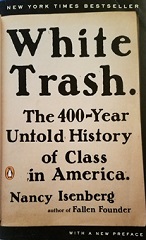 When I first saw the title of this book, I felt my body slightly recoil. In fact, the book was recommended to me by my boss who is a White-American. Previously, Amazon had placed the book on the list of recommended titles for my purchase but I had yet to take the plunge. This time around, I gave in and decided to see what was contained in the pages of this book. Having finished, I can say without a doubt that Nancy Isenberg has produced an eye-opening account of what truly is the untold 400- year history about class and race in America. At first glance, it may seem as if the book is a racist attack on people perceived to be of a lower social class. But in fact, the opposite is true. Isenberg brings light to the suffering and exploitation of a social class that is still disdained and mocked even today. The 2016 Presidential election brought the subject back into the public light provoking fierce debates about the success of the Republican Party and the election of Donald J. Trump. But the question truly remains, what does it mean to be called white trash?
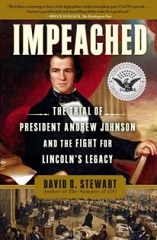 The American Civil War remains a key turning point in United States history. The nation nearly tore itself apart as the Union and Confederacy engaged in deadly conflict over several issues including States’ rights, secession, and the system of slavery. Prior to its conclusion, President Abraham Lincoln (1809-1865) met his tragic end on April 15, 1965, falling victim to assassin John Wilkes Booth at Ford’s Theater in Washington, D.C. Andrew Johnson, then Vice-President and Democrat, succeeded Lincoln as the 17th President of the Unite States of America. He would only serve in office through 1869 when Lincoln’s term would have ended, but in that short period, his administration would be the center of one of the most critical trials in United States history.
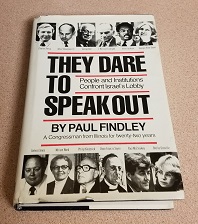 The title alone is enough to grab a person’s attention. Because of the subject matter, it was bound to stir controversy for it touches a topic that remains taboo thirty-seven years after its publication. And with the events this past week regarding the U.S. Embassy in Jerusalem, the contents of this book are as important now as they were then. Before you attempt to read this book, it is critical to understand the difference between Judaism and what is referred to as Zionism. There is a fundamental difference between the two that is often forgotten as charges of anti-Semitism and anti-Israel bias are leveled against those who dare to speak out. However, what I have learned from this book, is critical to understanding how our world functions and why peace is seemingly an impossible objective to accomplish in the Middle East.
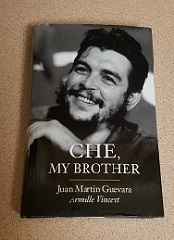 October 10, 1967 – Argentine newspaper Clarin announces that Ernesto “Che” Guevara (1928-1967) has died in Bolivia on October 9 after being capture with a group of guerrilla fighters attempting to spread revolutionary ideology throughout Latin America. In Buenos Aires, his family receives the news of his death and is completely devastated. Juan Martin, his younger brother, races to his father’s apartment where his mother and siblings have gathered as they attempt to piece together the last moments of Ernesto’s life. Che was secretly buried in an unmarked grave and his remains remained hidden for thirty years before author Jon Lee Anderson convinced a retired Bolivian general to reveal the grave’s location. His remains were returned to Havana on July 13, 1997 where he was buried with full military honors on October 17, 1997. In death, Che’s legacy grew exponentially and even today in 2017, he is the icon of revolution around the world. But after his death, what happened to his family and where did their lives take them? Juan Martin, at seventy-two years old, has decided to tell his story and reveal to us many facts about the Guevara family that have sometimes been overlooked by history.
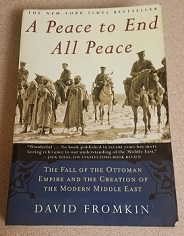 Ideology is sometimes as powerful of a tool as violence and in some cases has been the direct cause of violence. In the Middle East, ideology has maintain a stronghold as it finds itself on a crash course with modernity. Those who live outside the Middle East are at times confused and mystified by the traditions and events that occur throughout the Arab nations. In fact, many of us here in the United States do not know how the modern-day Middle East came into existence. To them, I say that the key to understanding the Middle East is to retrace its history to see why and how it developed into what we know it to be today. David Fromkin lends us a helping hand in this incredible historical investigative account of the fall of the legendary Ottoman Empire and the creation of a region that would never truly know peace.

You must be logged in to post a comment.