
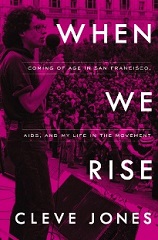
 This past November marked thirty-eight years since City Supervisor Harvey Milk and George Moscone were shot and killed by Dan White. Their murders and the sentencing of Dan White to just five years in prison, led to the White Night Riots and filled the LGBT community of San Franciscans with shame and disgust. After serving several years in prison, Dan White committed suicide in 1981. Milk’s life was adapted for the silver screen in the Gus Van Sant directed biopic Milk. Sean Penn assumed the role of Milk in what became on his greatest performances. Josh Brolin took on the role of the film’s antagonist, Dan White and turned in an equally great performance. They were joined in the cast by James Franco, Alison Pill, Diego Luna and Emile Hirsch who plays the role of activist Cleve Jones. Jones is the most energetic character in the film and serves as Milk’s second in command as they take of Anita Bryant, John Briggs and Proposition 6.
Nearly forty years after their groundbreaking efforts, Jones has penned this autobiography which is not only the story of his life but also about that remarkable time in the Castro when men and women came together to effect profound change in the way Americans thought about sexuality. And as one of Milk’s closest associates, he gives additional insight into how and why many of their decisions came about. The film is about Milk and because Jones is a supporting character, his life is never explored except for the fact that he is from Phoenix, AZ. But was we learn in the book, his life story is simply extraordinary and could easily be adapted for the silver screen itself. Having been a first hand witness to all the major hurdles to be overcome in the movement, he is a treasure trove of history and knowledge. And the revelations in the book about his life and those around him are intriguing and also surprising. As an activist for the rights of the LGBT community, it is to be expected that he faced a severe amount of hate, bigotry and backlash for his efforts. It is detailed in the book and will be tough for some readers to get through but it is necessary in understanding the importance of the movement in which he partook.
Incredibly, he came out to his parents at a young age, but as opposed to what is shown in the film, he had already traveled in and out of the United State and across it even before he formed his allegiance with Milk. The early part of his life is incredible but will resonate with the hearts and minds of those who have the passion for travel. His meetings with Milk and subsequent involvement in Milk’s campaign signified the alignment of two minds united in a common cause. Much younger than Milk, he becomes a student of the movement and quickly makes his mark. And following Milk’s death, he became one of the loudest voices in keeping Milk’s memory and legacy alive. But what is overlooked is his life after Milk’s death which took on yet another critical turn with the onset of the AIDS epidemic. While Milk is covered in the book, this is not the story of Harvey Milk, this is Jones story and this time, Milk is the supporting character.
Accurately portrayed in And The Band Played On, San Francisco became ground zero for the growing HIV epidemic originally believed to be a “gay cancer”. Today we know that the term is pure nonsense and was fabricated by those ignorant of how HIV is spread. His account of the growing crisis which affect those around him is heartbreaking but an all too common story of hundreds or perhaps thousands of LGBT men and women who lived during the era. He does not try to explain the crisis but does lend a voice to what he saw and heard through his experiences and relationships with many of the late leading figures such as activist Bill Kraus and author Randy Shilts. And his own story is guaranteed to leave the reader both shocked and angered in regards to the political and social climate that once existed broadly in America and in some places still does. In spite of everything that happened and his personal struggles, he is still here and his voice is still relevant. He is in an integral part in San Francisco and American history.
Jones is a lifelong activist and his work on behalf of the movement has never ended. In the second half of the book, he tells even more about the continuing movement, his role and life at the time. The battle for marriage equality became the most important crusade and the Supreme Court’s decision deeming parts of Proposition 8 unconstitutional, became a landmark moment in the mission for true equality. Jones was there as a witness and participant and his memories of the effort are important and a testimony that deserves both preservation and exploration. Many years after he is gone, we will look back on his words to understand the enormous amount of work that goes into a movement and the courage that is required to face the daily threat of harm and death. This is his story, one that transcends across all social spectrums and is a historical record of pivotal times in the continuing evolution of the United States of America.
ISBN-10: 0316315435
ISBN-13: 978-0316315432
 In 1955, Dorothy Dandridge was nominated for Best Leading Actress in a Leading Role for her performance in “Carmen Jones”. Her nomination marked the first time an African-American woman had been considered for the prized recognition. Ten years later she was gone, having died of an accidental overdose of prescription pills on September 8, 1965. She was forty-two years old. Her rise and fall in Hollywood is one of the most tragic stories of the era and she joins the ranks of other fallen female greats such as Billie Holiday and Marilyn Monroe. She left behind a legacy that is undeniable and she broke down barriers that other African-American female stars faced prior to her rise to stardom. But for all of her success on the silver screen, Dandridge’s personal life as shown here in this definitive biography by Donald Bogle, shows a woman who struggled throughout her life with her childhood, motherhood, fame, success and love. Her story is largely forgotten but at one point in America history she was one of Hollywood’s biggest actresses.
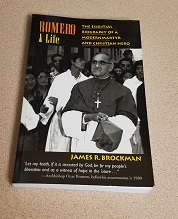 ening of March 24, 1980 marked a changed in the course of the history of El Salvador. In the evening of that day, Archbishop Oscar Romero was shot and fatally wounded as he conducted a mass for his followers. He is rushed to a nearby hospital but quickly succumbs to his wounds. His death plunges the nation in mourning and earns widespread condemnation across the globe. On May 23, 2015, thirty-five years after his death, he was
  On December 30, 1970, Charles “Sonny” Liston (1932-1970) died at his home in Las Vegas, Nevada at the age of thirty-eight. His body was discovered six days later by his wife Geraldine when she returned home from a trip out-of-state with Liston’s son Daniel. It was first suspected that Liston, a known user of heroin, had overdosed. But it was later declared by the coroner’s office that he died of natural causes. To this day it is the official cause of death. The late Liston is remembered as one of the greatest boxers to ever grace a ring. His battles in and out of the ring with Muhammad Ali are some of boxing’s most entertaining moments. Although Liston lacked the personality of Ali or the flair of Floyd Mayweather, Jr., he was feared in the ring as a powerhouse of a brawler unafraid to go in and demolish whoever stood in front of him. His personality in the ring was a direct reflection of his personality outside the ring in a life full of twist, turns and ultimately tragedy. Shaun Assael recounts the short and tragic life of Liston and his death which he believes was in fact a homicide that was wrongly classified at the time of Liston’s death.
 January 26, 1962, Naples, Italy – Salvatore Lucania, also known as Charlie Luciano and Lucky Luciano, dies of a massive heart attack at Naples Airport at the age of 64. The aging mobster had suffered several recent heart attacks and had arrived at the airport to meet film producer Martin Gosch, who was to adapt a screenplay of the legendary mobster’s life. Luciano had resided in Italy since February, 1946 when he left New York Harbor for the last time. The terms of his parole, granted after lending his help to the allied effort in World War II, required that he leave the United States and never return. Tragically, it wasn’t until death that he was allowed to come home when he was interned at St. John’s Cemetery in Middle Village, Queens, New York.
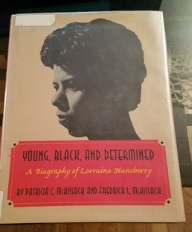 January 12, 2017 will mark fifty-two years since Lorraine Vivian Hansberry (1930-1965) died at the age of thirty-four after a long battle with intestinal cancer. Her masterpiece A Raisin In The Sun and the Broadway play of the same name, broke new ground in America for African-American playwrights. In fact, her play was the first by an African-American woman to have a run on Broadway. The story of the Younger family has been played out in cities all over the country as people have desired to leave their own communities in search of a better quality of life. The book remains her most popular work but just who was the real Lorraine Hansberry? In this biography, Patricia and Fredrick McKissack tell the story of the playwright’s life from start to finish. And what we see is the formation of the one of the most gifted Americans to have ever lived.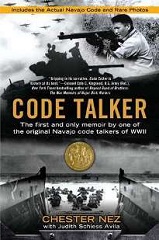
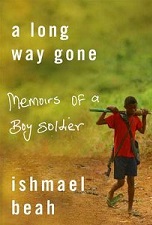 The story of the continent of Africa is one of the most beautiful and tragic we have ever seen. The mass of land that has been described as the cradle of civilization and home to some of the most beautiful places on earth, has also been subjected to severe colonization resulting in continuing poverty, tribal and cultural division and civil wars that nearly destroyed several countries as millions of people lost their lives before the genocidal campaigns were brought to a halt. The story of Rwanda is largely well-known, from books and even a feature film, ‘Hotel Rwanda’ starring Don Cheadle. Rwanda, however, is not the only country to experience a crisis of that nature and as we learn in this memoir by Ishmael Beah, Sierra Leone also has a dark history of internal conflict which caused the nation to be considered one of the most dangerous places in the world. And even to this day, their dark past continues to remain relevant.
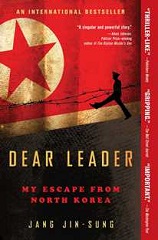 On more than one occasion during my trips abroad, I came to the realization that I had been blessed to have been born in Brooklyn, New York in the United States of America. And while my country has its share of issues that plague the nation, I do enjoy a level of freedom many people around the world would die to have. Because I was born here, it is far to easy to take for granted the rights and privileges that I enjoy as an American citizen both here at home and when I travel outside the country. I’ve always been fond of personal stories of triumph for they remind me that outside of the borders of the place I call home, many people do not have the luxuries or lifestyle that I do. In fact, in many nations in this world, there is next to nothing for millions of men, women and children.
 FREETHINKING BIBLIOPHILE
You must be logged in to post a comment.