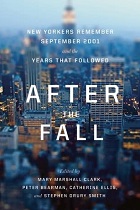
 Twenty years ago on this day, life for New Yorkers and Americans changed permanently. The crash of United Airlines Flight 93 and attacks on the World Trade Center and Pentagon forced America to confront a new deadly reality that terrorism could strike at any time and at any place. Nearly three-thousand people left their homes that morning never to return. As a New Yorker, I can assure you that what we saw that day was beyond horrific and the collapse of both towers at the World Trade Center complex is something that no one will ever forget. Anyone who was in New York City that day and in particular Manhattan, has their own story of what they recall at the moment they learned America was under attack. The editors of this book conducted interviews with various New Yorkers, some of whom were at the World Trade Center during the collapse. Others who gave their time are the heart and soul of New York City and the people we pass on the streets, in the subways, in stores and in other parts of the five boroughs. And through their words, the true horrors of that day come back to life and remind us that tomorrow is not promised.
As I read through the interviews, I noticed the diversity among the speakers which is undoubtedly what makes the book as strong as it is. Some are American citizens by birth and others are immigrants to the land of opportunity. Regardless of their origin, they are each American citizens and deeply affected by what they saw that day. But I must warn readers that some descriptions of the day’s events are graphic and those sensitive to subject matter involving death might want to use discretion. The speakers do not hold back and tell us what they remember as it happened. Videos and photos of people who fell or jumped from the towers can be found online and has been included in multiple documentaries. But reading the words from those who were up close to the events gave me a chill. Further, I realized that the number of people who died in that manner is probably much higher than what has been shown. And these are only some of the memories revisited that are heartbreaking.
Some readers might be surprised at how each person responds to the tragedy. In fact, the changes in each person vary greatly with some becoming dovish in their political views and a few advocating for a tough response. However, not one person is in favor of America embarking on a path of destruction. Their lives were changed forever, and they lost people close to them but what they have to say about 9/11 is deeply profound and a testament to the human spirit that can shine even at the darkest moments. A few of the interviews did stand out and filmmaker/journalist Robert Snyder made this comment which I think exemplifies New York City:
“And I guess the final thing I’d say is that for all the heroism of the uniformed workers [on September 11] we cannot forget that ordinary people, who were not wearing uniforms, helped out too. I was saved by women wearing McDonald’s uniforms. Those were the uniformed people who saved me.”
There were many heroes that day who did their jobs without missing a beat. Others came to the rescue of those in need and aided in the recovery process. That day, all hands were on deck. However, in the wake of the tragedy, opportunists were not far away and one revelation by a volunteer medical technician at the pile (rubble of the WTC) is beyond disturbing. But I cannot say I was completely surprised and believe that it was one example of actions taken by some volunteers present at the pile. Human beings are certainly some very strange creatures at times.
In the years following 9/11 the people interviewed have moved on with life, but the attacks remain with them. Each has struggled in his/her own way but continued through life confronting their demons the best way they know how. The death and destruction they witnessed that day was unimaginable but unfortunately a reality that some re-live every day. Those of us who were not there and observing from a distance may not be able to fully relate to what they deal with, but I believe in learning their stories and reading what they have to say, we give them the time and space they deserve to tell others what they know about a dark that America cannot and will not forget. And nor should it. Highly recommended.
ASIN: B005GPSKQ0
This post will be a little different as I decided to include what I remember of the attacks. I have often been asked as a New Yorker, to explain what was taking place in various parts of Manhattan. I did not work at the World Trade Center (“WTC”) complex but had been there many times before September 11th. Though twenty years have passed, it still feels as if the attacks happened yesterday. I am sure the same applies to thousands of others who were in New York City that day. This may sound cliche, but that Tuesday morning began as quiet as one could expect. Others have mentioned in interviews that the weather was perfect that day. I concur and the sky that morning was the bluest I have ever seen. There were no clouds or strong winds, plus there was little to no humidity that day. It was a stunningly beautiful September morning. When I left home, I was upbeat and looked forward to a quiet but productive day at the office.
That morning I decided to take the 3 train into Manhattan, and I recall that very few people were on board. A little before 9:00 a.m., the train reached the Park Place Station where it was held by the station dispatcher. The conductor did not have much to report and seemed to be as confused as the passengers. But I distinctly recall that while the doors were open, a group of office workers entered the car. A woman sitting close to where they were standing, overheard their discussion and said, “what did you say?” One of the men replied, “a plane hit the World Trade Center”. All of us in the subway car looked at each other not knowing what to expect. My first thought was what idiot decided to fly into the WTC? And how could they not see that huge tower? I assumed that the Fire Department would handle it and that someone in a small Cessna or similar aircraft had not been paying attention at the controls. We had no idea of the magnitude of the emergency.
Eventually the train left the station but all of us were left a little uneasy knowing that some sort of aircraft had crashed into the WTC. As the train pulled into 34th Street, I thought to myself that once I reached the office, I could find out exactly what was going on. After walking through Penn Station and down West 31st Street, I reached 21 Penn Plaza at the corner of 9th Avenue where the office was located. I took the elevator up to the 15th floor and while walking down the hall I noticed that the everyone was in the conference room with the television on. This was strange because there were no depositions or meetings scheduled for that day. I poked my head in and caught a glimpse of the television screen. At that point, I realized that the first plane which struck the North Tower was definitely not a Cessna. I also realized that the second plane was no accident. America was under attack. Instantly I headed to the men’s restroom which had windows facing Lower Manhattan. And there I had an unobstructed view of both towers on fire. The black smoke was surreal and at first, I found myself speechless.
I do not recall who, but someone had a radio turned on and we would hear bits of information coming through. The television was still on, but I don’t know if any of us heard what was being said. Cell phones networks were jammed so getting a call to go through was nearly impossible and because it was 2001, I had no idea what text messaging was and doubt that my phone at that time even had the ability to do it. But surprisingly, email was still working so I logged into the computer and sent a message to my girlfriend at the time who was working at John Jay College on West 59th Street. She was already on her way home as most people were. In fact, on 9th Avenue, there were hundreds of people walking north towards the Port Authority Bus Terminal and their apartments. I had never seen so many people walking on 9th Avenue at any given time. The scene was surreal and looked like something out of a Hollywood film. You could hear fighter jets in the skies and emergency sirens everywhere as police, fire and emergency medical vehicles raced downtown towards the WTC. By this time, people had already left our building and were headed to pick up their kids and loved ones. The boss had wanted the staff to stay a little longer until things calmed down but the idea most of us had was to get out of Manhattan. But we assumed that the towers would be fine. You see, up until that point, almost no one thought they would collapse. I did not think that would happen but did feel that a lot of reconstructive work would need to be done to repair the damage from the planes. But when the South Tower fell, the dark reality set in. Not long after that, the North Tower fell, and all hell really broke loose. My boss had been watching from the men’s room and when he came back, his face was serious, and he said “I just watched both of those buildings fall”.
Immediately after the second tower collapsed, the only thought we had in the office was to get out if possible. But the problem was that New York City had gone into full lockdown mode. The tunnels and bridges had been shut down and subway service had been suspended until further notice. Most people just started walking unless they could catch a bus or carpool with a colleague or in some cases a stranger. Surface transit was running but in limited capacity and in some cases re-routed and/or re-deployed for emergency use. Realizing that without the trains, I would be forced to walk for at least several hours, I stayed at the office as there was no clear way for me to get home. I remember that the noise from the fighter jets streaming over Manhattan became louder and made us even more nervous. Further, the collapse of the towers caused debris to damage a Verizon switching station near 7 World Trade Center. The result was interruption in phone service for thousands of customers. At this point, I realized I hadn’t spoken to my parents, but I knew my father was working in New Jersey that day. My mother was near Grand Central Station and far away from Lower Manhattan. I knew she was safe as well, but it was unsettling that I had not been able to speak to either of them. My brother was safe at Adelphi University in Garden City, New York.
We continued to watch the news and gasped at the images from the Pentagon. At this point, the office manager nearly shaking with rage. Rumors had started that another plane might be headed to Manhattan, so authorities took no chances and made everyone leave and get out of Lower Manhattan. But in midtown there were hardly any police on the streets as most had been sent to help out at the WTC and the surrounding area. The news coverage continued to play on the television, and we spent the rest of the morning trying to reach as many people as we could to find out if they were safe. It was clear that no one was working on anything that day. We knew that the office was a safe location and thankfully, there was no issue with the power in the building. Around noon, I went to the men’s room and looked out the window only to see a cloud of dust from the debris blowing across Lower Manhattan. It felt as if we were all in a bad dream that we could not get out of. None of it seemed real. I thought to myself, how could they be gone? The buildings were each over 100 stories tall, how could they collapse to rubble that fast? Nothing made sense that day.
I don’t remember exactly when the news came out about the hijackers’ identities but when it did, I felt a chill because the delicatessen on the ground level was operated by immigrants from Yemen. And we knew they would become a target for anyone looking to vent their rage. Thankfully, I never heard of any acts of violence being committed against them. As we learned more about those fingered by the Federal Bureau of Investigation, it became clear that this attack would have long lasting repercussion and life would not be the same again. True, most of us remembered the first bombing of the WTC in 1993 but that was nothing like what we saw that day. The first bombing occurred on a cold February day that brought light snow to the Big Apple. But make no mistake, the bomb set off by Ramzi Yousef sent shockwaves through the city. However, the towers continued to stand and though hundreds were injured there were fewer than ten deaths. I was at home watching the news live as emergency crews moved to contain the situation. Yousef was eventually caught and now resides at the Supermax facility in Florence, Colorado. Had he not been captured; his next plan would have unleashed a wave of terror unlike anything we had ever seen.
If I said to you that none of us were afraid that day, I would be lying. The truth is that we had no idea what was coming next and were horrified at what we saw. And if the Pentagon could be attacked, what was next? The White House? In hindsight I see that would not have happened as all air traffic had been grounded by the Federal Aviation Administration (“FAA”). But at the time, we were unaware of the nationwide shutdown in effect and did not learn of it until later in the day. Around 3:00 p.m., I made plans to leave the office because limited subway service had been restored. Lower Manhattan had become a disaster zone and we did not learn of the full damage to the 1/9 subway line until weeks later. (Today, only the 1 train runs, the 9 was retired several years ago) Outside the building, people were moving fast and trying their best to get home. But one thing I noticed is how quiet the streets were. Many people were in shock and lost in their thoughts. Some were crying as they walked. We were all moving around but when you looked into someone’s eyes you could tell that they too were thinking about what was happening to New York City and America. Later I thought that some of the people I passed might have known someone who worked at the WTC or had a relative there that day. And others had gone nearly an entire day without being able to reach their loved ones. I managed to catch a downtown C train and transferred at 14th Street for a Canarsie bound L-train. At Broadway Junction, the L becomes elevated, and I remember looking out the window and seeing the smoke still rising in the distance. Everyone on the train was staring into the distance trying to comprehend what our eyes were seeing. None one said a word. The attack had left us speechless.
When I finally reached home the apartment was empty. My mother had to wait in Manhattan for an express bus which was delayed due to the tunnel closures. My dad had been forced to camp out at a gas station along route 1/9 once the entry ways into NYC were sealed. The next day he came home exhausted and had one of the stiffest drinks I’ve seen him take. After I took off my shoes, I turned on the television to watch Mayor Giuliani’s press conference. To this day I have never seen him look as somber as he did that evening. After being forced to flee the command center near the WTC complex, the mayor had to confront the reality that thousands of people were feared dead and over 300 firemen were missing. (Later I learned that the siren sounds in video footage were the alarms firemen had that were set to go off if they were incapacitated) The full death toll would not be known for several weeks later. That first night the focus was still on rescuing anyone still alive. Outside my building the street was quiet. In fact, the city was quiet as we came to terms with what happened that day. The nightmare was far from over and soon pictures of those missing began to appear all over Lower Manhattan. There were so many faces that it was haunting to think about their last moments before the collapse. I watched the news that night but to be honest, things became a blur as my mind could not focus on anything. The realization that the WTC was gone was too much to bear. How could NYC exist without the Twin Towers? Nearly every film about New York City had a shot of the towers somewhere in the film. To say that they were iconic is an understatement. I then thought of the people that died. What happened to them? The scenes of the complex showed nothing but wreckage. Two 100 story buildings were reduced to nearly nothing. Where are the people? The thoughts became darker and more disturbing, and I did not sleep that night. The images of the gaping holes in the tower, people jumping and the mushroom cloud of debris spreading across Lower Manhattan stayed in my mind for months afterwards. After the attacks, my girlfriend at that time switched jobs and found a law office position on Broadway a few blocks from Ground Zero. When I picked her up from work in the evenings, I saw the complex up close and it was surreal to see the ground still smoking months after the attacks. The building in which the Central Intelligence Agency (“CIA”) had its office was sheared in half. I had never seen anything like it and hope I never do again.
I am sure that I probably left small details out of this narrative not by choice but rather because they have been suppressed after so many years. Tonight, as I write this, the lights are shining bright at Ground Zero as a reminder of what once stood there twenty years ago. While walking home from the gym, I took a few minutes to take a good look at the lights and the realization that two decades have passed since the attacks. The devastation we witnessed that day was unprecedented but New Yorkers are resilient. The collective effort I saw from people of all backgrounds in the wake of the attacks made me proud to be American and a native of the city that never sleeps. We knew that we could never go back to the way things were on September 10th. We had no choice but to heal, repair and ultimately rebuild. And it is this unwavering determination to keep going that serves as the basis for the pride that runs deep through the Five Boroughs of New York City.

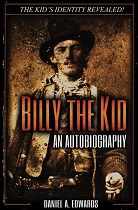 I vividly recall the first time I saw the 1988 Hollywood film Young Guns in which Emilio Estevez played the role of William H. Bonney also known as Bill the Kid (1859-1881). The film was sensational and for many years it was the sole source I had for what Bonney’s life was like. Of course, as a kid I was naive to the way Hollywood works and the liberties that filmmakers take. Today, I know that the story of Billy the Kid is far less glamorous. And while it is true that the Kid did commit several murders, he was not a psychopathic killer or reckless outlaw. Researchers have done their best to set the record straight about the Kid’s violent life. Daniel A. Edwards has thrown his hat into the mix and in this intriguing book, he examines the claim of William “Brushy Bill” Roberts (1879-1950) that he is Billy the Kid and had not been shot by Pat Garrett (1850-1908) on July 14, 1881, in Fort Sumner, New Mexico. Brushy’s claim was quite bold, and he has been written off by some as a crackpot. By all accounts, Brushy was born in 1879 and if so, his claim to be the Kid holds no weight due to the fact that it is generally accepted that the Kid was born in 1859, twenty years earlier. However, Roberts did have knowledge of important events that was not widely known in an era before the internet, social media, and the ease of access to information we have today. His claims are eye catching but is he really the Kid? There is much in the book that could lead readers in either direction. I came away with mixed feelings.
 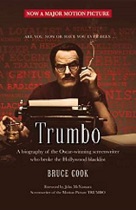 On March 9, 1954, CBS journalist Edward R. Murrow (1908-1965) prepared for a scheduled broadcast of the television program “
 When most of us hear the word “Kennedy” we immediately think of President John F. Kennedy (1917-1963) and former Attorney General Robert F. Kennedy (1925-1968). Although he was in office only for one thousand days, John F. Kennedy set into motion numerous plans, many of which became reality during the administration of his successor Lyndon B. Johnson (1908-1973). Kennedy was a gifted orator and skilled politician but struggled to move legislation through Congress. Johnson lacked the flair and polish of the Kennedys, but he was a master politician and he excelled in the one area that is crucial to presidential success: the Senate. The Kennedys knew that to move the Senate, the old guard would have to be removed one by one. And do that meant putting younger senators in office with moderate and liberal views. As part of this plan, the youngest of the Kennedy clan, Edward M. Kennedy (1932-2009) followed his brothers into politics and made the Senate his home. And though he never became president or even vice-president, Edward M. Kennedy or “Teddy” helped changed the course of American history during the forty-seven years he served in the U.S. Senate. In this first volume of a two-part biography, author Neal Gabler explores Edward Kennedy’s life from his birth in 1932 until the year 1975.
 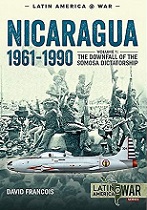 In June 1987, Lt. Col. Oliver North (Ret.) gave testimony in front of the Senate Select Committee on Secret Military Assistance to Iran and the Nicaraguan Opposition and the House Select Committee to Investigate Covert Arms Sales with Iran. The hearings had cast a dark cloud over Washington and the administration of President Ronald W. Reagan (1911-2004) doubled down on anything that could be conceived as illegal pursuant to United States law. I can still recall the shock on my father’s face when the news of the scandal broke across media outlets. The two of us watched the nightly news to learn more about a situation that had danger written all over it. Those who remember the Iran-Contra affair most likely have images in their minds of North testifying in his military dress before Congress. Details of the Reagan administration’s covert plans became unraveled but the full truth about the affair remained elusive for many years. The sale of weapons to foreign nations did not surprise me at all and military hardware has always been big business. But what did catch my attention was the atmosphere in Central America, a region that suffered extensively due to Washington’s support of dictatorships thirsty for blood and determined to crack down on all opposition.
 A few weeks ago, my family had its first gathering in nearly two years. The even took place at Jacob A. Riis Park in Queens, New York. As I walked the boardwalk next to the beach, I wondered how many people there knew the story of Jacob A. Riis (1849-1914) for whom the park is named. In 1890 this book by Riis was published and more than one hundred years later is stands as a crucial piece of writing about the island of Manhattan. At the time Riis wrote the book, the City of New York had yet to be incorporated. That occurred eight years later on January 1, 1898. His focus here is on the tenements in lower Manhattan and the different ethnic groups that inhabited the area. And though New York has changed significantly in the years since Riis wrote this book, the gap between the wealthy and poor still remains wide.
 In 1968, the race for the next President of the United States intensified as sitting President Lyndon B. Johnson (1908-1973) issued a public statement that he did not want, nor would he accept the nomination for his party’s candidate for the oval office. The announcement stunned the nation and took the election in a much different direction. The late David Halberstam (1934-2007) had been following the campaign of former Attorney General and then Senator Robert F. Kennedy (1925-1968)(D-NY). As he observed Kennedy’s evolution into a powerhouse figure, he noted that “Robert Kennedy was in many ways the most interesting figure in American politics, not only because he was a Kennedy, not only because so much of his education had taken place in the public eye—it could be traced by putting together film clips of this decade—but primarily because he was a transitional figure in a transitional year.” Kennedy was riding a wave of popularity and had resurrected the image of Camelot that was assigned to the presidency of his older brother John F. Kennedy (1917-1963).
 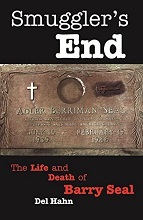 Americans in my age range and older will easily recall Nancy Reagan’s (1921-2016) advice to “just say no” to drugs. At the time, America had become fully engulfed in a deadly war against the rising trafficking and use of narcotics. The federal government continued to increase spending each year in the effort to combat drugs in America but regardless of the approach, the drugs kept coming and brought with them lengthy jail sentences, murder, and scores of addicts. However, the drugs did not arrive without help. Drug traffickers quickly realized that the growing market for cocaine and other hard drugs also produced large amounts of money. Drug routes began to sprout up all over the planet as traffickers continued to find ways to elude authorities. Stories of their exploits are plenty. And I believe everyone knows the names of the major drug kingpins such as Pablo Escobar (1949-1993) and Joaquin Guzman known as “El Chapo”. The bosses made the deals, but the groundwork was left to those willing to risk death and capture in a market worth billions of dollars. Among these fearless individuals was Adler Berriman “Barry” Seal (1939-1986). Fans of the Netflix show
 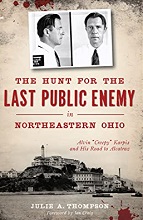 A few years ago, I visited San Francisco and decided to take the boat ride around the bay under the Golden Gate Bridge. As the vessel made its way back to the dock, it traveled around the eastern side of the defunct prison once known as Alcatraz. The facility has long been closed but seeing it in person puts the stories about it into a new perspective. To some, the prison was simply known as “the rock”. Regardless of what it was called, it was home to some of America’s most dangerous criminals. And make no mistake, a decision to send an inmate to Alcatraz was not made lightly. Further, inmates knew that if you were sent to Alcatraz, you better be prepared to spend a lot of years there. Alvin F. Karpis (1907-1979) spent three decades at Alcatraz and in the annals of American history, he remains one of the most prominent crime figures from the outlaw era that saw the rise of such as John Dillinger (1903-1934), George “Baby Face” Nelson (1908-1934) and the deadly duo of Bonny Parker (1910-1934) and Clyde Barrow (1909-1934). Unlike many other outlaws, Karpis not only survived the 1930s but was eventually released from Alcatraz. This is the story his time on the run, capture by the Federal Bureau of Investigation (“FBI”) and later years as a free man.

You must be logged in to post a comment.