Ribbentrop: A Biography – Michael Bloch

20190202_003914On September 1, 1939, the Second World War began as the German army invaded Poland as part of Adolf Hitler’s quest for world domination.  Britain had warned Germany that any military action against Poland would result in England coming to the aid of its ally.  Interestingly, Adolf Hitler (1889-1945) did not want to go to war with England, preferring to accomplish the annexation of Poland through diplomatic methods after having successfully partitioned Czechoslovakia in what is infamously referred to as the “appeasement at Munich”.  But if Hitler did not want to wage war against Britain, knowing their intention to save Poland, then why did he give approval to the invasion that plunged the world into a major conflict?  The answer to that question lies in the story of his Foreign Minister and Nuremberg defendant, Ulrich Friedrich Wilhelm Joachim von Ribbentrop (1893-1946).

In the annals of the Third Reich, perhaps no other figure is as glanced over as Joachim von Ribbentrop.  Standing next to nefarious characters such as Hermann Goering (1893-1946), Joseph Goebbels (1897-1945) and Heinrich Himmler  (1900-1945), he is often an afterthought.   Semi-illiterate but able to speak fluent English, he was one of the few officials in the Third Reich with extensive exposure to the culture of the west. And the time he spent in London early in his life, made him the right choice by Hitler for the position of Ambassador to Great Britain.  By all accounts, no one found him to be enjoyable company but incredibly, he maintained a position close to Hitler’s ear with the Führer listening intently and in some cases implementing Ribbentrop’s suggestions.  Their unusual relationship would have dire consequences in 1939 at Hitler set his sights on Poland. It is here in this phenomenal biography that we learn another part of the story behind the Poland invasion and Ribbentrop’s critical role in the events.

At first glance, it is easy to write of Ribbentrop as “non-essential” to the story of the Third Reich.  And although he is mentioned in many books about the Nazi regime, his role is typically minor in the grand scheme of events.  But make no mistake, his advice and misconceptions about foreign nations, played pivotal roles in the rise and fall of the Third SS Reich. Bloch has capture Ribbentrop’s life beautifully in this biography that tells the story of the former Foreign Minister for all to see.  In comparison to the other figures of the Nazi regime, his personal life could be considered average.  But his entry in the Nazi party and actions thereafter, helped changed the course of history.  As I was reading the book, I could not help feeling mystified as to how a figure such as Ribbentrop maintained the confidence of Hitler as each blunder piled up.   Admittedly, Hitler did not consult him on every foreign policy matter, apparently realizing his many shortcomings.  But he did trust Ribbentrop enough on some of the most important decisions to be made, many of which changed the course of world history and produced a mark on the history of Germany which can never be erased.

Notwithstanding his restricted voice in Hitler’s government, he was an important figure in Hitler’s vision of a Anglo-German unification.  In fact, Ribbentrop’s actions towards and with the British government are the crux of the book.   Naturally, his positions as Ambassador and later Foreign Minister, resulted in his constant communication with the Ambassadors of England, Italy and Japan.  However, his close position to the Führer did not earn him the envoy of others but rather their wrath.  Hitler was known to pit subordinates against each other, using the divide and conquer technique.  Their fights and attempts to sabotage each other take center stage in the book as they compete for Hitler’s approval, the elimination of enemies and advancement in rank.   The story reveals a terrible cast of characters drunk on power and filled with venom for competitors and the Jews of Europe.  Standing center among these characters was the sad Ribbentrop, the man often the butt of jokes and contempt, who was rarely seriously.  Having finished the book, I am dumbfounded as to how Hitler’s administration functioned at all.  The decisions they reached and methods used were simply surreal and Ribbentrop plays a direct part in many of them.

On October 14, 1946, Ribbentrop was the first to be executed after Goering committed suicide in his cell the night before.  He left behind a widow and four children, all of whom are still alive today.  Decades have passed since their father’s death and in the passage of time, their lives will also reach a conclusion.  But they remain witnesses to a time in history in which the world was on the brink of complete anarchy as Adolf Hitler set out to dominate the planet.  Next to him was his fanatically dedicated Foreign Minister.  This is the definitive biography of the life and death of Joachim von Ribbentrop.

ISBN-10: 0517593106
ISBN-13: 978-0517593103

Bad Blood: Secrets and Lies in a Silicon Valley Startup – John Carreyrou

181231143615-07-best-books-large-169Theranos was supposed to the company that changed health care forever.  The Silicon Valley startup had issued a bold proclamation that it had developed technology that could analyze a person’s blood and screen it against a multitude of known conditions, thereby providing early detection of sometimes fatal conditions.  The startup attracted attention and investments from big name players, all highly interested in the potential of what promised to be a revolutionary product.   Today, Theranos is gone, having officially become defunct in September, 2018.  Its proposed device nicknamed “Edison”, never materialized into the product it was designed to be and the fall of Theranos left many with shock, frustration and anger.  But why did a small company with such a game-changing idea, fail to live up to its potential? John Carreyrou is a journalist with the Wall Street Journal who received a tip about an obscure Silicon Valley startup plagued by internal problems and using deception as a tactic to accumulate investors.  His investigation has resulted in this best-selling account of the rise and fall of Theranos.

The central figure in the story is Elizabeth Holmes, the wide-eyed young lady with bright blonde hair who envisioned a product that would project her to stardom in the male dominated world of information technology.  Although she only completed two years at Stanford, she was able to launch the startup with the help of very wealthy investors.  Interest into the product accumulated and in a short amount of time, the money rolled in. But as time went on, investors began to realize that little return was being shown.   And as the facade slowly crumbled, the truth was revealed for the world to see.   And even then, many on the outside of Theranos had no idea about what really transpired behind the scenes.

Former employees agreed to talk to Carreyrou, even in the face of legal threats from Theranos’s counsel.  A widow also talked, even as she mourned the suicide of her husband, once one of the company’s best technicians.  The picture that has come together is a web of secrets and lies that doomed the company from the start.  This inside story is nothing short of mind-boggling and it is surreal that the startup existed for as long as it did.  During its prime, it claimed as members of its Board of Directors, Henry Kissinger and Gen. James  “Mad Dog” Mattis.  Investors such as the savvy Rupert Murdoch also put their money into the startup, believing it truly did have an innovative concept that would change the world.  The ability of Holmes to sway investors towards Theranos and finalize deals with major carriers such as Walgreens, highlighted the ambition behind her vision that carried a win at all costs mindset.  But that same mindset would later prove to be her downfall and that of Theranos.

Interesting, Carreyrou does not enter the story until about midway. Prior to that, we learn about Holmes’s life and the foundation of Theranos.  Contacts are reached and employees soon fill the roster of a promising young company.   But as they would soon learn, there was far more than meets the eye and no one would come away unscathed.  Leadership that evolved into tyranny cast a dark cloud over the startup and a revolving door of employees ensues.  Carreyrou tells each of their unbelievable stories while covering the progress of Theranos step by step.   But over time, optimism faded and former employees could no longer ignore the many illegalities and outright lies purported by the company.  And as Carreyrou is beginning to learn about the startup, he finds assistance and guidance in the voices of those who were once on the inside.  At this point in the book, the story picks up the pace and the battle between Theranos and the media, in particular the Wall Street Journal, is nothing short of a slug-fest.

The investigation by the Wall Street Journal, in addition with anonymous tips to the Center for Medicaid and Medicare services, combined to seal the fate of Theranos. And despite threats of litigation to the paper from Theranos’s legal counsel, the Wall Street Journal moved forward publishing a series of articles that opened the eyes of many to a deception that had gone unnoticed by even the sharpest of eyes.   By the time the end came and the company was a shell of its former self, nearly all of the major players and investors were gone but the memory of Theranos remains firmly implanted in their minds.

Silicon Valley is full of startups, bristling with activity in the belief that it might by the next big thing in technology.  But sometimes, a company can move too fast too soon, never stopping to evaluate itself and its motives.  Haste of that nature combined with ego and vindictiveness, can combine to form a nexus of nefarious behavior that can only lead to defeat and in some cases, total destruction.  This is the unbelievable story of the mysterious and ultimately disappointing, Theranos.

ISBN-10: 152473165X
ISBN-13: 978-1524731656

Trail of Tears: The Rise and Fall of the Cherokee Nation – John Ehle

cherokeeAmerica often has an uncomfortable relationship with its past.  The dark moments in the founding of the nation are sometimes left out of history books and never discussed in conversation.  Native Americans are either viewed with empathy or disgust, typically depending on the observer’s knowledge of history.  Alcoholism, depression and economic instability have continued to plague Native American reservations, given as a token gesture by the United States Government.  In Hollywood, they have often been presented as wild savages determined to murder Americans, only to be repelled by heroic soldiers and cowboys seeking to preserve the union.  The reality however, is that there is much about the Native Americans of North America that remains largely unknown.  In the State of New York where I reside, virtually nothing is taught about the Lenape Indians who owned what is today the Tri-State area, in addition to other vast territories.  In the South, the once mighty Cherokee nation owned land, lived under their own rules and were content with life before the arrival of new  nation, created following the independence of 13 colonies from British imperialism.  Today the Cherokees are an afterthought for most, but at one time, they ruled large parts of what became the future United States of America. This is their story and that of the infamous “Trail of Tears”, that would permanently change the lives the Cherokee Indians.
John Ehle takes us back in time to the late 1700s as George Washington takes his post as the first Commander-in-Chief.  The new colonies need land and expansion is their answer.  But the land they seek is owned by Native Americans who have no desire to leave the only homes that they have ever known.  New settlers become engaged with native tribes and the stage is set for some of the bloodiest conflicts in United States history.   The Creeks, Choctaw, Sioux and Iroquois are just a few of the dozens of tribes that composed North America.  Their removal and partial extinction is similar and relevant to the current story.  And I assure you that after you have finished this book, you will look at American history quite differently.  Further, there is more to the story than just the seizure of land and it is a story that proved to be more than I had anticipated as I began to read this book.

The early parts of the book are detailed with the many skirmishes that occur as the two opposing forces become entangled in conflict.  Reminiscent of Alejandro González Iñárritu’s The Revenant, released in 2015,  relations between White settlers, French settlers and Native Americans were at times fragile and the battles deadly.  Ehle provides detailed and sometimes graphic descriptions of the brutal conflicts that developed which break down the facade of the glorious creation of America.  In fact, I warn readers easily upset that this part of the book might prove to be challenging to read.  The words are uncomfortable but so is the truth and the author minces no words.

The story has its central characters and it becomes slightly difficult to follow as they each make an appearance.  Major Ridge, John Ridge and John Ross become the power players at the top of the Cherokee command. The United States is represented through President Andrew Jackson and Georgia Governor John Forsyth, among others.  Their names and actions often intersect and the story may seem a little confusing at first but once the government’s position is established, the  narrative becomes highly focused as Georgia and Washington put the official plan into action, and the removal of thousands of Native Americans commences. It is here through the Treaty of New Echota in 1935, that the “Trail of Tears” is born and the story takes a dark and regrettable turn.

Earlier I mentioned that there was more to the story and there is one aspect of Cherokee life that is largely unknown and never acknowledge and that is its relationship with slavery in America.   It came as a surprise to me and I am sure that many Americans never learned this in school.   But it is relevant to their story and a part of history that we must understand as we continue to revisit the legacy of the United States.

Predictably, the latter part of the book is focused on the Trail of Tears itself and the deadly impact it had upon the Cherokees and African slaves, forced to march mainly by foot, from Georgia and other parts of the South, out west to Oklahoma, the territory designated for them by Washington.  The full number of people who made the journey is still up for debate but it is quite possible that up to 100,000 were forced from their homes and ordered to move west. The number of Cherokee deaths ranges anywhere from several thousand to as high as 16,0000.   Harsh winters, disease and famine combined to produce a deadly plague that took the lives of many.  And for those that did survive the journey, their lives were never the same again.   And to this day, they have never reclaimed the lives they once had.

In recent years, more U.S. States have taken the bold step of renaming Columbus Day to Indigenous People’s Day, recognizing the complicated and violent history America has with its Native American citizens.  And if we are going to continue to move forward while acknowledging  wrongdoing and correcting it, then we must first learn the true history of America’s birth.

ISBN-10: 9780385239547
ISBN-13: 978-0385239547


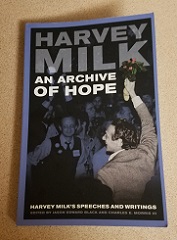
An Archive of Hope: Harvey Milk’s Speeches and Writings – Harvey Milk, Jason Edward Black, Charles E. Morris and Frank M. Robinson

20190119_180840This past November marked forty years since the assassination of Harvey Bernard Milk (1930-1948), who is recognized as being the first openly gay politician to hold office in the United States. The 2008 film Milk, starring Sean Penn, brought Milk’s life back into public light, where public interest has continued to increase. In the City of San Francisco, he is revered as one of its greatest citizens and the Castro neighborhood where he operated his camera store and conducted his political campaigns, pays homage to him with a bar named in his honor. Throughout the streets of the Castro, his image can be found throughout and on occasion, tourists might be fortunate enough to encounter someone who knew Milk personally.   On a visit to San Francisco a year ago, I did not have this fortune, but I did visit 575 Castro, the former site of his store which now serves as the base for the Human Rights Campaign.  Standing in the middle of the floor felt surreal as the realization settled in that this was where Milk lived and worked nearly forty years prior.  In the upstairs window at the front of the apartment where Milk lived, there is a full size image of him looking down at the street. It is as nostalgic as can possibly be. As I walked the Castro, I began to think, what if he were alive today?   What would he think of progress made by the LGBTQ community?  I think he would be proud but not satisfied, continuing to push for further advancement and acceptance of LGBTQ men and women  in society.

Sadly there are many young gay men and women who still have yet to learn about Milk’s life and contributions to the gay rights movement.  But fortunately for them and us, he left behind scores of speeches and writings devoted to the cause he wholeheartedly believed in.  Part of this collection of speeches and writings contained herein, are  appropriately titled An Archive of Hope, which brings the past alive as Harvey takes center stage in his own words.  Frank M. Robinson (1926-2014), was a speechwriter for Milk and had a cameo in the 2008 film where he plays himself.  He provides a foreword for the book, which he wrote in 2012, that is a testament to Milk’s legacy and some of the best writing I have ever read.  It is not hard to see why Milk solicited his assistance in creating the speeches that would help define his legacy.  On June 30, 2014, Robinson died at his home in San Francisco following a decline in health, due in part to heart problems.  His death was confirmed by friend and fellow activist Danny Nicoletta.

Milk’s brilliance cannot be overstated and it is on full display in the book.  The writings that are included are taken from newspapers that Milk contributed to, letters he wrote, sometimes to editors, and highlights from his most famous speeches.  The book follows a chronological order and at the beginning of each section, the authors provide a back story to the writing at hand.  It serves as a compliment to Milk’s words and helps the reader to follow along as Harvey challenges the establishment while throwing himself into the political arena as he runs for City Supervisor.  And although he lost the first few races, his popularity increased exponentially and all in San Francisco knew that Milk was here to stay.  What I found the most attractive in the book was Harvey’s foresight into the future.  It is with profound sadness that I can say that many of his predictions about San Francisco have come true. His words were prophetic and had his vision for San Francisco come to fruition,  the course of Californian politics would have undoubtedly taken a different course.

Reading Milk’s writings was a pleasure in itself.  His ability to analyze and critique the system was beyond precise and his words are still relevant today.  And while he did run for office, he was never a true politician.  In his view, they were all hypocrites and for Harvey, there was no way he could join that club.  Perhaps he was too driven, honest and outspoken for politics. Regardless,  he never wavered in his dedication to the movement which he rightfully called the candidate in his tape recorded will.  But as much as he railed against the persecution of the LGBTQ community, he also criticized the same community for its failures as well.  His words of advice for the gay community can applied today as they were in the past.  As Harvey believed, everyone, whether gay or straight, had a role to play in the movement.  And that movement found itself on a collision course with the evangelical right, determined by any and all means to take away the rights of the LGBTQ community.   They would find their icons in singer Anita Bryant and former Senator John Briggs. The advancement of California Proposition 6, also called the Briggs initiative, resulted in call to arms in the gay community and as Harvey points out, the forces mobilized in response to Anita Bryant’s crusade against homosexuals.  I had hoped to see more of the transcripts of the debates between Milk and Briggs included but as the authors point out, many were not recorded and others  suffered from sub par sound.  But from the small section that is included, it is clear that Harvey had mastered the art of politics without becoming a politician.  At his core, he was an activist or even more plainly stated, a humanist.

No book about Milk would be complete without his campaigns to become a City Supervisor which finally resulted in victory in November, 1977 after several failed attempts. The book follows these campaigns and includes the text of his speeches following his history win.  Harvey realized his work was far from over and continued to push forward until he succeeded with the successful vote of the gay rights ordinance that was opposed by only one Supervisor, Dan White, the man would later murder him.  A year before his untimely death, Milk tape recorded his will, the full text of which is included in the book.  And those words truly define the vision and goal that Milk had for the movement.  The Mayor of Castro Street had arrived and had he lived, I believe he would have gone on to accomplish even greater things for the gay community and the State of California. Right now we find ourselves as nation, in the midst of a turbulent political climate where individuals rights are sometimes still under attack.  Wounds of division and a short memory can combine to produce a society in which no one moves forward and we continue to make the same mistakes of generations prior.  Whether you are heterosexual, gay, lesbian, bisexual or transgendered, contained within the pages of this book truly is an archive of hope.

ISBN-10: 0520275497
ISBN-13: 978-0520275492

Looking for Lorraine: The Radical and Radiant Life of Lorraine Hansberry – Imani Perry

20190115_234339This past Saturday was the fifty-fourth anniversary of the death of the late American playwright and author Lorraine Vivian Hansberry (1930-1965).  Her untimely death at the age of thirty-four silenced one of literature’s greatest voices.  However, more than fifty years after her death, her masterpiece, A Raisin In the Sun, continues draw audiences curious to learn why the play is one of the longest running on Broadway.   I personally attended a run starring Denzel Washington and his portrayal as Walter Lee Younger is as good as the original performance by the legendary Sidney Poitier.  For some, Hansberry remains a bit of a mystery. and a throwback to an era long past.  The younger generation of today largely have yet to discover her genius and her influence on the African-American experience.  And what many of them are unaware of is that five decades ago, she was a voice advocating for the many freedoms they have today.   Sadly, it has taken many years for her to be recognized for the gifted writer that she was.  As we come to know her work more intimately, we must ask ourselves, who was the real Lorraine Hansberry?  Imani Perry searched for and found her in this semi-autobiography and psychoanalysis.  The book is an examination of Lorraine’s thoughts and writings while also adding  recollections of historical events filled with larger than life figures who are no longer with us today.  But make no mistake, this is about Lorraine, the woman who changed Broadway.

Before I started the book, I was not sure what to expect.  I had previously read a biography of Hansberry, Young, Black and Determined: A Biography of Lorraine Hansberry, by Patricia C. McKissack and Fredrick L. McKissack and Lorraine’s published works.  Surprisingly, this book takes a completely different approach in revisiting Hansberry’s life.   The author does follow her life from beginning to end like a standard biography but where the book takes its own path is in the author’s excellent analysis of who Hansberry while breaking down each part of her life so that we may unravel the complicated layers that composed the dynamic figure.  And like most popular figures gifted with talent, her life was anything but ordinary.

If you are expecting this book to read like a standard biography, this is not the case.  In fact, things get very psychological as we step deep inside Lorraine’s mind to understand how she came to view the world she lived in.  Jim Crow, Communism, homophobia and Vietnam were just some of the many topics she felt so passionately about.  Her words were sharp, cutting right to the heart of the matter and her point was made, always unapologetic.  Today she is viewed as a pioneer and visionary, but in her era, she was viewed as a radical who even attracted the attention of the Federal Bureau of Investigation (FBI).  But such was the character of Lorraine Hansberry, afraid of no one and nothing.  Perry captures her fierceness and determination with a haunting accuracy that caused me to feel as if Lorraine was alive and speaking directly to me.  In addition, throughout the book, I could not help but feel a strong sense of loss over the death of Hansberry, a woman who died many years before my birth.  But those feelings are a testament to her gift and legacy which continues to thrive.

There is one subject in the book that I feel deserves special mention.  For many years, rumors have persisted about Hansberry’s sexuality.   We know that she was once married to Robert Nemiroff (1929-1991), who worked dutifully to preserve her legacy all the way up until his final days.   But from Perry’s research and Lorraine’s own words, I believe the rumors can be put to rest once and for all as her true feelings are clearly shown.  Fittingly,  Hansberry’s sexuality is a key component to her work and the story at hand. Perry handle the subject perfectly,  making sure not to let it dominate the story or detract from it.  And that is one of the true hallmarks of a good biographer.

To say that Hansberry’s life was eventful is an understatement.  This is her life, a story filled with love, civil rights, fame, loneliness and tragedy.  She was far from simple and it is clear that from everyone that knew her,  she was unique and one of those rare people who come into your life and change it forever.   It is my sincere hope that more young men and women continue to discover her work and learn about her life.   For Black-Americans, she is sometimes a forgotten voice in a power movement that changed the United States and countries around the world.  If you have the time, take a journey with Imani Perry and go looking for Lorraine.

ISBN-10: 0807064491
ISBN-13: 978-0807064498

Nothing to Envy: Ordinary Lives in North Korea – Barbara Demick

nothing to envyThe Democratic People’s Republic of Korea remains one of the most secluded nations on earth.  To some, it is the best example of the society George Orwell described in his masterpiece, 1984. Documentaries, photographs and videos taken in North Korea have given the rest of the world glimpses into a nation ruled by an iron fist, where individuality and personal expression are as forbidden as foreign literature and films.  Every living moment of North Korean life is in service to the State under the tutelage and patronage of the “Dear Leader”.   The ideology of the North Korean Republic known as “Juche” was made famous by the late Kim il Sung (1912-1994) and has been carried forward by his son Kim Jong il (1941-2011) and currently his grandson, Kim Jong Un.  Portraits of the leaders can be found on the walls of nearly ever building in the country, reinforcing the demand for subservience by the government of its citizens.  The threat of American Invasion and moral corruption of young Koreans by foreigner influence are used by the State as justification for its seclusion from most of the world.  But for some citizens, the smoke and mirrors become clear as nothing more than propaganda used to keep society in line. and curiosity of the outside world creeps steadily in.   Their awakening results in a mix of emotions, one of which is defection to South Korea typically by way of China.
Barbara Demick is the former Beijing bureau chief of the Los Angeles Times and spent five years in Seoul interviewing defectors from North Korea. This book tells the story of several individuals who made the difficult decision to leave the only place they have called home.  I think it is fair to say that anyone outside of North Korea is aware of the totalitarian regime imposed upon the people of that nation.  Journalists have lifted the carefully guarded veil constructed by Pyongyang. But what is contained in the pages of this book might surprise even the most knowledgeable readers. In fact, descriptions of their daily lives will stun some but in order to understand their desire to learn about the outside world, escape a suppressive regime and find peace and happiness, we must learn their stories and the challenging lives they were born into.  Their names are Kim Hyuck, Mi-Ran, Jun-Sang, Oak Hee, her mother Song Hee Suk and Dr. Kim Ji-eun.  Their stories are different but they are all united in the defection to South Korea, leaving behind family members and friends.  But what they witnessed will remain with them for the rest of their days.   Those events which we learn about in this book are more than any of us would want to endure.  I guarantee that for American readers, after you have finished this book, you will have a greater appreciation for the privilege of living in the country that is perhaps the most powerful nation on earth.


For those readers new to literature about North Korea and/or its defectors, the author provides a good history about the Japanese occupation of North Korea and its liberation following World War II.  Kim il-Sung would rise as the leader of the new Soviet backed North Korea while Syngman Rhee (1875-1965) established him as the leader of the U.S. backed South Korea.  The establishment of the 38th Parallel also known as the DMZ, as the dividing line between the two countries, remains firmly in place as the line that separates two very different countries and different worlds. Sung’s goal to create a new version of Communism, resulted in a regime that ranks among the most brutal anywhere in the world and seemingly stuck several decades behind the rest of the modern world.  And as the nation endured periods of famine and near economic collapse, increasing numbers of North Koreans, including those in this book, made their way south by any means necessary.

When we first meet our characters, their lives are typical of North Korea, far removed from any knowledge of or influence by the western world.  Allegiance to the “Dear Leader” is mandatory and all seem to stay in line willingly.   But over time the facade wears away and the death of Kim il-Sung on July 8, 1994, would provide the catalyst for many to open their eyes to the truth about life in North Korea.   Radio programs and even television from South Korea began to infiltrate the nation as growing numbers of citizens began to question all that they had been taught from a young age.  For figures in the story at hand, the moment of revelation of a life outside of North Korea proved to be too seductive to ignore and once the decision was made, the next step was to act which they did under the most intuitive of ways.  And in stark contrast to the idea of communist citizens all falling in line without thought, each of the characters prove to be as sharp and clever as anyone determined to seek asylum in the hope of a better life.  Their successful defections to the South are not without complications and their adjustment to life in Seoul, also shows the complicated efforts that exist to undo many years of indoctrination and seclusion.

Throughout the book, a constant theme is the possible collapse of North Korea and even the author remarks that it has been predicted for many years.  In spite of conditions that should cause the downfall of any government, North Korea continues to maintain its position as the rogue nation that issues threats to neighboring countries while preparing for a believed conflict with the United States.  The government operates on a system of dysfunction and in some cases hypocrisy.  While those at the top enjoy American cars, films and imported goods, millions of North Korea endure malnutrition and destitution.  Time will tell if the regime will collapse but what we do know, not just from news reports but also from the stories in this book, is that outside of Pyongyang, life for millions of North Koreans is marked by famine, poverty and fear of the State.  Defectors have survived the roughest of ordeals and no longer live in the fear that grips North Korea.  However, their hearts are still with those left behind and they do believe in the dream that one day Korea may once again be unified.  Until then, the number of defectors may continue to rise and people seek to move away from scavenging for food and praising the Dear Leader to having a full meal, talking freely and being able to watch any show they prefer on television.   Their stories may give others inspiration that there is a life outside of North Korea and for some, it is worth dying for.  But it is hoped that they are able to escape and enjoy the many privileges that so many of us take for granted.

This book has caused me to really think about the concept of freedom and how precious is truly is. I have seen and accomplished things that most North Koreans either have no knowledge of or ability to do. I am grateful for the life that I have and the author is correct when she says that life in North Korea is nothing to envy.

ISBN-10: 9780385523912
ISBN-13: 978-0385523912

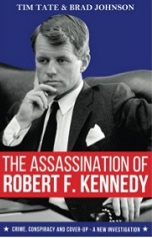
The Assassination of Robert F. Kennedy: Crime, Conspiracy and Cover-Up – Tim Tate and Brad Johnson

bobbyJune 5, 1968 – Senator Robert F. Kennedy (1925-1968) (D-New York)  concludes his speech at the Ambassador Hotel in Los Angeles, California after scoring a critical primary victory in his quest for the Democratic nomination for President of the United States.  As he walked through the pantry while exiting the hotel, he was shot and mortally wounded.  Twenty-six hours later in the early morning hours of June 6, 1968, his life and the dream he inspired came to a tragic conclusion.  He is survived by his widow Ethel and eleven children, the youngest of whom was born after his death.  Her name is Kerry Kennedy and along with brother Robert, Jr., she keeps her father’s memory alive and well.  Her book Robert F. Kennedy: Ripples of Hope: Kerry Kennedy in Conversation with Heads of State, Business Leaders, Influencers, and Activists about Her Father’s Impact on Their Live  is a fitting tribute to her late father’s life and is yet another testament to the profound influence he had on those who knew him and even those who never met him.  His alleged murderer Sirhan Sirhan, remains incarcerated at the Richard J. Donovan Correctional Facility in San Diego County, California. The official narrative paints a picture of Sirhan being a deranged lunatic determined to murder Kennedy at all costs.  He was initially sentenced to life in prison after his conviction but several years later, his sentence was commuted to life. In the eyes of many, he is the man who killed Kennedy in an open and shut case. But there have always been questions surrounding Sirhan’s actions that night that cause many to pause before proclaiming his guilt.  Did Sirhan Sirhan really act alone and did he fire the shots that took Kennedy’s life?
Tim Tate and Brad Johnson have taken another look at one of America’s most tragic murders fifty years after Kennedy gave his last speech, examining the crime from start to finish.  And in the process they have raised many questions which have never been answered by the Los Angeles Police Department (“LAPD”) or the State of California. In fact, what we can see very clearly, is an investigation full of missteps, inaction and disturbingly, outright deceit by law enforcement.   The investigation became a mixture of destruction of evidence, stonewalling and witness intimidation as the LAPD focused its attention on Sirhan with the intention of convicting him at all costs. But as Tate and Johnson show, there were many reason to doubt Sirhan’s guilt and proof that more than one gunman was in the pantry area that night.  While they do not provide a smoking gun as to who the shooter may be, they do establish that there was more that occurred that night than police were willing to admit.  And Sirhan may not have been the person he has been portrayed to be.  We know that he did discharge a gun that night, but the authors have given reasons to believe here, that none of his bullets struck Kennedy.

As I read through the book,  at times I could not believe my eyes.  Similar to the murder of John F. Kennedy (1917-1963), Bobby’s death became shrouded in controversy as rumors swirled of a conspiracy.   At the center of the many conspiracies is the infamous  woman in the polka dot dress. The authors examine her role in the matter and give a strong explanation regarding her possible identity.  Readers curious about the mystery woman will find Fernando Faura’s The Polka Dot File on the Robert Kennedy Killing: Paris Peace Talks Connection a good read regarding this infamous figure who official remains unidentified and ignored by supporters of Sirhan’s guilt.   However,  the authors have shown that not only did multiple witnesses see the woman, some had personal encounters with her, including Sandra Serrano, a worker in Kennedy’s campaign.  Her experience with LAPD investigators is one of the most bizarre parts of the story but also reveals an important clue about the department’s motives in streamlining the investigation.  We may never know who the woman in the polka dot dress is or was, but what is clear is that she was not a figment of anyone’s imagination.

Previously, I had read material on Kennedy’s murder but this assessment of the assassination, revealed many things which I did not have prior knowledge of.  Sirhan’s trial was an easy win for prosecutors as they successful painted Sirhan with the image of a lone gunman with a deadly fixation on Kennedy.   As the shadow of Dallas hung over the trial, authorities made sure Sirhan was tried and convicted as expeditiously as possible.  However, there was one aspect of the trial that no one could completely put to rest which would come back to haunt the case until this very day.  Sirhan’s claim of having no memory of the shooting was at first dismissed but as the authors show, there was and is strong evidence to support this theory. And at this point in the book, the story kicks into high gear as a cast of characters appear including the Central Intelligence Agency (CIA).  And we are forced to ask, was Sirhan a “Manchurian Candidate”? To some, the idea sounds like another crack pot theory.  But as Tate and Johnson show, the CIA  actively engaged in mind control through several different programs it admitted to conducting, the most well-known being MK ULTRA. I would like to stress the fact that the authors never claim to have a smoking gun regarding Kennedy’s death.  However, they do succeed in providing ample evidence provides a strong basis for a new investigation into the murder of Robert Francis Kennedy.

If you are curious about Kennedy’s murder or have studied it previously, then this book is a must have.  To say it is mind-blowing is an understatement.  The authors pull no punches, leaving the reader with chills as they show the side of the investigation police never intended for the public to see.  Highly recommended.

ISBN-10: 1786080818
ISBN-13: 978-1786080813

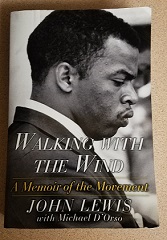
Walking with the Wind: A Memoir of the Movement – John Lewis with Michael D’Orso

john lewis

The Declaration of Independence of the then Thirteen States of America, is often looked upon as inspiration for what liberty truly means. The second paragraph drives home the point with the following words: “We hold these truths to be self-evident, that all men are created equal, that they are endowed by their Creator with certain unalienable Rights, that among these are Life, Liberty and the pursuit of Happiness.” The words, when taken at face value, give off the impression of a country in which one can truly be free. But we very well know through history, that the opposite has been true, millions of people, in particular Black Americans have had to endure a long and hard struggle to achieve equality in the United States. Two weeks from today, America remembers the legacy of Dr. Martin Luther King, Jr. (1929-1968) and his view for a United States in which its citizens were truly united. Great strides have been made since Dr. King’s death, but by no means should his legacy be forgotten. Congressman John Lewis (D-Atlanta) was a close associate of Dr. King’s and today he is one of the remaining figures from the Civil Rights Movement. Many of his peers are deceased but today at seventy-eight years of age, he is still serving in the U.S. House of Representatives continuing to fight for what he believes is the direction to the move the United States forward. At first glance he is unassuming but if you study his life and words closer, you will soon learn that this remarkable figure has an extraordinary story to tell about his participation in the movement for racial equality.

When we think of the Civil Rights Movement, John Lewis is typically not the first figure many would have in mind. With his short stature and plain image, he appears to be the loving grandfather on the neighborhood block rather than the activist he was and still is. But just how did a young kid from the country in Georgia go on to be a pivotal figure in the movement that changed America? The answer to that question and many others about Lewis’ life are contained within the pages of this autobiography that is sure to leave the reading asking for more. In fact, I found it increasing difficult to stop reading the book once I had started. With Lewis’ easy-flowing narrative and endless anecdotes about himself and some of the most legendary figures America has ever seen, the book transplants the reader back in time to witness how a cause became a national and world-wide struggle against discrimination.

One of the things that I found likeable about the book is Lewis’ openness about his own shortcomings. He never portrays himself to be above anyone or all-knowing. In fact, he easily recalls the times in which he was lacking in knowledge, overcome with fear of his opponents and reluctance to partake in the cut-throat world of politics. Quite frankly, he has walked the walk and talked the talk, risking his life in sit-ins, marches and voter registration drivers in the deep American south, culminating with the showdown with the virulent racist Sheriff of Dallas County, Alabama, Jim Clark. (1922-2007). In fact, the events Lewis recalls, are also discussed in the book by another of his close associates, Ralph David Abernathy (1926-1990). His autobiography and memoir of the movement was appropriately titled And the Walls Came Tumbling Down . Both authors played an important part in those events and do not fail to explain in full detail how they developed and why they were important. I highly recommend that book as a complement to Lewis’ story.

Similar to Abernathy’s book, King is a critical character in the story and both authors show how important King was to the movement at hand. What is also revealed, particularly here is the complicated power struggles within the Southern Christian Leadership Conference (SCLC). Infighting, jealously and egos all play their parts in the story revealing the sometimes fragile relationships at the base of the movement. Misogyny, homophobia and even racism against White Americans became the tools that turned the SCLC into a shell of its former self. The assassinations of the 1960s convinced many that nothing could ever be the same again. Lewis addresses all of them and his relationship to several of the late figures. Students of the movement will recall that Lewis eventually became part of the campaign by Robert F. Kennedy (1925-1968) for President of the United States. His memories of Kennedy are touching and is yet another example of the extreme sense of loss that following in the wakes of the assassinations that became all to common in the turbulent 1960s.

Today it is nearly impossible for youths to imagine what life was like for Black Americans during Jim Crow and later, even as President Lyndon B. Johnson (1908-1973) pushed forward an earth-shattering civil rights bill. As Lewis puts it, raw fear was a daily reality in a time where social justice warriors sometimes died early deaths and authorities used every trick in the book to maintain a strict social structure of power. His ability to fair in the book and examine every situation from all sides has earned him followers and detractors but here, Lewis explains himself, leaving it up to the reader to digest his words and perhaps use them in a positive way. What I found equally important as the story at hand is his messages to Black Americans as well. Change in society must come from all places, and only then can a nation truly move forward. John Lewis has spent the majority of his life fighting for equality on behalf of those who sometimes have no other voice. His eyes have seen some of the most important events in history and he is a living testament to the strong character common to his peers who became world-respected figures in their own right.

If you are looking for a good read about the Civil Rights Movement, this is a fine place to start where you can follow John Lewis as he is walking with the wind.

ISBN-10: 9781476797717
ISBN-13: 978-1476797717

In Contempt – Christopher Darden with Jess Walter

dardenIt is difficult to put into words, the polarizing effect of the trial of O.J. Simpson had on America.  The ugly history of racism took center stage as lead attorney Johnnie Cochran (1937-2005) formed a defense based on it and the prosecution under the guidance of lead attorney Marcia Clark, sought to exclude it.  The crime was beyond brutal and contained a level of savagery that caused a twitch even in the most hardened of stomachs.  Photos of the crime scene are available on the internet in all of their shocking and gory details.  I vividly recall the car chase that played out on the television screen as the Los Angeles Police Department followed Simpson’s white Ford Bronco. The truck later became fodder for parody but at the time,  caused bewilderment as everyone wondered where on earth Simpson could be going.  When he was acquitted of murder, loud cheers could be heard throughout the school.  To many of us, it seemed unfathomable that Simpson, the gridiron great could have committed such a heinous crime.  Further, the L.A. Riots remained fresh on our minds and the video footage of the beating of Rodney King, a reminder of the fragile co-existence between the police and Black communities across the country.   To some, the justice system had worked and we knew O.J. was innocent. Or did we?  Were we assuming his innocence based on his skin color and our need for a hero? Or was it, as some believed, a chance to “get even” with the system? The trial was many things but above all it was surreal.

The moment when Simpson was asked to try on the gloves found at the scene, is among the most intense in television history.  Cochran’s famous line “if it doesn’t fit, you must acquit”, has become a classic catch phrase that instantly recalls memories of the trial. For prosecutor Christopher Darden, it was a pivotal moment in the case that changed the course of the trial.  Legal experts thought it was a mistake. Even Darden’s own team had wanted to stay clear of it, but the seasoned prosecutor held to his belief that it would happen at some point and there was only one way to be sure. After the trial, he slowly faded out the public light but has continued to serve the county of Los Angeles as a dedicated prosecutor.  Initially, he had resisted writing a book but slowly came to terms with the fact that he did have a story to tell, one that is just as important as co-counsel Marcia Clark’s “Without a Doubt” .  And this is Darden’s show, he is here not only to talk about O.J. Simpson, but about his private life which many people had very little knowledge of.

The book begins as an autobiography as Darden goes back to his childhood in the town of Richmond, California as the fourth child out of a total of eight children. From an early age, he forms a tight bond with his late brother Michael and the two quickly become known as trouble.  In fact, some of Darden’s revelations regarding his youth might cause the reader to wonder how he became a star prosecutor. The answer is here and Darden minces no words about his many mishaps and errors in judgment as a youth and even as an adult. Bu throughout the book, he remains focused on the story at hand, never letting the pace slow down and bore the reader.  His story picks up pace from the moment it begins and keeps building momentum.  Darden finds his calling in law, working his way through law school while becoming a father and learning about life in ways he could have never expected.  And his career as a prosecutor might have remained the way it was if not for the grisly murders of Nicole Brown Simpson (1959-1994) and Ronald Goldman (1968-1994).

As Darden explains, he had a feeling he would become part of the O.J. trial and he was right, except he could not have foreseen just how involved he would be.  From the moment jury selection begins, it is clear that this trial will be one for the ages but Darden is not one to back down and as we follow him back in time to revisit the past, we are able to see the case from another angle, that of the man known as the “African-American prosecutor”.   Cochran would throw the race card into every angle the case and the introduction of notorious detective Mark Fuhrman would ultimately prove to be one of the nails in the prosecution’s coffin.  In fact, the battle of race, would pit Cochran and Darden against each other with both receiving death threats.   Like a master narrator,  Darden goes over what went right in the trial and what went horribly wrong.   Further, he explains how and why many decisions were made even in the face of clear adversity.  But he is a dedicated prosecutor who believes in the wheels of justice.  However, in a trial inflamed by race, the L.A. Riots, fame, domestic violence and distrust of the California legal system, those wheels would turn in much different ways. For Darden, it was the time in his life where he was always in contempt. This is a cold hard look at one of the most notorious and important trials in American history.

ISBN-10: 1631680749
ISBN-13: 978-1631680748
ASIN: B01D5CNPYW


Bolivar: American Liberator – Marie Arana

simonIn the annals of Latin American history, perhaps no other figure is as studied as Simón Bolívar (1783-1830), the liberator of South America.   Former Venezuelan President Hugh Chavez (1954-2013) famously spoke with images of Bolívar behind him as he sought to transform the country into a contender on the world stage. The life of Bolívar lasted less than fifty years but within two decades he became the leading figure in the Latin American movement for independence from the Spanish Empire. The nations of Colombia, Peru, Ecuador, Venezuela, Panama and Bolivia (his namesake) are the products of his vision, a united South America free from the influence of its northern neighbor.   And prophetically, many of his beliefs about the future of South America have come to pass, cementing his legacy as one of the continent’s greatest heroes.  Marie Arana, a native of Bolívar’s beloved Peru, has composed a stunning biography of the late figure that shows a complex character, driven by ideology but crippled by his own generosity and disregard for personal well-being.

On July 24, 1783, Don Juan Vicente and Doña María de la Concepción Palacios y Blanco welcomed their fourth child into their growing family but neither of them could have imagined then that their son would one day become the liberator of South America.  To understand the mind of the future leader, it is necessary to understand his past and Arana presents his story in a format that is guaranteed to pull the reader in.  The story takes us back in time where the Spanish Empire controls nearly all of the continent and a young Bolívar is learning about colonialism first hand.  Tragedy became a part of his life from an early age as the deadly disease known as tuberculosis wreaks havoc across the continent.  What is clear however, is that from a young age, the rebel the world would come to know was being crafted through life experiences and the ugly hierarchy of exploitation and racism used to subjugate those considered to be unworthy by the Spanish monarchy in Madrid. The young revolutionary proved to be a fast learner and before long, he became part of the growing movement for freedom.

The book continues to heat up as Arana brings the past alive allowing us to follow Bolívar as he traverses Latin America, covering more ground than any of the greatest warriors in history. But the campaign was far from easy and behind the scenes, back door deals, treachery and in some cases luck, combined to push forward the independence movement.  And as Bolívar rises through the ranks, a cast of characters develops, increasing the suspense in the story as the final showdown with Spain looms in the horizon.   The author increases the suspense as the book moves forward, making it impossible for the reader to stop.   I found myself captivated as I followed the events that culminated in the legendary battles that chartered a new path for Bolívar and millions of South Americans.

The battle of Ayacucho in the Peruvian War of Independence proved to be the straw that broke the camel’s back with the Spanish Empire withdrawing the majority of its forces from South America. For Bolívar this was just the beginning of a long struggle that would see the continent nearly tear itself apart and result in his exodus from the place he called home.  Assassins, opportunist, traitors and cowards became major players in a deadly game of treachery that ensued following the continent’s liberation from Spain.  Arana puts all of the players and pieces together in a narrative that is both shocking and disheartening.  And through the story, we can clearly see the development of the Spanish Empire’s system of racial hierarchy  that has remained with Latin American society to this very day.  Fully aware of this, Bolívar made it a point to include everyone in his campaigns with the belief in his heart of a truly united and free Latin America.

Before he died, he recorded a statement regarding the lessons he learned after two decades of service in the revolution.  Hauntingly, his words proved to be correct and to this day, Latin America has never been able to eradicate the very issues proclaimed by  Bolívar in 1830.  And if he were alive today, he would be discouraged to see that he was correct.  Nevertheless, he did succeed in liberating Latin America before greed and deception caused infighting among the new republics that has never fully subsided.  But perhaps one day, we may finally see a truly united continent, free of demons from Spanish and British rule and the dreadful effects of the systems of class division and slavery.  And in that moment, the spirit of Bolívar will truly live on.

The story at hand is one of courage, love, triumph, betrayal and vindication.  Bolívar is long gone but his name and legacy continue to live on.  Marie Arana has done a great service to a legendary historical figure who changed the course of world history and paved the way for the birth of a new South America.

ISBN-10: 1439110204
ISBN-13: 978-1439110201
ASIN: B008J4PNX8