
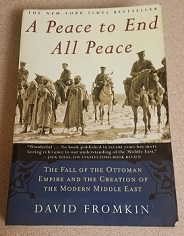
 Ideology is sometimes as powerful of a tool as violence and in some cases has been the direct cause of violence. In the Middle East, ideology has maintain a stronghold as it finds itself on a crash course with modernity. Those who live outside the Middle East are at times confused and mystified by the traditions and events that occur throughout the Arab nations. In fact, many of us here in the United States do not know how the modern-day Middle East came into existence. To them, I say that the key to understanding the Middle East is to retrace its history to see why and how it developed into what we know it to be today. David Fromkin lends us a helping hand in this incredible historical investigative account of the fall of the legendary Ottoman Empire and the creation of a region that would never truly know peace.
I find it a bit ironic that the title is called A Peace to End All Peace because when the reader has finished the book, he or she will see that is far from what happened. But the question is why not? To find that answer, we revisit Constantinople, headquarters of the empire, prior to the outbreak of World War I. Iraq and Jordan (formerly Transjordan) had yet to be created. Iraq was then known as Mesopotamia and Jordan was still part of Palestine. The Zionist cause was still in its early stages and it would be several years before the signing of the Balfour Declaration. Regardless, these nations were caught in the middle of a bitter conflict as Britain and Russia took on the German Republic for control of the Ottoman Empire. But as casualties mounted and victories were won, what was really transpiring behind the scenes? And who were the major players? As we step back into time with Fromkin, we are re-introduced to long-lost figures such as the famous Winston Churchill (1874-1965), former Prime Minister Lloyd George (1864-1945), U.S. President Woodrow Wilson (1856-1924) and Thomas Edward Lawrence (Lawrence of Arabia)(1888-1935). Lawrence has been transformed throughout the years into a larger than life character but Fromkin provides a good biographical sketch of him and investigates his true role in the fall of the Ottoman Empire and the British goal of conquering the Middle East. However, as Fromkin shows us, the heart of the entire stories lies in the Sykes-Picot Agreement, the secret pledge between Britain, France and Russia to partition the Ottoman Empire after the defeat of Germany in World War I. The agreement shaped relations between the nations for decades to come.
The story is an incredible from start to finish and after you have completed the book, you will better understand why the Middle East is the way it is today. You will further understand how the Zionist cause for a homeland grew in strength due in part to the actions of the British Government. The story of Palestine is especially important for the effects of the actions then are still being felt today. Fromkin has done an excellent job of researching the topic and it is evident in his writing. The book reads like a historical novel full of intrigue, mystery and ultimately tragedy. Further, the relationship between Russia and the nations of the U.S.S.R. are examined highlighting the cultural diversity that once encompassed the Soviet Union. The Bolshevik revolution is discussed but not at great length. Vladimir Lenin (1870-1924) and Joseph Stalin (1878-1953) make appearances but their story is only discussed regarding its relevance to the current topic. And throughout the book, developments in other nations are mentioned but the author never strays off topic. Like a master professor, he keeps us on course throughout a critical time in the history of the world that was complicated to say the least.
The book ends before the rise of Adolf Hitler and the start of World War II. And it would not be until 1948 that the nation of Israel was formally created. Readers may be surprised to reach the end of the book only to find that the story does not continue in the next decade. But the reality is that was never the intention and is irrelevant to the story at hand. True, the events in this book would affect the future in many different ways but that is a topic for another discussion. For those who wish to understand how an Empire came crashing down, the development of the modern-day Middle East and how several nations underestimated the power of the Islamic faith, this is a great place to start. And for others who have an active interest in the Middle East, this book is a much welcomed addition to any library.
“To the victor belongs the spoils” – New York Senator William L. Marcy
ISBN-10: 0805068848
ISBN-13: 978-0805068849
 As a student growing up in the United States, my classmates came from many different backgrounds. Some came from as far away as India and Korea. Others from Guyana and Dominican Republic. No matter where they came from, we were equal peers studying to enhance our lives through prosperity. However, only sixty-four years ago, the ruling of
  Author Frank previously published his spellbinding investigative account,
  October 1st marked forty-seven years since James Marshall “Jimi” Hendrix (1942-1970) died in the flat of Monika Danneman in the Kensington section of London at the age of twenty-seven. Today his music is still revered and Hendrix is considered one of the greatest electric guitar players in music history. In fact, there are those who believe that we was the greatest to ever live. The collection of music he left behind continues to be discovered by younger generations and maintains a place in my own collection. His cover of Bob Dylan’s All Along The Watchtower and the classic Hey Joe are among my favorites and some of Hendrix’s best works.
 Eighty years after her disappearance and death, the life and tragic ending of Amelia Earhart (1897-1937) continues to incite curiosity not only among researchers but the general public in the United States. She is remembered as one of aviation’s true female pioneers and her ill-fated trip with navigator Fred Noonan (1893-1937) in July, 1937, is considered one of history’s greatest unsolved mysteries. Similar to the deaths of John F. Kennedy and James R. Hoffa, myths, half-truths , conspiracy theories and fabrications have plagued the investigations into their final moments. Officially, their disappearance remains unsolved but there are many who believe that the U.S. Government knows far more than it is willing to admit.
 Nestled between Brazil and Argentina is the small Latin American nation of the Oriental Republic of Uruguay (República Oriental del Uruguay). The nation is the second smallest on the continent next to Suriname and boasts one of the highest
  The resignation of Richard M. Nixon (1913-1994) as President of the United States on August 9, 1974, remains one of America’s darkest political moments. The revelation of the break-ins at the Democratic National Committee office in the Watergate complex and the subsequent attempted cover up, riveted American citizens and resulted in the downfall of a political icon. Through the years, myths and disinformation about the Watergate scandal have been propagated causing an aura of mystique over a crime of monumental proportions. I picked up this investigative account by Fred Emery to learn what really happened on June 17, 1972 and the process behind the scenes that led to Nixon’s resignation. And what I found is a book that dives deep into the Watergate scandal to show the reader what really happened from start to finish.
 The wars that have been fought by mankind contain many secrets that have survived the test of time. Hindsight has become society’s treasured tool in investigating the past to learn what really happened. The Vietnam War is among the most unpopular conflicts in American history. The war continues to haunt the United States as a reminder of failed foreign policy and according to some as a premonition of the 2003 invasion of Iraq. As we look back on the Vietnam War, we come to learn about the very dark side of the American involvement in Southeast Asia and the devastation that occurred when two nations collided in a struggle that pitted ideology against weapons at war. Douglas Valentine, author of
 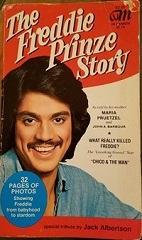 At 1 p.m. on January 29, 1977, Freddie Prinze, Sr., died at the UCLA Medical Center after suffering a self-inflicted gunshot wound the night before while talking to his manager Marvin “Dusty” Snyder. Prinze was twenty-two years old and left behind grieving parents, siblings, a widow and a son, Freddie, Jr., who would go on to have successful career of his own in Hollywood. Prinze rose to stardom at the age of 19 and in just three years went from aspiring comedian to a star on the comedy circuit and in the hit show Chico and the Man. His time on earth was brief but at the height of his career, it is estimated that his face had been seen by nearly 40 million viewers. I had often heard about Prinze and listened to my parents talk about him in conversations about their favorite shows from the past. I had always wondered what drove him to take his own life? And could it have been prevented? His late mother Maria Pruetzel (1921-2013) tells her story and the story of Freddie’s short but incredible life in this memoir of their time together as mother and son. His father Karl (1914-1979) is also in the story but in a supporting role for reasons Maria explains early in the book.
 The summer of 2017 is winding down and a new school year is nearly upon us here in the United States. Seven months have now passed since Donald J. Trump was sworn in as the 45th President of the United States. And in that time, the world has witnesses events that few can claim to have seen before. I previously reviewed

You must be logged in to post a comment.