
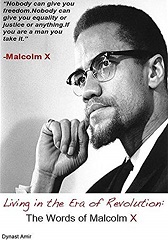
 In the United States, the month of February is dedicated to African-American history. February 21 stands out during the month as the day that el-Hajj Malik el-Shabazz better known as Malcolm X (1925-1965) was assassinated at the Audubon Ballroom in Harlem, New York City. On the radio, the eulogy given by the late Ossie Davis (1917-2005) is played taking us back to Malcolm’s final days on earth. In 1992, Warner Brothers released Malcolm X, the biopic directed by Spike Lee and starring Oscar winner Denzel Washington in the lead role. Washington lit up the screen, delivering a performance for the ages. Davis’ eulogy accompanies the closing scenes and the credits are rightly finished to the sounds of Aretha Franklin’s rendition of ‘Someday We’ll All Be Free’ and Arrested Development’s ‘Revolution’. The film has stood the test of time and is a fitting tribute to Malcolm X’s legacy. Lee did an incredible job but there was no way he could have included all of Malcolm’s speeches and writings into the final product. Malcolm was brilliant, not just as an orator but as a critical thinker who presented his arguments in an engaging and articulate manner. And some of those words can be found in this book by Dynast Amir.
Amir has compiled several selected speeches and combined them will Malcolm’s best quotes on the America in which he lived. The book is not Amir’s story or a biography of Malcolm. There are other books that more than serve that purpose such as Alex Haley’s (1921-1992) ‘The Autobiography of Malcolm X’. Here, this is Malcolm at full throttle, delivering his messages to those in attendance and the many followers of the Nation of Islam (NOI). His words are sharp and he does not mince words. Today, many of us would find his words to be extreme, but it is imperative to remember that the America his lived in is quite different from the one that exist today. Further, he was reacting to the injustices that occurred regularly against Black Americans and others deemed to be a minority. The truths are uncomfortable and he forces America to look at itself in the mirror. Sadly, some of his words are still true to this day but if make it a point to remember them, we can continue to move forward as a nation.
Although I am not a follower of the Islamic faith, I have felt that some of their beliefs about the place in society of Black Americans were correct and no one who reads this book can ever say that Malcolm did not love his people. I firmly believe that even readers who are not Black American or African can still find truth in his words. But for those readers, some parts may be hard to get through. The time period in which these selected speeches come from was the turbulent Civil Rights Movement in the deadly decade that was the 1960s. In his words, you can feel his passion and anger for the deeply rooted discrimination and injustice in American society.
As a Black American, I understand Malcolm’s view and his words are pertinent to the importance of education for without it, we cannot go anywhere in this world just like he says. Furthermore, we have an obligation human beings to treat others with dignity, compassion and respect. However, there was one topic which I have never felt completely comfortable with but I do hot hold Malcolm personally responsible for the belief came directly from the teachings of the NOI. That teaching is the of the story featuring the scientist named Yakub who is believed to have created the White race. It would require too much space here to go into detail but the story itself suffers from lack of any credible evidence and could be interpreted as right-wing propaganda. Further, the NOI has always claimed that W.D. Fard was t in 1934 is one of the several mysteries of the NOI that have never been fully explained. It is also widely believed that the NOI was directly complicit in Malcolm’s murder.
For all of the stirring rhetoric, call to arms and critical evaluation of America, there are some bright spots in the book with the main one being his pilgrimage to Mecca. Had he not taken the trip to Mecca and engaged with Muslims of a different ethnicity, his beliefs about Caucasian men and women may have never changed. And at the time of his murder, he was at a turning point in his life as he continued to build the Muslim Mosque, Inc., an organization that could have potentially left the NOI in the shadows. Sadly, fate intervened in a tragic way and Malcolm was silenced forever.
History will potentially remain divided on Malcolm’s legacy with his followers swearing allegiance and his detractors writing him off as a demagogue. Regardless of what we may think of him, we cannot deny his importance in history at the truth in his words. If you want to learn more about what made Malcolm tick and why he had his beliefs, then read this book by any means necessary.
ASIN: B00MSXXCR0
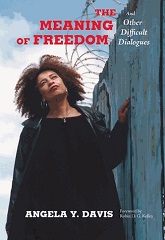 Freedom is a term that is often used but not always understood. The costs associated with it are often high and some of us have paid and will pay the ultimate price to obtain it. Here in the United States, we like to think that we are free but the truth of the matter remains in question. Perhaps we are still in a state of denial of about freedom’s true meaning and its role in the American way of life. Angela Davis is one of the brightest voices to emerge from the Civil Rights Movement and has established herself a political activist, an author and professor whose many speeches and writings are some of the best society has ever seen. While the book is not an autobiography, this is clearly Davis’ show and a collection of selected speeches in which she discusses topics that she rightly refers to as difficult dialogues. But her ability to not only discuss these topics but provoke thought in the reader, is what makes this book so special. And I can state with full conviction that I wished I had discovered this gem much earlier in life.
 Every year that I age, I have noticed that I have a growing appreciation for classic literature and the works of other authors that are no longer with us. James Baldwin (1924-1987) is near the top of my list of authors whose books are critical to American history and the current day state of affairs in the United States. The Harlem native who took his last breath in France, stands out as a commentator on race in America. His observations which he then put into words, were sharp, analytical and deeply profound. Baldwin lived what could only be described as an eventful but complicated life. He was a Black American and homosexual in a time in which both were considered to be crimes of the highest nature. America had yet to see the passing of the Civil Rights Act of 1964 and homosexuality was still considered a crime against nature in many states. Baldwin was both and carried himself with an aura of confidence and intellect that has remained impressive many years after his death. In this short but intriguing book, Baldwin comments on race in America based off of his experience and encounters with White Americans and even Elijah Muhammad and the Nation of Islam. He never joined the nation but his account of his meeting with Muhammad is one of the highlights of the book. Racial discrimination is never an easy topic to discuss and many of us would prefer to discuss more pleasant issues. But Baldwin was a master of taking a explosive topic and relaying it to the reader in a way that forces one to do deep soul-searching if they are not African-American and reevaluate their own existence if they are.
 There are a number of adjectives that come to mind to describe the late Eldridge Cleaver. (1935-1998) If I had to choose one in particular, my choice would be unpredictable. His voice is legendary among the most prominent of the Civil Rights Movement. He co-founded the Black Panty Party but was later expelled by Huey P. Newton due to ideological differences. In 1954, he was convicted of possession of Marijuana and sentenced to slightly over two years at Folsom Prison in Represa, California. He began to write letters in his cell and those writings form the basis of this book considered be a classic text on revolution, racism, sexuality and the future of America. The book was published in 1968 after Cleaver had served a second prison term for an attempted rape with assault conviction. Married by then to Kathleen Cleaver, the marriage eventually fell apart due to his erratic behavior and philandering ways. In later years following his split from the Panthers, he distanced himself from his Muslim faith, ran for President, created the “penis pants” and eventually joined the Mormon church. He died on May 1, 1998 in Pomona, California. The cause of death was withheld from the public. Today he is still a controversial figure and his writings and the confessions within have resulted in a split of opinion; readers either like him or hate him. However, the fact remains that he was a valued and highly intellectual voice within the movement that attempted to manifest the issues that faced Black and White America.
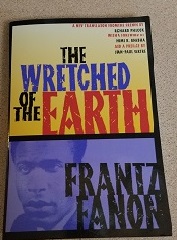 On July 1, 1962 a referendum was held that paved the way for Algerian independence from the government of France. The complete cessation of armed conflict marked the end of war that lasted seventeen years. The Algeria movement for freedom stands out as a success story similar to the legendary revolutionary campaigns in the Caribbean and Latin America. It is also a case study for those seeking to go down the path of revolution as a method to enforce social reform. No revolution is complete without a defining text and in this case, the struggle was analyzed and transcribed the famed revolutionary, writer, philosopher and psychiatrist, Frantz Fanon. (1925-1961) The book was finished shortly before his death and published not long after. Originally written in French, it has been translated by Richard Philcox for English readers.
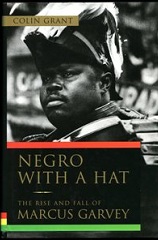 In the Bedford-Stuyvesant section of Brooklyn lies Marcus Garvey Blvd, a street named after the late iconic figure in the African-American struggle for civil rights in the United States and abroad. The native son of Jamaica and former resident of London, England, made his name famous on the streets of Harlem, New York through the formation and activities of the Universal Negro Improvement Association (UNIA). The organization’s purpose to build up the moral, economical and social status of Black Americans, combined with his “back to Africa” movement, remain defining movements in the African-American experience. At the time of his death on June 10, 1940, Garvey was a shadow of his former self after several severe strokes had taken their toll on his aging body. His death dealt a sever blow to the strengthening movement for equality. And 76 years after his death, his writings, speeches and life, are still remembered, quoted and analyzed for they remind us of the importance of standing up for what we believe in. Garvey remains one of most magnetic figures of the 20th century.

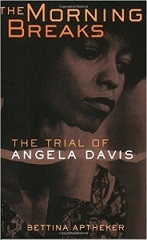 October 13, 1970-Angela Davis is arrested in New York City and extradited to Marin County, California, where she is charged with conspiracy to commit murder. The charge stems from the death of Judge Harold Haley, taken hostage by Jonathan Jackson and accomplices in an effort to free the Soledad brothers and all political prisoners from United States federal prisons. Davis’ arrest and trial became a focal point in the struggle against an unjust and discriminatory judicial system in which the privileged often found themselves defenseless in frivolous trials resulting in equally absurd prison sentences.

You must be logged in to post a comment.