
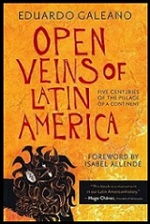
 Latin America is home to some of the most beautiful scenery in the world. The Iguazu Falls, Andes Mountains and Patagonia attract millions of visitors annually. The beauty of these and other sites across Latin America stand in stark contrast to the poverty that can be found outside of major cities and sometimes within. In between major railway stations and ports exist slums that remind us of the severely uneven distribution of wealth throughout the continent. Speaking from personal experience, most Americans would be shocked at living conditions that still exist in Latin America to this day. But why does a continent with a history that goes back several hundred years and is home to beautiful people, beautiful languages, great foods and beautiful scenes of nature, continue to suffer from poverty, corruption and exploitation.
The key to understanding the current state of these and other Latin American affairs, is to revisit its history. Eduardo Galeano (1940-2015) has done just that in this eye-opening and best-selling study of Latin American history that was first published in 1971. The edition that is the subject of this review was re-published in 1997, and contains a foreword by Isabel Allende, a cousin of the late Chilean President Salvador Allende (1908-1973). On September 11, 1973, Allende died on a self-inflicted gunshot wound as opposition forces engaged in a CIA-backed overthrow of the government. Isabel currently lives in California and is a naturalized United States Citizen.
Galeano starts by revisiting how Latin America came into existence from a continent of indigenous people to one in which Spanish is the dominant language. The arrival of Christopher Columbus in the Caribbean marked a distinctive change in the course of world history and although he never set foot in North America, Columbus is still considered by many to be the person that discovered what is today the United States. In recent years however, the holiday of Columbus Day has been replaced by Indigenous People’s Day or in others not acknowledged. In Central and South America, the arrival of the Spanish explorers would have a profound impact and set the stage for plunder, murder and exploitation that engulfed the continent. Next to Columbus are the stories of Vasco Núñez de Balboa (1475-1519) and Pedro de Valdivia (1497-1553), explorers who would spend their last days in South America. And as Galeano re-tells their stories, the reader might want to make notes of names, dates and places as the story comes together like a puzzle.
While the tragedy of exploitation and violence played out, not all voices were content with Spanish domination and the extermination of South America’s inhabitants. Tupac Amaru (1545-1572) and Simón Bolívar (1783-1830) also appear in the book and it would be safe to say that an author would find it impossible to discuss Latin American history without recounting their extraordinary and short lives. However their efforts proved to be ineffective against the rush of colonization that dominated the southern hemisphere. And it is at this point in the book that Galeano turns up the heat as we learn how natural resources became a gold mine and and the populations of the Carribean, Central American and South American nearly disappeared as a result of warfare, famine and disease. World superpowers sank their teeth into the Latin American cash machine and have never let go.
The grip of foreign control has proven to have disastrous effects on politics, producing revolutions and widespread practice of the coup d’état. Leaders who leaned left and sought to reclaim industries exploited by foreign corporations were quickly dealt with through American foreign policy. Those who did play the game were rewarded and tolerated through the Good Neighbor Policy and other shady practices. The climate of distrust and violent overthrow of the government has never left Latin America. The current events in Nicaragua, Venezuela and Argentina are prime examples of the volatile political climate that continues to exist. And all the while, foreign corporations continue to reap enormous profits as they move around offices and politicians like pieces on a chess board.
Galeano provides a staggering amount of information in the book which is sure to shock the reader. But this book is key to understanding why Latin America has developed so many third-world countries. It would be easy to blame those countries for their own failures. But what we know is that after a colonizer has left the colonized, it is immensely difficult for those nations to find a permanent path of success. This was beautifully explained by Frantz Fanon (1925-1961) in his classic The Wretched of the Earth. The future is bleak for many Latin American nations as inflation rises and the IMF becomes more reluctant to give out loans. Poverty continues to increase giving rise to protests, crime and strikes. What we see today is a manifestation of what Galeano calls “five hundred years of the pillage of a continent”.
If you have never traveled through Latin America, I implore you to do so at least once. I firmly believe that there are many great things that are unfamiliar to those who live in the northern hemisphere. I have had the privilege of visiting Argentina, Brazil and Uruguay. Chile is next on the list. Through my travels, I have met many people who have become a permanent part of my life and I am eternally grateful for having met them. Galeano died on April 13, 2015 after a battle with lung cancer but he left behind important works and this masterpiece which has been translated into more than twelve languages. This book has proven to be the companion guide every person needs in order to understand many of things that will be seen in Latin America, including the current presence of open veins.
ISBN-10: 0853459916
ISBN-13: 978-0853459910
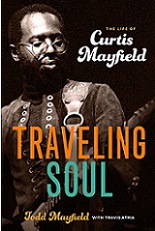 His voice was unlike any other I have ever heard. My grandparents, aunts and uncles played his music regularly and his songs are recognized as part of the soundtrack to the continuing movement for equality carried on through Black Americans. His hits We’re A Winner and Keep on Pushing are some of most iconic songs from that era and a testament to the skill and passion of the late Curtis Lee Mayfield (1942-1999). Along with his group, the Impressions, Mayfield helped redefine music as we have come to know it. His soundtrack for Super Fly is legendary and next to Isaac Hayes, the music therein was the cream of the crop for the Blaxploitation films that became the norm for African-American stars. And although he has been gone for nearly nineteen years, his music sounds as if it were recorded yesterday. On the surface, the beard, eccentric clothing, glasses and guitar tuned to F sharp gave the image of a musician larger than life. But how much of his personal life do we, his fans, know? And what was the real Curtis Mayfield like?
 Every summer, my parents make their annual visit to the Mashantucket Pequot Museum and Research Center in Ledyard, Connecticut to continue learning about the Pequot Indian tribe who lived in what is now the State of Connecticut. They are one of the many tribes that called North America home prior to the arrival of European settlers and the creation of the United States. Today, they can be found largely on reservations having been forced off of the only lands they knew to make way for a country that had liberated itself from British colonization. Far too often, their plight is ignored and history books have traditionally re-written the history of the foundation of the United States of America. This book by the late Dorris Alexander “Dee” Brown (1908-2002) challenges everything we thought we knew about our country and the scores of people often referred to simply as “the Indians”.
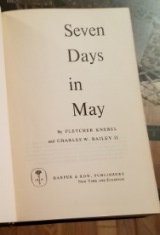 Many of us believe that it could never happen here and that the United States is too stable and developed for the military to even attempt a coup. The suggestion would be dismissed instantly by those who believe such things happen in Third World nations. But what if it did happen in the United States? And how would the plot develop? Fletcher Knebel (1911-1993) and Charles W. Bailey, II (1929-2012) put their minds together as they pondered these questions and others resulting in this masterpiece, Seven Days in May. According to legend, President John F. Kennedy (1917-1963) liked the book so much that he allowed director John Frankenheimer (1930-2002) to use the White House grounds while creating the film of the same name that was released in 1964 starring Burt Lancaster (1913-1994) and Kirk Douglas (1916-). Kennedy did not live to see the film and his assassination was more than the writers could have imagined as they created this book.
 On July 18, 1969, Senator Edward M. “Ted” Kennedy (1932-2009) lost control of his vehicle while crossing the Dike Bridge on Chappaquiddick Island, Massachusetts. In the passenger seat was a twenty-eight old former staff member of Robert F. Kennedy’s (1929-1968) presidential campaign and member of a group of women known as the “Boiler Room Girls”. She was later identified as Mary Jo Kopechne. In death she became a permanent part of the history of Chappaquiddick and a reminder of what happens when we are negligent in our actions. Over time she has been largely forgotten, having been overshadowed by the lives of the Kennedy family. And with regards to Chappaquiddick, she has been known as the “woman in Kennedy’s car”. But the real Mary Jo Kopechne has an interesting story of her own that was cut short at only twenty-eight years of age.
 The definition of courage is the ability to do something that frightens one. On October 13, 1972, Roberto Canessa was one of forty passengers aboard Uruguayan Air Force Flight 571 bound for Santiago, Chile. The plane clipped the top of a mountain peak and crashed in a region known as the Valley of Tears. Seventy-two days passed before all of the survivors were rescued. Canessa and Nando Parrado, author of
  On October 13, 1972, Nando Parrado was a twenty-two year old rugby player with the Old Christians from Montevideo, Uruguay. The team was en route to Santiago Chile for an annual match against a rival team. As their Fairchild 227 flew north through the Andes following a navigational error by the plane’s pilots, it clipped the top of a mountain peak as the crew struggled to force the aircraft to climb over the deadly terrain. The initial crash killed several passengers and by the time the survivors were rescued in December, 1972, only sixteen remained. Their story was told by author Piers Paul Read in the 1974 book
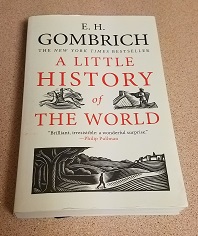 Can you imagine several thousand years of world history compressed into three hundred four pages? Before reading this book, I certainly did not and I believe the same applies to many others. However, that is exactly what Ernst Han Josef Gombrich (1909-2001) has done in this history book that came into existence as a result of challenge issued to the author to write a better history book than the one he was editing at the time. The book was written in 1935 and subsequently re-published bringing it up to date with modern history events. Gombrich never intended for the book to replace all of the history textbooks in use by teachers and professors. However, the book does serve as a complement to dozens of study aids used by students across the globe. Interestingly, the book is geared towards the ages of seven to nine years but I think that readers of all ages will find it to be quite informative.
 When I think back on the history classes I attended in elementary school, high school and then college, I remember that it seemed as if it took forever to go through any topic. And that says a lot for someone like myself who has always loved the subject and still does. For most people, history is beyond mind-numbing and often revisits events in the past to which most people do not give a second thought. But as we are often reminded through history, we need to know our past in order to reach our future. In comparison to the history of Europe, Asia and other parts of the world, the United States is a very young nation that has been in existence less than three hundred years. Incredibly, in that short amount of time on the world stage, some of the most memorable events in modern history have taken place in North America and had reverberating effects across the planet. If we were to study American in its entirety, that would be a course that would last a couple of years at least. But what happens when you cram that history into a book that is three hundred nine pages long?
 FREETHINKING BIBLIOPHILE
You must be logged in to post a comment.