

The Cuban Revolutionary war has been viewed through different lenses, typically dependent upon which side of history the viewer falls on. Fidel Castro’s march through Havana after the exit of Fulgencia Batista was paraded as the era of change that Cuba needed in order to break out from Yankee imperialism and the iron grip of organized crime. The charismatic and bearded leader introduced a new pride in Cubans with promises of true revolution and equality for all. Today, nearly sixty years later, we know that did not happen and the true number of people persecuted under his rule may never be known. Reinaldo Arenas (1943-1990) was just one of thousands of exiles who were able to leave the island they called home to escape relentless persecution because of their sexuality and literary beliefs. And when he took his own life on December 7, 1990, an end came to a short but painful life in which he never truly found peace. Before his death he made it a goal to complete this autobiography as a sort of farewell gift to those who knew him or his work. His death was no accident and Arenas explains himself that he will in fact leave this world as his choosing. Twenty-seven years have passed since his death but his story is remarkable even today. The book was adapted into a screenplay by Julian Schnabel and the film starred Javier Bardem and Johnny Depp. Both are great actors but as good as the film may be, the only person who told Arenas’ story the best was Arenas himself.
The author begins the book by taking us back to his childhood in Cuba, in particular his village of Holguín where he was born into a village of poverty where he and his closest siblings had no shoes and sometimes ate the earth. The descriptions of the poverty that could be found in his village are shocking but an accurate portrayal of life in small villages just decades ago. At a young age, he realizes he is a homosexual and his sexual orientation will be a major factor in almost all of the events that take place throughout the rest of his life. They are also central to everything in the book. Stories of the persecution of homosexuals in Cuba under the Castro government are well-known but those outside of Cuba may not know just how much. In a society where all were supposed to be equal, the blatant harassment and discrimination of gay men and women contradicted the revolutionary ideology. Nevertheless, from Arenas’ words, it does seem at times as if homosexuality was as common as heterosexuality. His encounters with men are spontaneous, dangerous and also numerous. And his descriptions of his encounters and what he witnesses are graphic and not for readers that are uneasy with explicit sexual dialogue.
As a writer, Arenas also possessed another quality which made him an enemy of the state. He explains himself that Castro does not like writers, either those for or against the government and the suppression of free thought, speech and works of literature is present everywhere as big brother cracks down in Orwellian style manifested in the classic 1984. Informants, mail-opening and surveillance were tools of the trade as ordinary citizens lived under a microscope where everyone was suspected of being counter-revolutionary and forced to live on meager rations with nearly no income. In fact, their lives stood in stark contrast to the opulent lifestyle enjoyed by Castro and his subordinates. In short, it was the classic totalitarian state despite of the image projected by the Castro regime. Cuban exiles will readily agree with this but even in Cuba, there are those who believed in Castro and still do. The debate will go on for an eternity.
Arenas realizes that his sexual orientation and writing have made him a target and he knows it is just a matter of time before the authorities come for him. They do and his incarceration in Cuban jails makes up the central part of the book. His descriptions of life in Cuban prisons defy belief and it is a miracle that anyone survives. Towards the end of the book, he admits that he never fully healed from prison and that no one ever does. But he remains strong in the face of adversity as authorities do their best to break his spirit and turn him into informant. When he finally puts prison behind him, he troubles are over as he has to earn a living but is known to the State and known in society as part of a group of people who are often ostracized. He knows he must get out of Cuba, but the questions remains as to how he will do it. A chance event in Peru changes his life and the lives of thousands of other Cubans and when he finally steps foot on U.S. soil, the next phase of his life begins but not long before it tragically ends.
Although this is Arenas’ autobiography, he tells the story of the lives of many people close to him, all struggling to find peace and happiness in a society which represses anything an everything. Scene and scene of debauchery and tragedy play out by characters just short of despair. Their stories and Arenas’ life reveal the facade behind the triumphant revolution which replaced on dictator with another who was at times even more brutal towards his own citizens. In a cruel twist of fate, Castro outlived Arenas and many other Cuban exiles depriving them of the chance to see Cuba after Castro. The future will tell if Cuba will every truly be free but as the nation moves towards that goal, then it is best served to remember the stories of those who have suffered and Arenas who through his words, one of Cuba’s loudest voices.
ISBN-10: 0140157654
ISBN-13: 978-0140157659
 There is something about the Italian-American crime syndicate that continues to fascinate American culture. The larger than life characters that appeared on television and in newspapers have been immortalized in movies and documentaries. Their close-knit organization which we have come to know as the Mafia, became as American as apple pie. Violence, money, sex and power become staples of the gangster’s life. Many of them die before their time as the street life inevitably catches up with them. John Alite knows this all too well. The former hit man for the late Gambino Family boss John Gotti (1940-2002), served several years in prison after being extradited from Brazil in 2006. He later agreed to testify against a former associate which reduced his sentence. In 2017 he was released from supervised parole.
 It is sometimes called the forgotten war, the conflict which remains in the background as World War I, World War II and Vietnam take center stage as the wars that defined the United States Military and U.S. foreign policy. Unbeknownst to many Americans, the Korean war never officially ended. An armistice was signed on July 27, 1953 bringing a halt to the firing from all sides. But the armistice did not permanently resolve the conflict and to this day the 38th parallel, instituted after World War II, remains as the dividing line between the Communist North and the Democratic South. Recently, U.S. President Donald J. Trump attended a peace summit with the leader of North Korea, Kim Jong Un. Washington claimed the summit a success but only time will tell if the Korean War will officially come to an end and peace is finally obtained. For veterans of the conflict, feelings run deep and mixed thoughts on the summit are bound to exist. Two years ago, a veteran of the war close to my family died after several years of declining health. Curiously, he never spoke of the war, preferring to keep his thoughts and feelings to himself for more than 50 years. And as he went to his grave, he took with him, knowledge of the war and memories that most people would never want to have. But the questions still remain, what caused the conflict and why did war wage for three years? Furthermore, why did the fighting eventually cease?
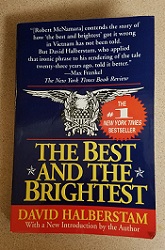 I have often wondered why my uncle and many other veterans that I have met, were sent to Vietnam. He and others never speak of the war, choosing instead to internalize their memories and feelings. But from the few things about being Vietnam that my uncle has told me, I cannot image what it was like to be fighting a war in a jungle 13,000 miles away from home. Today he is seventy-two years old and his memories of Vietnam are as sharp today as they were when he left the country to return home. And there is a part of him that still remains in Vietnam, never to leave its soil. He is one of five-hundred thousand Americans that served in a war that claimed fifty-eight thousand lives.
 Latin America is home to some of the most beautiful scenery in the world. The Iguazu Falls, Andes Mountains and Patagonia attract millions of visitors annually. The beauty of these and other sites across Latin America stand in stark contrast to the poverty that can be found outside of major cities and sometimes within. In between major railway stations and ports exist slums that remind us of the severely uneven distribution of wealth throughout the continent. Speaking from personal experience, most Americans would be shocked at living conditions that still exist in Latin America to this day. But why does a continent with a history that goes back several hundred years and is home to beautiful people, beautiful languages, great foods and beautiful scenes of nature, continue to suffer from poverty, corruption and exploitation.
 His voice was unlike any other I have ever heard. My grandparents, aunts and uncles played his music regularly and his songs are recognized as part of the soundtrack to the continuing movement for equality carried on through Black Americans. His hits We’re A Winner and Keep on Pushing are some of most iconic songs from that era and a testament to the skill and passion of the late Curtis Lee Mayfield (1942-1999). Along with his group, the Impressions, Mayfield helped redefine music as we have come to know it. His soundtrack for Super Fly is legendary and next to Isaac Hayes, the music therein was the cream of the crop for the Blaxploitation films that became the norm for African-American stars. And although he has been gone for nearly nineteen years, his music sounds as if it were recorded yesterday. On the surface, the beard, eccentric clothing, glasses and guitar tuned to F sharp gave the image of a musician larger than life. But how much of his personal life do we, his fans, know? And what was the real Curtis Mayfield like?
 Every summer, my parents make their annual visit to the Mashantucket Pequot Museum and Research Center in Ledyard, Connecticut to continue learning about the Pequot Indian tribe who lived in what is now the State of Connecticut. They are one of the many tribes that called North America home prior to the arrival of European settlers and the creation of the United States. Today, they can be found largely on reservations having been forced off of the only lands they knew to make way for a country that had liberated itself from British colonization. Far too often, their plight is ignored and history books have traditionally re-written the history of the foundation of the United States of America. This book by the late Dorris Alexander “Dee” Brown (1908-2002) challenges everything we thought we knew about our country and the scores of people often referred to simply as “the Indians”.
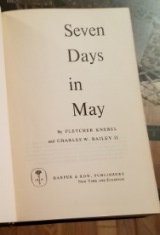 Many of us believe that it could never happen here and that the United States is too stable and developed for the military to even attempt a coup. The suggestion would be dismissed instantly by those who believe such things happen in Third World nations. But what if it did happen in the United States? And how would the plot develop? Fletcher Knebel (1911-1993) and Charles W. Bailey, II (1929-2012) put their minds together as they pondered these questions and others resulting in this masterpiece, Seven Days in May. According to legend, President John F. Kennedy (1917-1963) liked the book so much that he allowed director John Frankenheimer (1930-2002) to use the White House grounds while creating the film of the same name that was released in 1964 starring Burt Lancaster (1913-1994) and Kirk Douglas (1916-). Kennedy did not live to see the film and his assassination was more than the writers could have imagined as they created this book.
 On July 18, 1969, Senator Edward M. “Ted” Kennedy (1932-2009) lost control of his vehicle while crossing the Dike Bridge on Chappaquiddick Island, Massachusetts. In the passenger seat was a twenty-eight old former staff member of Robert F. Kennedy’s (1929-1968) presidential campaign and member of a group of women known as the “Boiler Room Girls”. She was later identified as Mary Jo Kopechne. In death she became a permanent part of the history of Chappaquiddick and a reminder of what happens when we are negligent in our actions. Over time she has been largely forgotten, having been overshadowed by the lives of the Kennedy family. And with regards to Chappaquiddick, she has been known as the “woman in Kennedy’s car”. But the real Mary Jo Kopechne has an interesting story of her own that was cut short at only twenty-eight years of age.

You must be logged in to post a comment.