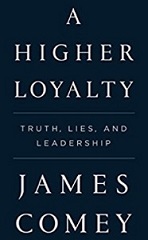
A Higher Loyalty: Truth, Lies and Leadership-James Comey

comeyIt is not often that a former Director of the Federal Bureau of Investigation writes a book.  In fact, it is almost unprecedented.   In all fairness, there have been books written by former members of the Central Intelligence Agency and U.S. intelligence apparatus.  When James Comey published this book, news outlets were eagerly waiting to get a copy of one of the most anticipated book releases in history.   The political climate of the United States is unlike anything most of us have ever seen.   There are a number of adjectives that come to mind, any of which could be rightfully applied to Washington, D.C.   Time will tell what will happen in the oval office.  The firing of James Comey through the media left many of us shocked, confused and even angry.   For some, it was just one more act by a vindictive and childish commander-in-chief.  Others believed that it was the right call as they believed the FBI was out of control.  I watched broadcasts that day and found myself astonished at the day’s events and wondering if this was just the start of a regrettable trend developing in the United States government.

During the 2016 president election, James Comey became a celebrity of sorts as a result of the bureau’s investigation of improper use of e-mail by Hillary Clinton.  She was never charged with a crime and given a warning about improper use of a mail server.  Several weeks later, it was announced that once again, the FBI was looking into the e-mail issue.  Critics of the FBI jumped on the announcement and blasted it as a smear campaign to discredit Clinton and tilt the election in favor of Donald Trump.   Whether the e-mails was the deciding factor that caused Clinton to lose the election, is still up for debate.  Comey was labeled all sorts of names by Clinton supporters and disliked even by some Trump supporters for not fully going after Clinton as they believed he should have.  Seemingly a man caught in the middle, he did his best to wade through difficult waters.  I have often wondered what really did happen and why did the FBI put out the statement about re-opening the investigation in Clinton’s emails?  Well, here in this book Comey answers that question and many others that have crossed the minds of millions of Americans.

The book is largely an autobiography where we learn about Comey’s childhood, his role as a husband and father and experiences in the U.S. Department of  Justice.  The young kid from Yonkers, NY, probably never imagined that one day he would lead the Federal Bureau of Investigation and find himself at the center of an election controversy.   What I found most interesting about the book is that Comey does not come off arrogant or self-pitying.   He is a neutral as you could expect.  It is clear that he truly believes in the bureau and the laws of the United States. But any beliefs about him being out to sabotage Clinton, help Trump or just make a mockery of the Department of Justice is ludicrous.  In fact, his revelation about his true feelings towards the election says a lot about how he approached his job.

Many of us are unaware of the sacrifices made by those who work in top positions in the U.S. Government. Long hours and time away family is often the norm and the jobs are sometimes quite unorthodox.  Comey speaks on this and the several times his family had to relocate as his career took yet another term is an example of the chaotic life that can come with service in government.   But not once does Comey complain and is grateful for everything he has done.  His story reads like that of an accomplished employee looking back on all that he has done.  That is until we get to the current President.

To say that the story takes a dramatic turn would be an understatement.   I do not believe that any of us knew exactly what would happen once Donald Trump took office.  The celebrity television star and real estate figure ran a campaign that bordered on the unreal at times.  But he received the electoral votes needed to become the next President of the United States.  Almost immediately, the relationship between Trump and Comey is filled with uneasiness and bizarre situations.   Readers might be tempted to believe that the book has turned into fiction but it does not.  The recollections come from Comey’s memos and memory of the meetings, the substance of which will make most people scratch their heads in bewilderment.  In addition, Comey puts to rest any notion people might hold about any relationship he has with Donald Trump.  And I would like to think that his very public firing confirms what Comey says about their prior encounters.  Most of the story will sound unbelievable but then again, the man in office was elected on a campaign that many thought was also unbelievable.

Regardless of party affiliation, if you believe in the laws of the United States and our  democratic institutions, the book is a good read about the Department of Justice.  And now we know the story of James Comey, who went from FBI Director to a man known to millions of people as the person unfairly fired by a President whose is beyond unpredictable. I do not know what the future holds for Donald Trump of James Comey but with this statement, the former FBI Director has taken a large step in clearing his name and reputation and telling his side of a most interesting story.

ISBN-10: 1250192455
ISBN-13: 978-1250192455

God is Not Great: How Religion Poisons Everything-Christopher Hitchens

hitchens1The title of this book is enough to cause a range of emotions in deist, agnostics and atheist.  Next to politics, religion is a subject which unites or divides, sometimes through the use of extreme violence. Today, when we think of religious fundamentalism, images of Islamic radicals readily come to mind causing us to forget that extremism exist is nearly every religion known to man.  In the United States, most deists are followers of monotheistic faiths.  Others are followers of polytheistic faiths and the remainder could be classified as agnostic, spiritual or even atheist.   Those who are atheist remain firm in their belief that God does not exist. But for deists, God does exist and is present all around us at all times.  But what if is there is no such thing as God?  Believers will find the mere mention of such a concept preposterous. But in all fairness, no one has ever come back from the dead to tell humanity what really happens when we die.  Furthermore, non-believers point to the world’s many ills as proof that an all-loving God is nothing more than make-believe.   Christopher Hitchens (1949-2011) wrote at least thirty books, some of which like this, addressed religious faith.  Here, he takes on God and puts forth his argument that religion itself is the cause of many of the world’s ills.  One look at the cover will cause some to claim blasphemy and write Hitchens off as doomed and demented soul who surely found out when he died, that God does in fact exist.  Regardless of what side of the fence you are on, the book is a good discussion on the effect religion truly has on our lives.

In the book, Hitchens does not focus on one religion solely, he addresses multiple religions as he makes his argument.  He is clearly well-read and by his own admission, grew up in a Christian childhood.   His career has taken him to all parts of the world where he was able to examine other faiths up close. And the arguments he makes in the pages of this book are thought-provoking and it would extremely difficult for even the most ardent believers to ignore the many problems with religion that Hitchens discusses.   As a believer, when you think of your faith, it is seen in a positive light.  It helps people, gathers them together, provides answers and gives a sense of purpose.   But was that always the case and is religion even necessary to have all of the things that we seek through it?

There are thousands of gods worship throughout the world.   However, the most dominant religions are mainly monotheistic.  Jesus, Yahweh and Allah have claimed billions of followers world-wide.   Hinduism also claims a large number of followers who pray daily to the many Gods that are worshiped. In parts of Iran and the Middle East, Zoroastrianism is still practiced.   Exactly when each of these religions developed is lost to history.   Science tells us that man existed for thousands of years and that the planet is at least a four billion years old.  That forces the question, did God create man or did man create the Gods?  Furthermore, are Gods even necessary to live a full and purposeful life?

Hitchens pulls no punches in this book and makes his point clear that he truly believes religion poisons everything.   However what he does not do is tell anyone to give up their faith nor does he attempt to belittle anyone who believes in the Gods that he mentions.  And although he does believe that a world without religion would be better, he is mature enough to understand that some will continue to believe in the only religion they have ever known.   Atheists are often thought to be vile and vicious beings who want to rid the world of religion.  The opposite is usually the case.  Hitchens, like Richard Dawkins and others who have made a case against religion, is very rational and in no point in the book, does he use rhetoric to incite any type of violence or force anyone to become an atheist overnight.  Clearly, the decision to no longer believer or remain in the fold is up to the individual.  But what he does do, is provide examples from history of why he believes religion plays a negative role in society.  The book is a journey from mankind’s earliest known relationship with God all the way to the present and the growing numbers of people in the United States who have no religious affiliation at all.

I believe that is fairly obvious that in order to read this book an open mind is needed.  And I also believe that those who do purchase the book are either unwavering believers curious to see what Hitchens says and others who no longer believe or are on the path to living religion free. We all have to find our own path in life but if we need an honest and critical examination of the role of religion in society, this is a good place to start.

ISBN-10: 9780446697965
ISBN-13: 978-044669796

Somebody to Love: The Life, Death and Legacy of Freddie Mercury-Matt Richards and Mark Langthorne

freddie21But who was the real Freddie Mercury?  His death on November 24, 1991 came just hours after he released a statement informing the world that he had developed AIDS after being diagnosed as HIV positive several years earlier. Those close to him were not surprised at the announcement. The press was relentless is following Mercury around London attempting to get a glimpse of the star who was rumored to be on his deathbed.  I remember when Mercury died and the news broadcasts that flashed across several networks.  The music world had lost one of its greats.  However, like all musicians, much of his life was subject to speculation and misinformation.  In fact, to this day there is much about him many people may not know.   But here in Somebody to Lovem we have a complete picture of the life of the late Freddie Mercury.
The story begins with the origins of HIV and its progression from SIV in Chimpanzees to a disease that became an epidemic.  In 1946, the world welcomed Farrohk Bulsara, born to Persian parents of the Zoroastrian faith.  He would be joined a younger sister, Kashmira.  From an early age, it is evident that music is his calling but the path he would take to stardom and his life after finding it, is a classic example of the importance of always following your dreams.  But with his rise to stardom and relationships with women, there was another side to Freddie Mercury that he fought desperately to hide from the press.  Today most of us think nothing of a gay or lesbian celebrity.  But we often take for granted how much the world has changed. For Mercury, coming out was not an option and the efforts he went to in order to contain his secret life are astounding.  But it is also a tragedy for Mercury was never able to find the true love that escaped him his whole life.  He does his best to find true love and the people who came in and out of his life all play a part his rise and eventual decline.   Mercury was not innocent himself and at times is nearly out of control and seemingly on a path of self-destruction.

It goes without saying that any book on Mercury could not be written without addressing the gay community.   Coincidentally, as Mercury was becoming a household name, kaposi sarcoma began to afflict large numbers of gay men in New York and San Francisco.  It would be known at first as the “gay cancer” and prompt officials in San Francisco to close all of the City’s bath houses. The race to identify the disease and find a cure became the topic of Randy ShiltsAnd The Band Played OnThe book was later adapted to a film starring Matthew Modine and Alan Alda.  Mercury was fully immersed in the gay lifestyle at this point and his connection to the story by Shilts might surprise even those who are well-read on the AIDS epidemic.   Before Mercury’s demise, he would lose many of those once close to him and the world would learn about a deadly killer that crossed all social and ethnic lines.

In just forty-five years, Freddie Mercury rose to the top of the music industry and Queen became legends.  In death, his status as a rock icon grew without boundaries but sadly he joined a long list of victims of AIDS, and his name is mentioned next to many such as Arthur Ashe and Rock Hudson, as celebrities who were unable to escape a killer that spared no one.  I sometimes wonder what would have happened had Mercury lived.  Before his death he had been planning more projects and writing material until he was forced to abandon his passion.  His passing was our great loss and we should be grateful for all of the great music he left behind.  His lifestyle was not agreeable to all but his talent was undeniable.  This is the life, death and legacy of Freddie Mercury.

ISBN-10: 1681881888
ISBN-13: 978-1681881881

Betrayal in Blue: The Shocking Memoir of the Scandal That Rocked the NYPD-Burl Barer, Frank C. Girardot, Jr., Ken Eurell and Kevin Pierce

BlueNearly twenty-six years ago, New York City Police Officer Michael Dowd was arrested by the Suffolk County Police Department in cooperation with the U.S. Drug Enforcement Agency for the possession and distribution on narcotics. His arrest, trial before Judge Kimba Wood of the  Southern District of New York and testimony before the Mollen Commission solidified Dowd’s reputation as the dirtiest cop in NYPD history.   Arrested with him were other officers, drug dealers and other participants.  Ken Eurell was retired at the time of his arrest but during his active tenure, he patrolled the streets of the Seventh-Fifth precinct with Dowd and embarked on a path of corruption that is still unbelievable to this day.  The duo recounted their life of crime in the 2015 documentary The Seven Five.  Undoubtedly, Dowd is the main focus and his recollections are backed up by Eurell and the other former officers.  This is the story from Eurell’s point of view about how and why he found himself more deeply immersed in crime with Dowd.

Eurell starts off by explaining his family history and how he joined the NYPD.  Hi story is relatively straightforward and certainly non-eventful until he crosses paths with Dowd.  Corruption had already existed and as Eurell points out, it was quite widespread throughout the department. Incoming officers were forced to learn on the quickly and those who made the decision to inform on dirty cops often faced a career derailed from being ostracized.  Dowd is not just corrupt but takes everything to the extreme and is blessed with a mind geared for exploiting every angle possible. It does not take long for Eurell and Dowd to begin to pull off numerous capers and form a working relationship with two of the biggest drug dealers in East New York.

I lived five blocks from the 75th Precinct and remember when the story broke.  Prior to Dowd’s arrest, there at had been stories of arrest at other precincts of cops that engaged in corruption of all sorts.  Most of the people in the neighborhood were not surprised as most of the officers from the “75th” were considered to a bunch of cowboys.  Having read this account by Eurell and that of Internal Affairs Investigator Joseph Tromboli in his book Good Cop, Bad Cop, the moniker of cowboys is a huge understatement.  They were nothing short of out of control and Dowd was on a mission to self-destruct and might have succeeded in the end if not for Eurell’s decision to cooperated with authorities.

The book is shocking at times but I do think Eurell and the authors were right about what East New York was like during the 1980s and 1990s.  Having lived there at the time, I can say with all honesty that the neighborhood looked like a war zone.  Poverty was rampant, murders common and the police struggled with containing the constantly increasing criminal elements.  But what happens when the cops are part of the element? Through participation with Adam Diaz and Baron Perez,  Dowd and Eurell had crossed a line from which there was no safe return.  East New York, described by officers herein as the “Land of F*ck”, was hell on earth and the problems that plagued the neighborhood extended far beyond the reach of the NYPD and led directly to City Hall. Today, those days are long gone and the landscape bears no resemblance to what it used to look like.  Vacant lots have disappeared, crack-cocaine is no longer the drug of the street and the faces of the NYPD are now more diverse.  But the 75th is still there at 1000 Sutter Avenue and for older residents, the place that was once the source of the dirtiest cops in all of New York City.

Today, Ken Eurell no longer lives in New York, having relocated to Florida as he attempted to put his life back together again following the fallout after Dowd’s final downfall.  As he tells his story he is candid about what he did, how he was seduced by the lifestyle and the pain he inflicted upon his own family.  He does not ask for sympathy, freely admits where he went wrong and never portrays himself as a victim or hero.  This is simply his part of the story and I think a good supplement to Tromboli’s book and the documentary. I would go as far as to say that if you have watched the film and read Tromboli’s book, then his is another piece of the puzzle.   Some of the information is revealed in other places but I do think Tromboli’s book contains a bit more because it is told from the side of Internal Affairs so he is able to convey what was known about Dowd and when NYPD brass knew it.   Some readers might be tempted to ask how did they get away with it for so long?  The answers are in the book and they just might surprise or even shock you.  But this was New York City in the 1980s and 1990s, when it was one of the most dangerous cities in America before gentrification arrived.

I often think about my childhood and early adult life in East New York.  Many of my friends have long left the neighborhood and I no longer live there myself.  But we all carry many memories and they will remain with us for the rest of our days as I am sure they will for Dowd and Eurell.  The East New York they knew is different today and if the City is successful, it will be unrecognizable to them in just a few years.  But no matter how much transformation occurs, the dark history of corruption within the Seven-Five  will remain in its history.

ISBN-10: 194226674X
ISBN-13: 978-1942266747

Slobberknocker: My Life in Wrestling-Jim Ross with Paul O’Brien

jr11Ross was never a “in-ring talent” and spent most of his days commentating or behind a microphone and a result, he possesses an invaluable insight into the promotional side of the business and how stars and heels are created and then sold to the public.  Contained within the pages of this book is a story that every pro wrestling fan should read.   Some readers may be tempted to think that because he was not a “superstar” in the sense that most people used to, he does not have an amazing story to tell.  I would like point out that they would be highly mistaken. In fact, Ross’ story is just as crazy as others that have been told.  The reason is that not only did he know the best but partied and traveled with them as well.  Like a sponge soaking up everything in its vicinity,  he observed and learned over four decades what it takes to survive in the crazy world of what my father used to call “rassling”.

Ross in typical autobiographical style, recounts his childhood and his path to becoming a man as he graduates high school and tries his hand at college.  But wrestling steals his heart and nearly his life as he goes through several marriages that produced two daughters.  His last marriage to Jan Ross is the most moving and tragic.   In March, 2017, she was on her way home from the gym on her scooter when she was struck by a vehicle driven by a seventeen year-old. She suffered severe head trauma and died shortly after at the hospital.   The book is partly dedicated to her memory.

I honestly believe that wrestling fans will truly love this book.  Ross takes us deep behind the scenes and the past comes alive with some of the most colorful characters in pro-wrestling history. Ric Flair, “Cowboy”Bill Watts, Dusty Rhodes,  The Junkyard Dog and Ernie Ladd are just some of the legendary figures Ross became closely acquainted to.  The book is a step back into time to an era that some would call the glory days of wrestling when promotions were scattered across the country.  The WWE was still the WWF and the competition came in the form of the National Wrestling Alliance (NWA), Georgia Championship Wrestling (GCW) and Mid-South Wrestling (MSW) which later became the Universal Wrestling Federation (UWF).  But a young visionary out of the Stanford, Connecticut would changed the industry forever the life of Jim Ross. His name is Vincent K. McMahon.

Undoubtedly, the crux of the book is the time JR spent with the WWE.  While his early days in the business are entertaining and revealing, the majority of fans remember him chiefly from that time.  Like many other stars, Ross had an interesting and at times odd relationship with the man nicknamed “Vinny Mac”.   McMahon, in a fitting gesture, wrote the foreword to the book.  And regardless of what battles they may have had backstage or the peculiarities that may have existed in their working relationship, it is quite clear that McMahon valued the man who became the voice of his organization.  And it was through McMahon that Ross went from a mainstay in the business to one if its legends.  The anecdotes are interesting and the section on the Montreal screw job will be of high interest to long-time fans.

The New York Times declared the book a bestseller and for good reason.  I assure you that once you start the book you will be hard press to put it down.  Ross covers it all and pulls no punches.  Pro-wrestling is a fascinating industry with the good, the bad, the ugly and the tragic.  Friends and mentors die, stars get injured, deals fall through and once close co-workers drift apart over time.   In some ways, it is a reflection of life.  However, it is how we navigate it that makes the difference.  This is an incredible story from an incredible person who exemplifies what dedication truly means.  And for wrestling fans, the next time you hear yourself say business is about to pick up, you can thank good old JR.

ISBN-10: 168358113X
ISBN-13: 978-1683581130

Best Evidence: Disguise and Deception in the Assassination of John F. Kennedy-David S. Lifton

liftonThe murder of John F. Kennedy (1917-1963) continues to maintain its place among the greatest crimes in American history.  The official story as published by the Warren Commission is that former Marine Lee Harvey Oswald (1939-1963)  fired three shots in six seconds from the sixty floor of the Texas School Book Depository, fatally wounding Kennedy and severely wounding Texas Governor John Connally (1917-1993).  To many, including the author of this book, David Lifton, the government version seemed to be the best and final explanation.  But over time Lifton came to doubt the official story and after obtaining a set of the twenty-six volumes that composed the Commission’s investigation, his doubt turned into disbelief and lead him down the path that culminated with this national bestseller.
At the time his odyssey began, Lifton was a law student at UCLA.  Working on campus was a law professor by the name of Wesley J. Liebeler who served as a Warren Commission attorney.  Disillusioned by the official report, he decided to confront Liebeler about the many discrepancies he found in the final report.  Over the next several years, the two men would become more closely acquainted as Lifton dived deeper into the murder and Liebeler sought to preserve the Commission’s report.  Ironically Liebeler is the person that suggested to Lifton that he should one day write a book.  He eventually did and this is book is a must read for anyone with unanswered questions about the murder of John F. Kennedy.

Having read multiple books on the assassination, I would like to point out that Lifton focuses on the medical evidence surrounding Kennedy’s murder.  He does not go into great detail about Oswald’s life, murder or the life and murder of J.D. Tippit.  This is strictly about the postmortem events from the time Kennedy was declared dead at Parkland Hospital until the official autopsy report was published by the physicians who were on call at Bethesda Naval Hospital when Kennedy’s body was brought in. I warn readers that the subject matter graphic as it pertains to the autopsy and a large number of anomalies with Kennedy’s body that by all appearances, occurred before the official autopsy even began.  Almost like a horror movie, the body tells signs of makeshift surgical procedures, unexplained bruising and conflicting testimony between doctors in Dallas and Maryland.  But as Lifton explains, the body is the evidence.  Skeptics might be tempted to ask how on earth could such changes have been made to Kennedy’s body before it arrived at Bethesda?  Well Lifton asked himself the same question and many others that have been answered through exhaustive research and due diligence in the most plausible manner to date.  But what is even more sound about Lifton’s work is that he supports his conclusion based off of evidence that is publicly available and in some cases, was hiding in plain sight.  His case is further supported by statements he obtained from numerous individuals who were at either Parkland Hospital, Bethesda or part of Kennedy’s entourage that escorted the body all the way back to Washington.

There are those of us who will refuse to believe that the Government could engage in such nefarious activity.  On the surface it simply seems absurd.  But we soon learn that there is far more than meets the eye.   As Lifton is continue to develop his case for a frontal shot a key event takes place changing his life forever.  On a FBI report filed by Agents Francis O’Neill and James Siebert is a section  in which they state that surgery had been performed on the president’s head prior to the autopsy.  I confess that as I read that section of the book I nearly jumped out of my seat.   This statement served as the catalyst for Lifton to change gears and become one of the most respected researchers to date.  As I continued through the book I noticed that at times chills ran down my spine.  As the story progresses, the macabre becomes a reality and it dawns on the reader that there was more to that day that had nothing to do with Lee Harvey Oswald.  This is a story that the Government did not want its citizens to hear.  But like Oswald’s murder, it refuses to be put to rest and leaves many unanswered questions.

There are many books about JFK’s murder, each taking a slightly different approach.  To get an idea of the overall picture of what happened that day, I always recommend to new readers Crossfire: The Plot That Killed Kennedy by the late Jim Marrs (1943-2017).  For others that have passed beyond that point, Lifton’s work is a critical addition to every researcher’s library.   The narrative is chilling: unexplained changes to the president’s head indicating prior dissection, two ambulances, two caskets, a helicopter and other mind-boggling postmortem incidents reveal a darker and more sinister plan in effect that most could not begin to fathom.   However, there are still many interviews that were classified and thousands of pages of others that remained classified. When they finally are released we can only guess or shudder as to what they might reveal. Until then, we have authors such as David Lifton that force us to take a close look at what is considered to be best evidence.

ISBN-10: 0881844381
ISBN-13: 978-0881844382

The Pentagon Papers: The Secret History of the Vietnam War- Neil Sheehan, Hedrick Smith, E. W. Kenworthy, Fox Butterfield and James L. Greenfield

ellsbergThe names of the 58,000 Americans who died in the Vietnam War that are found on the memorial in Washington, D.C., are a reminder of a conflict deemed by many to be the worst the United States has ever been involved in.  The withdrawal of U.S. forces in March, 1973, brought a sigh of relief to the American public which had long grown tired of a war with no end in sight.  The dark truth which we now know is that we did not by any means accomplish the mission.  And the mighty American war machine failed to secure a victory. I have met many veterans of the war and have an uncle who served.  What I recall most about all of them is that they do not speak of their experiences while in combat.  I know the memories are there and for some of them, they were unable to leave parts of the war behind.  Today we call it PTSD, but back then you simply found a way to move forward in life.   But why were they in Vietnam to being with?  Was the domino effect really a threat to the United States?

On May 11, 1973, Daniel Ellsberg found himself the talk of the town as charges pending against him for espionage were dismissed by U.S. District Judge William Byrne. He had been indicted for leaking what became known as The Pentagon Papers, the subject of this book and the topic of the movie The Post starring Tom Hanks and Meryl Streep.  The New York Times, after several battles in court, was finally allowed to move forward with its plan to publish The Pentagon Papers and contained in the pages of this book are the documents that the U.S. Government tried in earnest to hide from the American public under the guise of “national security”.   Ironically, the facts that are revealed in this book have absolutely nothing to do with national security but rather several presidential administrations that failed to find a workable solution to Indochina.

The late Secretary of Defense, Robert S. McNamara (1916-2009) has been called the architect of the war and was loathed by many because of it. However, the title is misleading and in some ways unfair. The war had many architects either by wishful thinking, uncontrolled ego or naiveté.  What is truly ironic is that as the war waged on, McNamara became a strong voice of dissent.  And in spite of what we have been led to believe, our existence in Indochina began many years before 1965.  The story of U.S. involvement in Vietnam is a long tale, filled with hard truths, false truths, deception and ultimately failure.  But this is how it happened and why.

The papers are divided into several sections which correspond to a different aspect of the conflict.  The administrations of Eisenhower, Kennedy and Johnson are examined to understand what each cabinet did and did not do as it grappled with the growing headache.   Step-by-step Southeast Asia opens up as black hole as more advisors are committed, instability rages in South Vietnam and war hawks finally get their wish as the United States jumped nearly feet first into a jungle conflict that proved to be nothing short of disastrous.  Rolling Thunder, troop deployments and South Vietnamese politics are just some of the issues that antagonized Washington for nearly a decade.

If you served in Vietnam, I forewarn you that the book might anger you in many ways. For others, this is a critical source of information in order to understand the war from a behind the scenes view.   We are often told that the military fights to protect the country and our freedoms that we take for granted.  But did a nation over 13,000 miles from U.S. soil really pose a threat to the most powerful nation on earth at the time? And what would we have accomplished if we had in fact won the conflict?   Perhaps Vietnam would have become a second Korea, partitioned between a communist controlled North-Vietnam and a U.S. controlled South-Vietnam.   Following the U.S. withdrawal, Saigon fell and the North achieved its goal of reunification.  Today the war is a distant memory for young Vietnamese but for the older generation, many painful memories remain.  The figures in the book are long gone but their actions will stay with us and the Vietnam war will always be a regrettable example of U.S. foreign policy gone wrong.

ISBN-10: 1631582925
ISBN-13: 978-1631582929

Blood in the Water: The Attica Prison Uprising of 1971 and Its Legacy-Heather Ann Thompson

20180602_232853On September 9, 1971, inmates at the Attica Correctional Facility in Attica, New York, staged a revolt in protest of the treatment they received by prison officials and the living conditions employed therein.  Several days later, New York State Troopers regained control of the prison after approval from Governor Nelson Rockefeller (1908-1979).   The siege had tragic consequences and ended with the deaths of nine hostages and twenty-nine inmates.  The fallout from the retaking was swift and to this day the story of Attica is considered the worst prison uprising in American history.  The riot caused sharp division among people with some believing in the inmates’ actions and others supporting the State of New York.  In fact, among Rockefeller’s most ardent supporters was President Richard M. Nixon (1913-1994) who would himself resign in 1974 due to the Watergate scandal.   The riot and its aftermath were so powerful that even Hollywood became interested and produced the television series Attica (1980) starring Morgan Freeman and Against the Wall (1994) starring Samuel L. Jackson (1948-) and Kyle MacLachlan (1959-).  Both film productions earned award nominations and the stars in each film would go on to have successful careers in Hollywood.  However, the questions always remain, how much did the producers get right, how much did they get wrong and how much did they leave out?   Further, how much do we, the public know about one of New York State’s darkest days?
Heather Ann Thompson composed this Pulitzer Prize winning account of the Attica prison uprising and the legacy it left behind.   Contained within the pages of this book is a story that is sad, shocking and infuriating.  Today in hindsight, we will be tempted to ask ourselves how could this have happened?  For starters, the social environment in which the main characters existed is much different from today in some regards. Law and order were applied in a far more repressive context.  Make no mistake, the prison system today is plagued with brutality and prisoners routinely complain of suppression of their basic human rights by guards and officials.  The prison industrial complex has become a multi-million dollar business and each year more Americans enter the penal  system generating more revenue for investors and contractors.  This system of mass incarceration is exactly what the Attica inmates strove to fight against and today many of the lessons that were learned in the wake of the riot have been lost or neglected.  But this book is the place to learn about the Attica riot and why we can never forget it.

Thompson acknowledges that many of the participants in the story are no longer alive and any secrets regarding Attica went with them to the grave.  What remains are their public statements and official testimony.  Some of the names are cemented in history such as Governor Hugh Carey (1919-2011), Black Panther Party co-founder Bobby Seale (1936-), attorney William Kunstler (1919-1995) and former New York City Mayor Robert F. Wagner (1910-1991). But others will become known such as Frank “Big Black” Smith (1933-2004), former guard Michael Smith and prisoner L.D. Barkley whose speech was captured by television cameras as the inmates made their voices heard.   The amount of research that went into the creation of this book is nothing short of painstaking.  And as an added touch of intimacy, the author supplements the story with photos of those relevant to the narrative.

From the moment I opened this book, I literally could not put it down.   At times I found myself sitting in disbelief and how and why the situation unfolded as it did.  And incredibly, an inner conflict arose because as I waded through the book, I came to support the inmate struggle as they fought racism, class based discrimination and the monster that is mass incarceration while at the same time I found myself empathetic to the guards taken hostage, some of whom would also perish.  And it dawned on me that they were all human beings who had different roles to play during those four days.  Decisions and actions made many resulted in a tragedy that claimed victims both dead and alive. And that is one of the main points of the book.  But perhaps one of the most shocking is the disregard by the State of the well-being of its own employees.  What Thompson has truly shown us is that lives on all side were ruined that day and there truly were no winners.  Everyone directed involved in the Attica riot carries with them scars to this day, some mental, some physical or possibly both.  Thompson has done all of them a great service by re-telling the Attica story in a book that should be read by every American that wishes to understand the frustrations of those convicted of a crime and the direction of the American penal system.  This is a definitive account of what truly happened at the Attica Correctional Facility between September 9 and September 13, 1971.

ISBN-10: 0375423222
ISBN-13: 978-0375423222


The Doomsday Machine: Confessions of a Nuclear War Planner-Daniel Ellsberg

Doomsday machineBetween August 5 and August 9, 1945, the United States Air Force changed the course of history when the B-29 pilots dropped atomic bombs on the Japanese cities of Hiroshima and Nagasaki.  Today, more than seventy years later, the debate regarding whether President Harry Truman (1884-1972) was right to give the final order to drop the bombs rages on.   The images taken in Japan following the bombings are still shocking even today and upsetting for many viewers.  And for many others, the concern remains that the world could once again see a nuclear weapon used in warfare.  It is commonly believed that August, 1945, was the only time atomic weapons had been used in combat.  But what actually constitutes “use”?  That is a question Daniel Ellsberg addresses in this chilling and eye-opening account his time as a nuclear war planner.  Some readers may be familiar with Ellsberg’s name due to his surrender, trial and the dismissal of all charges related to the Pentagon Papers which revealed the mistakes and poor judgment that allowed the United States to go to war against North Vietnam.  In fact, Ellsberg’s papers were the target of the crew of burglars that would go on to be discovered at the Watergate Complex. Their arrest and the cover-up by Washington helped lead to the resignation of Richard Nixon.  Incredibly, Ellsberg has outlived many of the major figures from that era and what he has accomplished, learned and ultimately disclosed are facts that should concern and be known to every American.

You might be wondering, what on earth is the doomsday machine?  It is quite frankly, the system of devices that are interconnected allowing for a nuclear attack or counterattack that would result in nearly this entire planet being obliterated in minutes.  Knowing what we do today about war, we could rightly say that the next world war could very well be the last world war mankind engages in.   The nuclear weapons of today are more power and in more abundance than what was used to force the Japanese to surrender.  And should there be an attack today, the fallout could be unlike anything we have ever imagined. But how did we get here?  To answer that question, we must go back in time with Ellsberg retrace the history of the development of atomic weapons.

The story of J. Robert Oppenheimer (1904-1967) and the project at Los Alamos is one that has been told more than once and it well-known to students of history and aficionados of World War II.  But what may not be known is the instigation of the Cold War from the west and the role that nuclear weapons played in the decisions and actions in Washington.  As Ellsberg reveals, the key to understanding the severity of nuclear warfare is the Cold war and the Joint Strategic Capabilities Plan (JSCP).  This very document served as the crux of the U.S. policy towards the Soviet Union and any nation found to be its ally.  What Ellsberg reveals about that plan and the approval it received from the White House will send chills down the spine of even the most hardened readers.  As an employee of the Rand Corporation and a member of high clearance personnel at the Pentagon, Ellsberg found himself in an intimate position to access even the most secretive of documents that were deemed too important to national security to be revealed publicly.  Among these documents was annex c to the JSCP, the Single Integrated Operational Plan(SIOP).  Just as frightening as the JSCP, this plan was another document that Ellsberg introduces to us so that we can digest its meaning and how dangerously close the Unites States came to nuclear war with the Soviet Union.  And as the late Robert McNamara (1916-2009) said in the 2003 Errol Morris documentary The Fog of War “Cold war? Hell it was a hot war.”

There is far more information included in this book than I could ever review here.  But there are a few questions the reader can ask before starting the book for the answers are contained inside: Was Hitler really building a bomb?  How many nuclear weapons did the Soviet Union have following World War II?  Is the president really the only person to authorize an attack?   Was it truly necessary to drop the atomic bombs on Japan? Just how many presidents threatened to use nuclear weapons to end subsequent conflicts?   What are the chances of a false flag due to a random error?   And what can we do to reduce the risk of nuclear warfare?

I vividly recall my father telling me about the Cuban Missile Crisis and how he was required to participate in air raid drills in October, 1962 as a student in grade school.  He very frankly said those thirteen days were the scariest he can recall and everyone was filled with the fear that nuclear war would erupt with the Soviet Union at any moment.  The conflict was eventually resolved but sadly Kennedy was assassinated the following year and Khrushchev was removed from power in 1964.  Their determination to avoid conflict removed the world from the brink of a nuclear war that might have had very few survivors if any.   And that threat still exist.  Error in judgment, egos and thirst for power could combine to form a deadly nexus producing another missile crisis.  If we are to prevent a nuclear holocaust, it is our duty to study the past, heed these words by Ellsberg and actively work towards dismantling the doomsday machine.

ISBN-10: 1608196704
ISBN-13: 978-1608196708

The Case Against Sugar-Gary Taubes

taubes

As of July, 2017, 100 million Americans have been diagnosed with diabetes.  The Center for Disease Control (CDC) found that in 2015, diabetes was the seventh leading cause of death.   My late grandmother suffered from it for many years prior to her death and my mother also deals with the disease.  In their cases, they are among the millions that have been diagnosed as having type-2.  And with the number of diabetics growing around world,  the future prognosis is grim.  More disturbingly, diabetes is just one of the several conditions that are considered to be effects of metabolic syndrome.  The link between food and health has long been established.  Food has been man’s source of energy and the key to life.  But somewhere along the way, our approach to what we eat changed dramatically and in the process we face health epidemics never before seen.

Gary Taubes appropriately named this book The Case Against Sugar.  What he has written in this book is sure to open your eyes and change the way you look at sugar which might possibly be the most common food ingredient in history.  In fact, it is so common that it is hiding in plain sight in dozens of foods we would never suspect to contain added sugar.  The first thing I should point out is that Taubes does not tell us to refrain from eating sugar nor does he tell us to consume it. He leaves that to the reader to decide.  What he does tell us is the unfiltered truth about the history of sugar and its effects on the human body.   Doctors and other health figures have told us for years that fat and salt were the culprits behind many of the illnesses we battled. But what if the real monster was there all along and ignored either unintentionally or even blatantly? Some readers may find the topic far-fetched and wonder if the sugar they put in their coffee and the sugar found in other products they consume daily are truly that bad.  Well in order to answer that question, we first have to understand how sugar came to be developed and why it has been so important to business and the food industry.  Taubes has done the leg work for us, presenting the material in an engaging format the pulls the reader in.  Additionally, he helps us understand the different types of sugars and why it is important that we know them intimately.

The story is centuries old and incredibly, without sugar, many of the empires throughout history would have had enormous difficulty existing.  In particular, the British Empire became extremely fond of the white crystals that bankrolled their imperialist machine.  Throughout history, sugar has accompanied every civilization, empire and ethnic group.  I dare to infer that its commonplace among all of these thing is precisely what made it so hard to believe for many that it could also be life threatening.  But it is exactly that which we learn but more importantly, Taubes, like a seasoned professor, explores in-depth why sugar was so important to big industry and why it was necessary to be protected.  He includes many facts that some readers may be completely unaware of.  The section on the tobacco and sugar industries should frighten every reader, especially if they are a smoker.

Diabetes is far from a modern disease. In fact, it has been in existence for centuries and its rise has been well noted and documented.   But what we see through Taubes, is that for a large portion of that time, the connection between sugar and diabetes never fully acknowledged.  If you ask any diabetic today, they will readily inform you that sugar is at the same time their worst enemy and most needed substance.    Their inability to produce enough insulin to handle rising blood sugar or inability to produce insulin at all, as in type-1 diabetics, highlights the precarious situation that exist for diabetics.   In essence, they walk a daily tight rope that could spell success or doom.

Diabetes is a focus of the book but the not the main focus and in addition to what is the silent killer, Taubes makes the case for the relationship between sugar and the conditions classified as metabolic diseases.  The connections form an intricate web and at times the reader may need to revisit a section more than once to understand the chain of events that occur in the body upon the ingestion of sugar, whether natural, refined or artificial.  Gout, cancer, hypertension, strokes and heart attacks plague millions of Americans and for years, doctors have known that what we eat does affect how we feel and age.   Inflammation has become a known factor in all of these conditions and other ailments that plague the human body.   Sugar is also known to play a role in all of these conditions. But is it safe to say that the reduction or elimination of sugar could reverse all of these illnesses?  Possibly so and incredibly,  it is believed that at least 4 in 10 forms of cancer are preventable.  I have always refrained from telling anyone what they should or should not eat.  That is a highly personal decision.  But what I can say is that I have had my own battle with sugar and dropped it from my diet well over ten years ago.  When I did, my acne disappeared, I lost weight, my digestive tract improved and I saw a marked improvement in cognitive function in addition to a surplus of energy.  However, there was a withdrawal process and I did suffer from headaches and irritability for a couple of weeks as my body readjusted to the absence of sugar and high levels of carbohydrates.   Today,  I do not even buy it, add it anything I eat or drink and also follow the mantra that if I cannot pronounce what is in a product then I do not eat it.  It may sound extreme to some but we are only given one body on this earth and it is up to us to take care of it.

This is the ugly truth about sugar, the once believed to be harmless product that our parents and grandparents gave to us without the knowledge that we have today.  The children of today are the first generation that may have a shorter lifespan than their parents.  That is unacceptable and I believe, criminal.  Our health has been sacrificed in the name of greed and mass production.  But we can fight back and take care of our lives.  And with books such as this one by Taubes, our minds are being awakened each step of the way.  If you suffer from a metabolic condition, trying to quit sugar or even curious about its dangers, this book is a must read.

ISBN-10: 0307946649
ISBN-13: 978-0307946645